Is History Repeating

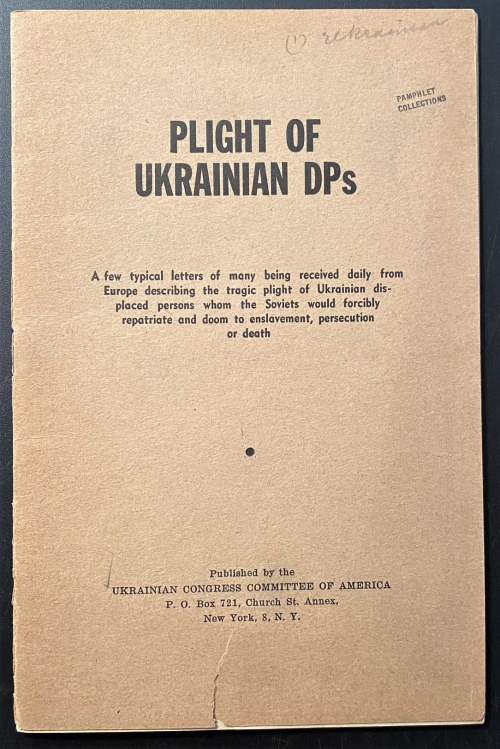
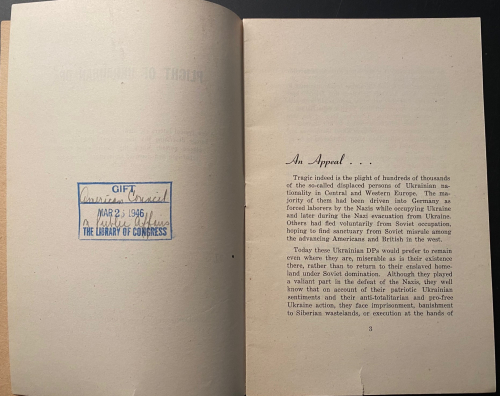
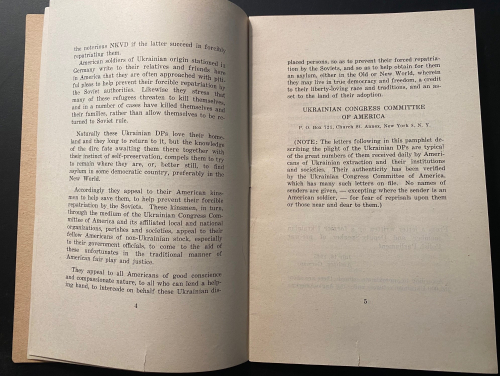
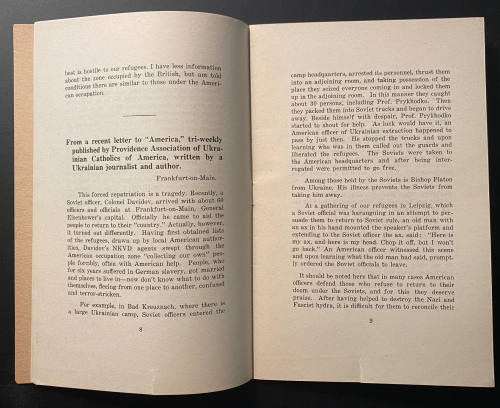
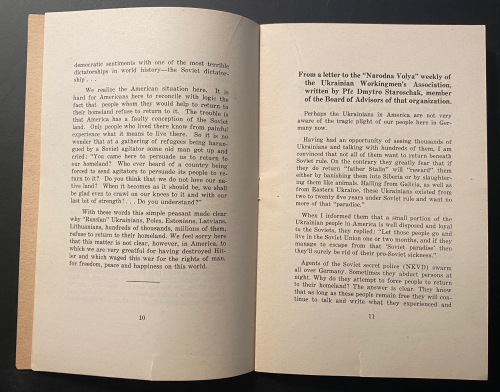
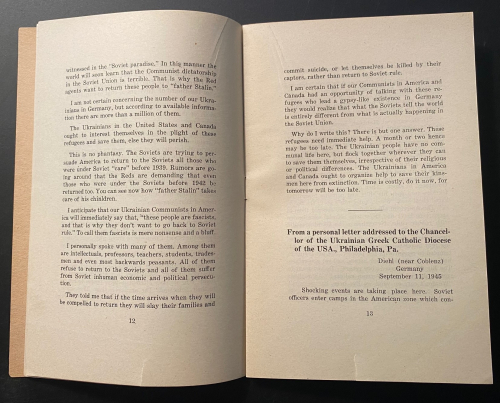
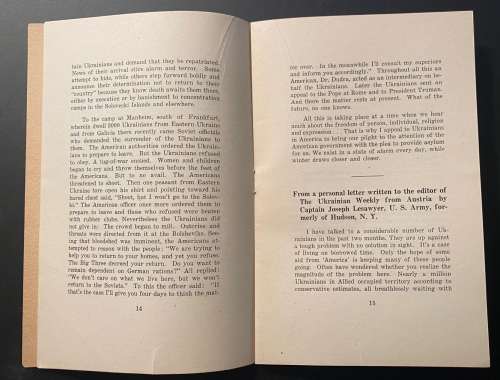
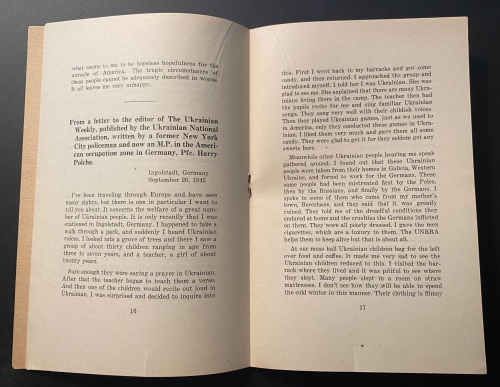
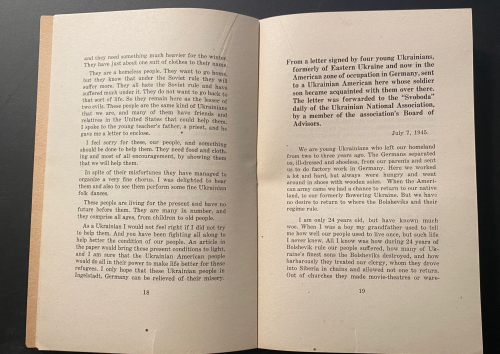
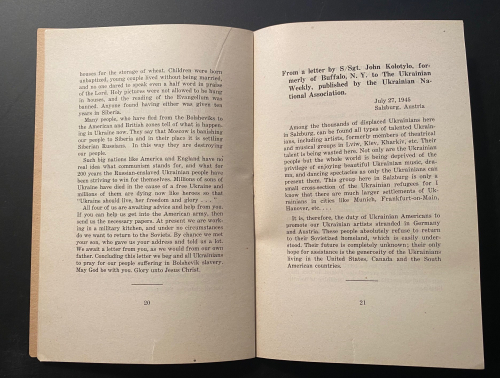
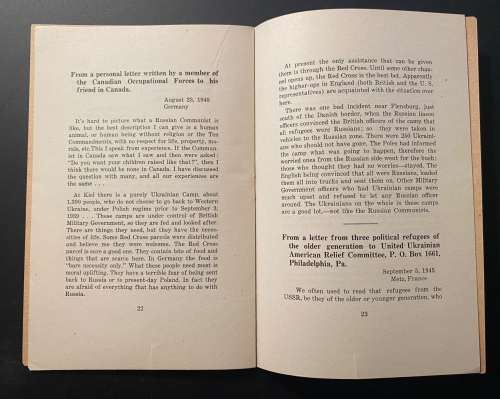
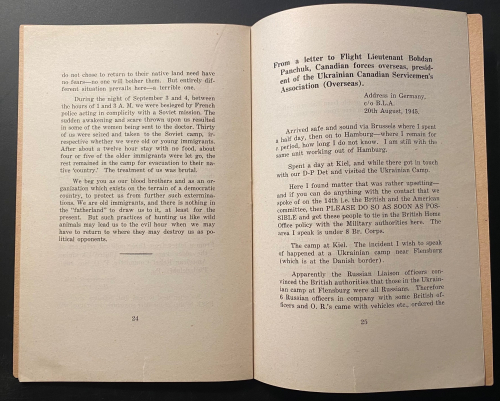
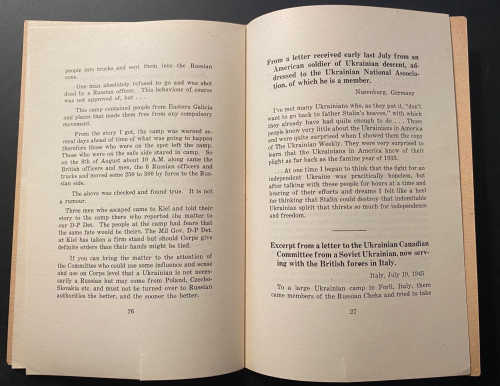
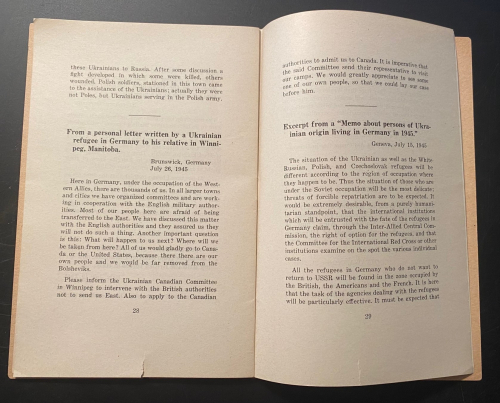
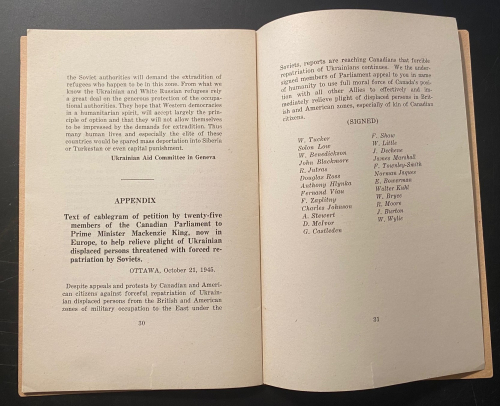
The pamphlet Plight of Ukrainian DPs : a few typical letters of many being received daily from Europe describing the tragic plight of Ukrainian displaced persons whom the Soviets would forcibly repatriate and doom to enslavement, persecution or death, was published in 1945. In just 31 pages, it describes the plight of Ukrainian displaced persons at the end of WWII. These millions of Ukrainians  had been war refugees or slave laborers forcibly moved by the Germans in their invasion of the Soviet Union and sent to work in German factories and on farms. Although some of the Ukrainians technically volunteered and were supposed to be paid for their labor, most were treated as virtual slaves. They were known as Ostarbeiter (Eastern Laborer), and at the end of the war many were repatriated to their country of origin. Of the 3.5 million Ostarbeiter, about 2.5 million remained alive at war’s end, with the vast majority–over 2 million–being from the Ukraine. This pamphlet details some of the terrible accounts of Ukrainians being repatriated to the Soviet Union and being treated as collaborators, criminals, and worse, some simply executed, while hundreds of thousands of others were sent on for “re-education”, with many winding up in the Soviet Gulags. It was a nightmare position to be in–the slave laborer returned home after the war to be treated as a criminal, and slave again.


Posted in Europe, History | Tagged , , , , | 2 Comments

Man serves the interests of no creature except himself

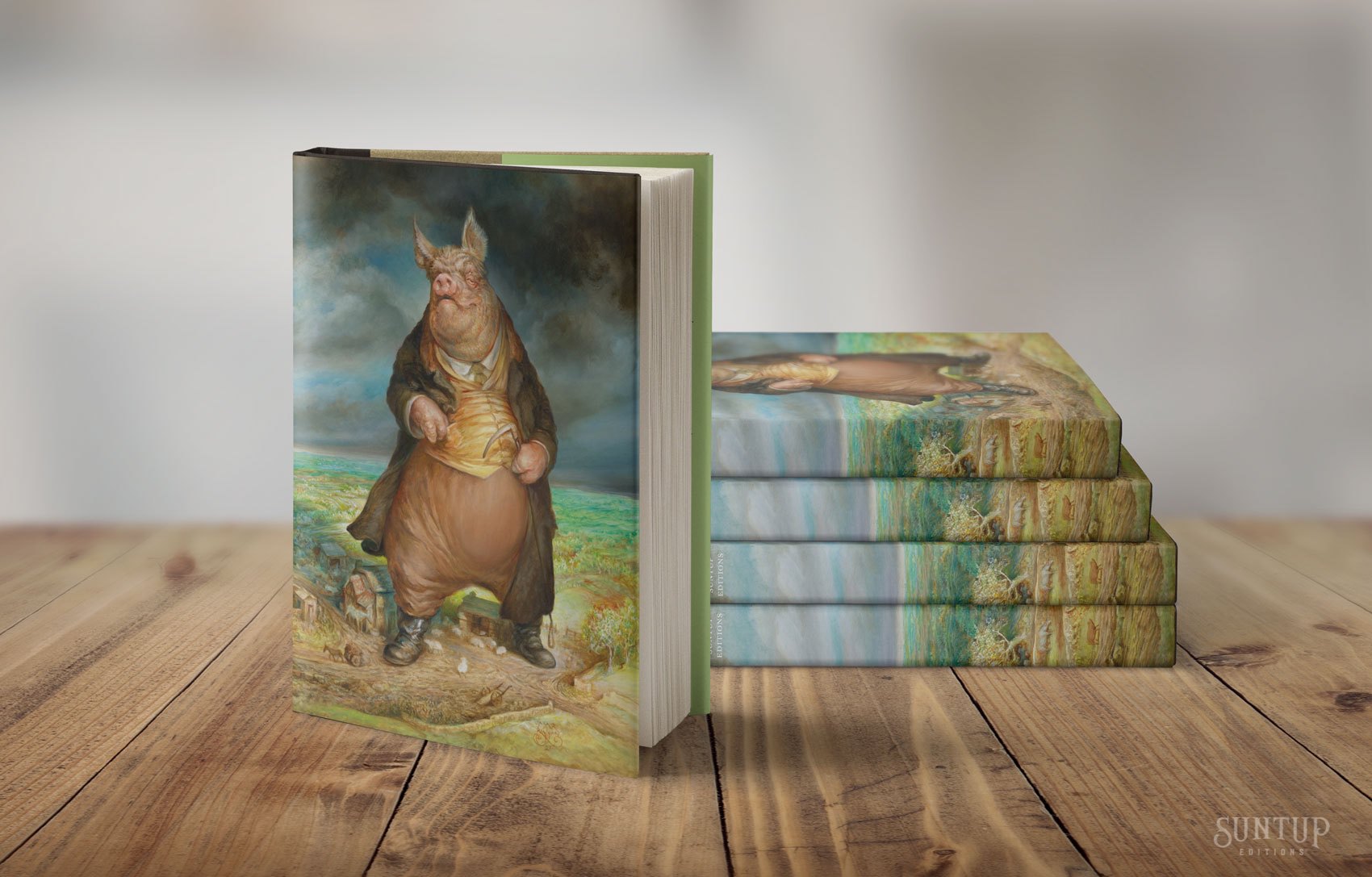
I first read George Orwell’s seminal anti-totalitarianism satire  Animal Farm when I lacked the political sophistication to truly understand the significance of the story, but some how I managed to grasp the essential themes of idealism, power and corruption in the book. Growing up in the latter half of the twentieth-century political allegories such as  Animal Farm: A Fairy Story  helped to make some sense of the dark side of modern history.

In Orwell’s illuminating fable, the animals at Manor Farm have had enough of Farmer Jones. He’s a drunken, reckless lout who cares little for their welfare. When the boar, Old Major, shares his revolutionary plans, the  farm’s animals are convinced they can thrive on their own once the despot Jones is overthrown. The barnyard animals revolt against their vicious human master only to submit to a tyranny created by their own kind. For as the pigs vie for power, they begin to bear an uncanny resemblance to the tyrants they have overthrown.
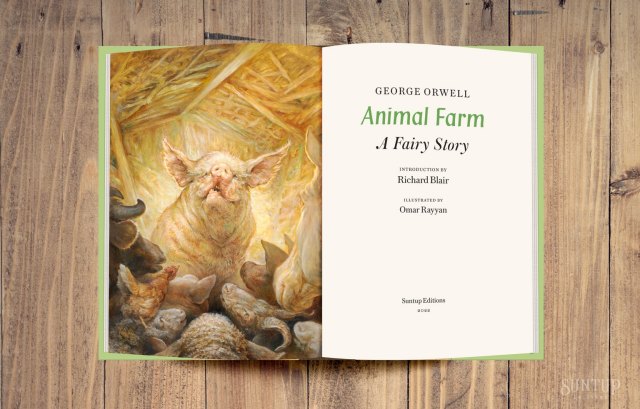
Orwell’s original title for his novel was Animal Farm: A Fairy Story, and it was first published as such by Secker and Warburg in London, England on August 17, 1945. U.S. publishers subsequently dropped Orwell’s subtitle when publishing the novel in 1946, and only one of the translations during Orwell’s lifetime kept it.

In a 1946 letter from George Orwell to Dwight Macdonald, the author discusses his intent in writing Animal Farm. Orwell writes, “What I was trying to say was: You can’t have a revolution unless you make it for yourself; there is no such thing as benevolent dictatorship.”

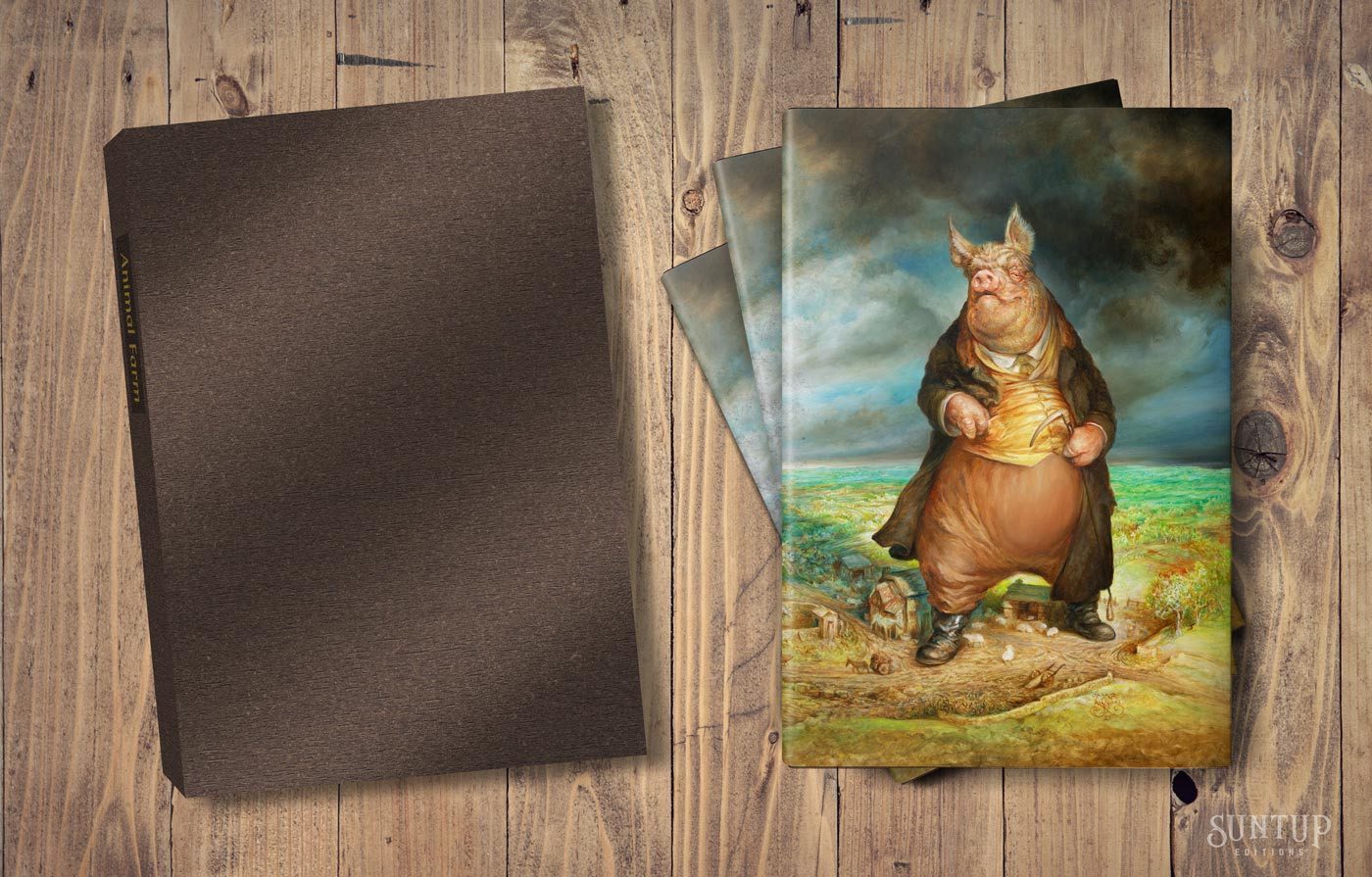
 I recently discovered  that Suntup Editions released a signed limited edition of Animal Farm. The edition features a new exclusive introduction by Richard Blair, adopted son of George Orwell, and six oil painting illustrations by Omar Rayyan. Also included are over 50 pages of bonus content including Orwell’s proposed preface to Animal Farm, Orwell’s preface to the Ukranian edition and a photograph of Orwell feeding his pet goat Muriel. The edition is highly limited with a low print run.

The signed limited edition of Animal Farm by George Orwell is presented in three states: Artist, Numbered and Lettered. The editions measure 6” x 9” and feature six full color oil painting illustrations by Omar Rayyan as well as a new exclusive introduction by Richard Blair, adopted son of George Orwell. The Numbered and Lettered editions are signed by Richard Blair and Omar Rayyan, and the Artist edition is signed by Omar Rayyan. All three editions are printed letterpress on a Heidelberg Cylinder Press by Norman Clayton in Ojai, California.
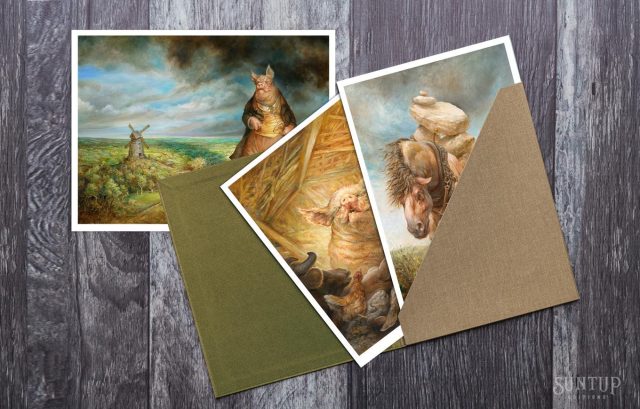
The Artist edition is limited to 1000 copies, and is the only edition to feature a wraparound dust jacket illustrated by Omar Rayyan. It is a smyth sewn, quarter cloth binding with Zanders Elephant Hide paper sides and hot foil stamping on the cover and spine. Endsheets are Hahnemühle Bugra, and the edition is printed letterpress on premium Mohawk Via Vellum paper. It is housed in an embossed wood grain paper covered slipcase and is signed by the artist.

The Numbered edition of 350 copies is a quarter vellum flatback binding with custom designed patterned paper sides by Laura Serra, which are printed letterpress on Hahnemühle Bugra. The spine is foil stamped in gold, and the edition is housed in a velour lined slipcase wrapped in Hahnemühle Bugra, which is printed letterpress and features European cloth ends. The edition is printed letterpress on premium Mohawk Via Vellum paper and is signed by Richard Blair and Omar Rayyan. Less than 30 copies of the Numbered edition remain.

The Lettered edition is limited to 26 copies lettered A-Z and is bound as a concave spine binding sewn on paper stubs, which have been attached to a handmade ring structure covered in goatskin at the back of the book. The front and back boards are covered in custom made spotted calf vellum with goatskin rings attached, interlocking at the spine, and finally hinged using an acrylic rod passed through each of the rings.

The hinged rod structure allow the boards total flexibilty and ease of opening, whilst the sewn stub also provides the textblock with greater functionalilty and protection. The concave has been in use since the 1980s in one form or another, know as either piano hinge or door hinge bindings; and examples of rod bindings date back as far as the Renaissance period.

Endpapers are hand marbled by Claire Guillot in Southern France. The book is housed in a Chemise-étui covered in leather and Hahnemühle Bugra paper, and placed in the well of a lipped tray locking quarter leather clamshell enclosure, lined in Japanese cloth and flocked velour. The rounded spine of the enclosure is stamped in 22 Carat genuine gold foil.

An original signed drawing as well as a set of six giclée art prints are included and housed in a custom handmade portfolio with a leather cover label stamped using 22 Carat genuine gold foil.

The edition is printed letterpress on Somerset Book Moldmade paper and is signed by Richard Blair and Omar Rayyan. It is handbound by bookbinder Gavin Dovey in Pound Ridge, New York.

For more information on all editions, visit: https://suntup.press.
 

Posted in Art, Books, Writing | Tagged , , , | 1 Comment

Inside the glacier

Regular visitors to Travel BetweenThe Pages are well aware of my long time obsession with Iceland. So I was excited to share this video of a live performance by the Icelandic band Kaleo, which was recorded in January within the Breiðamerkurjökull ice cave. Located in an outlet glacier in the southern part of Vatnajökull National Park, it ends in a small lagoon, known as Jökulsárlón. As the icebergs break away from the tongue of the glacier, they drift slowly to the mouth of the lagoon and eventually join the ocean. I’ve explored the lagoon by boat, but I haven’t had the opportunity to visit the caves yet.


Posted in Europe, Film, Music | Tagged , | Leave a comment

About suffering they were never wrong

W. H. Auden’s “Musée des Beaux Arts,” written in 1938, is one of the better-known examples of ekphrasis, or poems inspired by artworks, up there with Keats’s “Ode on a Grecian Urn” and Rilke’s “Archaic Torso of Apollo.”Auden’s subject is a painting by Pieter Bruegel the Elder: “Landscape With the Fall of Icarus.”In December of 1938, Auden was in Brussels, where he visited the city’s Royal Museums of Fine Arts. Like today, it was a period of crisis in Europe, and we can presume the looming war was on his mind. But the poem doesn’t mention war directly; it’s sneakier than that.

MUSÉE DES BEAUX ARTS

by W.H. Auden

About suffering they were never wrong,

The Old Masters: how well they understood

Its human position; how it takes place

While someone else is eating or opening a window

or just walking dully along;

How, when the aged are reverently, passionately waiting

For the miraculous birth, there always must be

Children who did not specially want it to happen, skating

On a pond at the edge of the wood:

They never forgot

That even the dreadful martyrdom must run its course

Anyhow in a corner, some untidy spot

Where the dogs go on with their doggy life and the torturer’s horse

Scratches its innocent behind on a tree.

In Breughel’s Icarus, for instance: how everything turns away

Quite leisurely from the disaster; the ploughman may

Have heard the splash, the forsaken cry,

But for him it was not an important failure; the sun shone

As it had to on the white legs disappearing into the green

Water; and the expensive delicate ship that must have seen

Something amazing, a boy falling out of the sky,

Had somewhere to get to and sailed calmly on

Posted in Art, Books, Europe, Museums, Writing | Tagged , , | Leave a comment

Stand With Ukraine

It’s heartening to see the response from street artists around the world who have created amazing murals to support the Ukrainian people in such a short period of time.


Posted in Art, Europe | Tagged , , | Leave a comment

Bookstore Tourism: The End of an Era

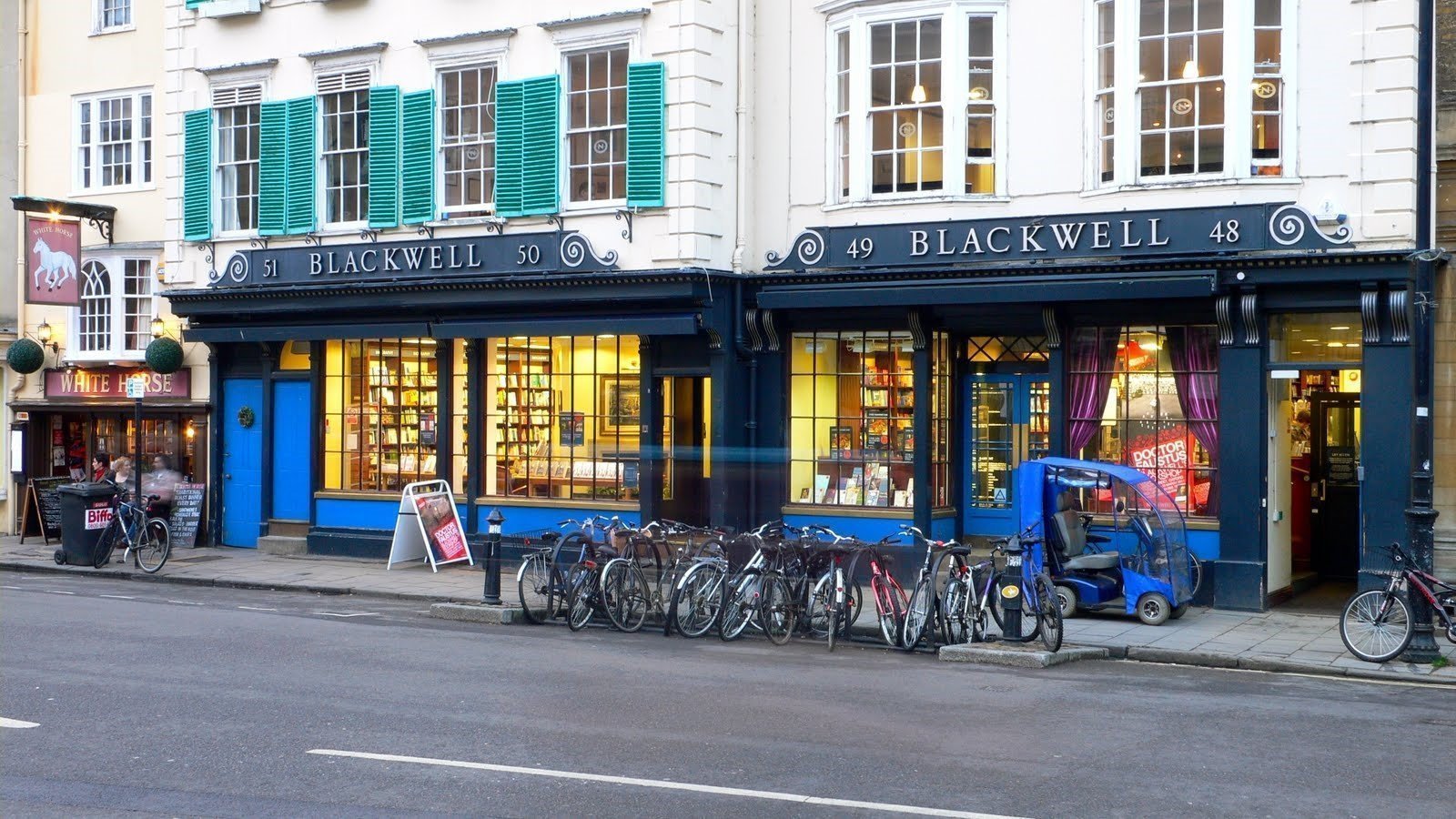
A 143 year legacy will soon be coming to an end after it was announced last week that Waterstones has bought Blackwell’s, the UK’s biggest independent bookshop chain. This will mean that Waterstones, Barnes & Noble, Foyles and Blackwell’s will all belong to the US hedge fund company Elliott Investment Management.

About the acquisition, Blackwell’s owner and president Toby Blackwell said:

“After 143 years of family ownership, finding a new home for our business and our wonderful booksellers, has been an extraordinary challenge. Waterstones have demonstrated in their acquisition of Foyles most recently, that they understand the advantages and benefits of holding diverse iconic bookselling brands in their portfolio. I view them not just as a buyer of the business, but as the right buyer at the right time. This is a positive outcome for Waterstones, Blackwell’s and all our customers in the UK and abroad, who will still be able to enjoy the individual nature of what both brands offer. I would like to thank our chairman and board and all of our fantastic staff, past and present, for everything they’ve done to uphold the Blackwell’s name over the years. I wish everyone well with this new chapter.”

While I’m relieved to learn that all 18 of Blackwell’s bookstores will remain open for now, it’s not likely that the new hedge fund overlords will allow them to retain their indie identity. In fact, it’s likely that Blackwell bookshops will slowly disappear from cities and towns around the UK, or replace a well curated selection of books with gifts, toys, souvenirs, and general tat.


Posted in Books, Bookstore Tourism, Europe | Tagged , , , | Leave a comment

Historic Borders

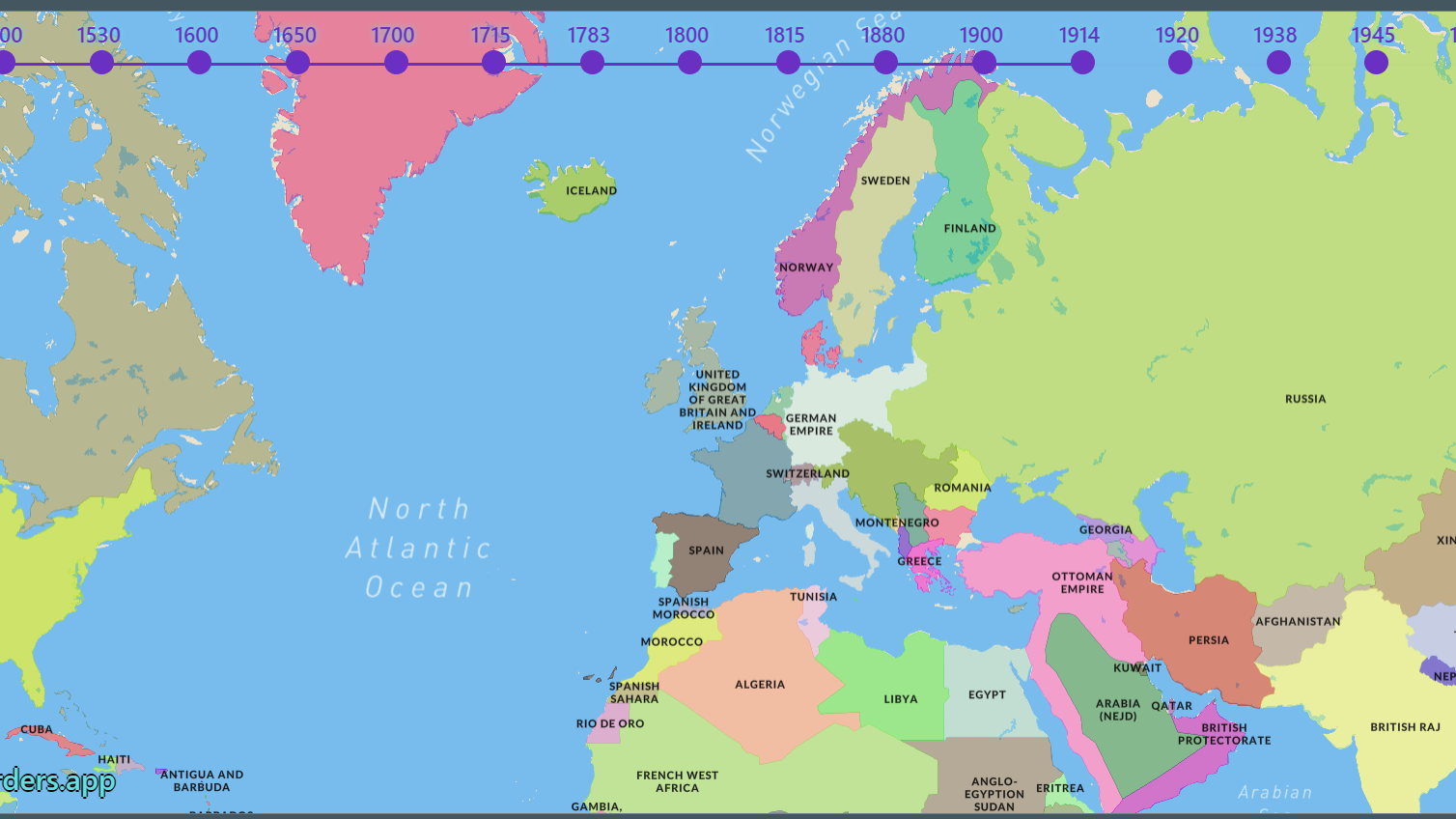
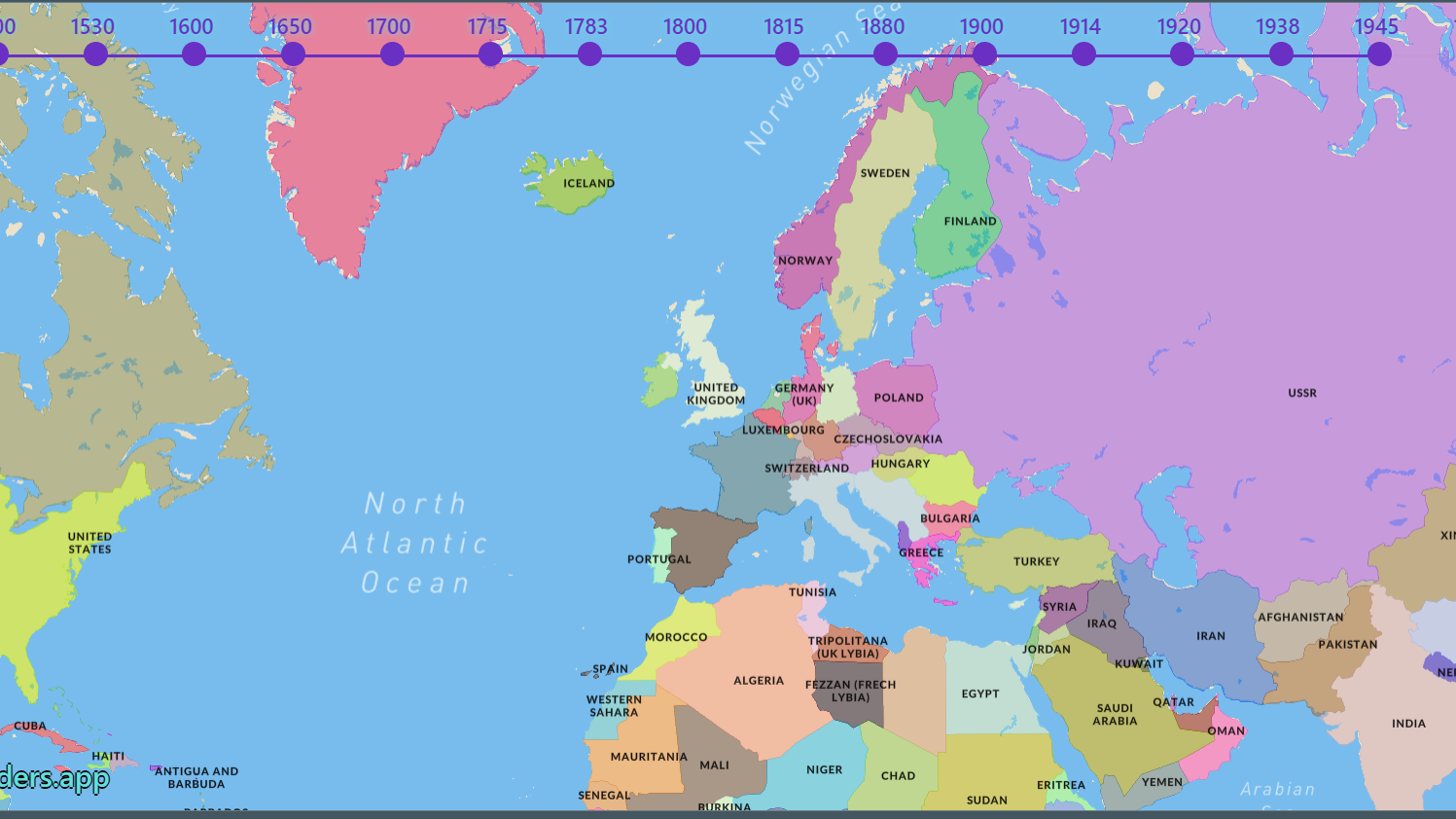
With the tragic news unfolding daily in Europe, it’s an appropriate time to take stock of how we got here. I’ve always found that maps can be an excellent way to help visualize geo-political conflicts. I recently discovered this simple, but elegant website that allows users to see exactly how borders have shifted over the decades.

Historic Borders colorfully helps to visualize the seemingly arbitrary nature of national borders and how politics and war have reshaped the world. The app features a basic world map topped by a timeline slider. Just click on a date to discover the national boundaries of that time.


Posted in apps, History, Maps | Tagged , | 3 Comments

forever making poems in the lap of death

Humanity I Love You

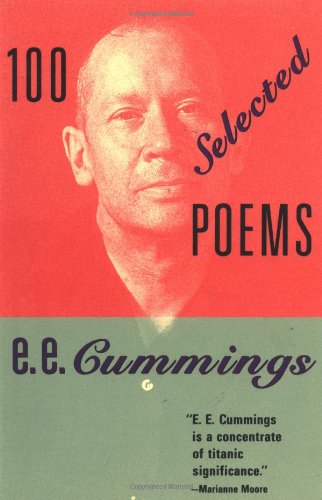
Humanity i love you
because you would rather black the boots of
success than enquire whose soul dangles from his
watch-chain which would be embarrassing for both

parties and because you
unflinchingly applaud all
songs containing the words country home and
mother when sung at the old howard

Humanity i love you because
when you’re hard up you pawn your
intelligence to buy a drink and when
you’re flush pride keeps

you from the pawn shop and
because you are continually committing
nuisances but more
especially in your own house

Humanity i love you because you
are perpetually putting the secret of
life in your pants and forgetting
it’s there and sitting down

on it
and because you are
forever making poems in the lap
of death Humanity

i hate you

Posted in Books, USA, Writing | Tagged , | Leave a comment

Ukraine: Finding Context

Like most people these days, I have been trying to learn more about the regional war that Putin has launched against Ukraine and to put it all in context. Sadly, I must admit that I have always paid more attention to Russia and the Soviet Union than Ukraine even though I have deep connections to that nation. If like me you are looking for more context — geopolitical, historical and otherwise — into the current, ongoing Russian invasion of Ukraine, here are some potentially helpful resources that may will give insight into the circumstances that led to what is now the largest conflict to erupt in Europe since World War II.

  • Borderland: A Journey Through the History of Ukraine by Anna Reid
  • The Gates of Europe: A History of Ukraine by Serhii Plokhy
  • Red Famine: Stalin’s War on Ukraine by Anne Applebaum
  • The Ukrainians: Unexpected Nation by Andrew Wilson
  • Ukraine: What Everyone Needs to Know by Serhy Yekelchyk
  • Roots of Russia’s War in Ukraine by Elizabeth A. Wood, William E. Pomeranz, E. Wayne Merry, and Maxim Trudolyubov
  • Ukraine and the Art of Strategy by Lawrence Freedman
  • Ukraine: A Nation on the Borderland by Karl Schlögel
  • Ukraine Over the Edge: Russia, the West and the “New Cold War” by Gordon M. Hahn
  • In Wartime: Stories from Ukraine by Tim Judah
  • The Battle for Ukrainian: A Comparative Perspective Edited by Michael S. Flier and Andrea Graziosi
  • The Cossack Myth: History and Nationhood in the Age of Empires by Serhii Plokhy
  • Culture, Nation, and Identity: The Ukrainian-Russian Encounter, 1600-1945 Edited by Andreas Kappeler,  Zenon Kohut, Frank Sysyn, and Mark von Hagen
  • The Frontline: Essays on Ukraine’s Past and Present by Serhii Plokhy
  • The Future of the Past: New Perspectives on Ukrainian History Edited by Serhii Plokhy
  • A History of Ukraine: The Land and Its Peoples by Paul Robert Magocsi
  • Making Ukraine Soviet: Literature and Cultural Politics Under Lenin and Stalin by Olena Palko
  • Revolutionary Ukraine, 1917-2017: History’s Flashpoints and Today’s Memory Wars by Myroslav Shkandrij
  • Russia and Ukraine: Literature and the Discourse of Empire from Napoleonic to Postcolonial Times by Myroslav Shkandrij
  • Total Wars and the Making of Modern Ukraine, 1914-1954 by George Liber
  • Ukraine and Europe: Cultural Encounters and Negotiations Edited by Giovanna Brogi Bercoff, Marko Pavlyshyn, and Serhii Plokhy
  • Ukraine: Contested Nationhood in a European Context by Ulrich Schmid
  • Ukraine in Histories and Stories: Essays by Ukrainian Intellectuals Edited by Volodymyr Yermolenko
  • Ukraine, the Middle East, and the West by Thomas M. Prymak
Posted in Books, ebooks, Europe, History, Writing | Tagged , , , , | 1 Comment

“How can I begin anything new with all of yesterday in me?”

It was announced last week that a previously unpublished book by Leonard Cohen—rejected by two publishers and then set aside—will be published this October by Grove Press. The novel, A Ballet of Lepers, will be published with fifteen short stories and a radio play script from Cohen’s archives, assembled by Cohen scholar Alexandra Pleshoyano.
A Ballet of Lepers, written in 1956, explores “toxic relationships and the lengths one will go to maintain them.” The story follows an unamed narrator who takes in his elderly grandfather. The publication of A Ballet of Lepers: A Novel and Stories coincides with Cohen’s wishes. Cohen said before his death that his life’s true masterwork was his archive, which he kept meticulously for the benefit of fans and scholars one day to discover. Robert Kory, trustee of the Leonard Cohen family trust, wrote in a statmeent. “I’m pleased that, with this book, his readers and listeners can begin that rich journey.”
 

Posted in Books, Canada, Writing | Tagged , , | 1 Comment