Not your typical cat videos

National Geographic wildlife photographer and filmmaker, Iwago Mitsuaki, presents a charming collection of cat footage from diverse locations around Japan. On this unique trip he discovers the lesser-known charms and customs of regions through the eyes of cats.

The selection of short videos can be viewed here or on the NHK World YouTube Channel.

Posted in Asia, Film, Tourism | Tagged , , | Leave a comment

Sentimental Souvenirs of the Past


Posted in Architecture, Art, Asia, Tourism, Travel Writing, Writing | Tagged , , | Leave a comment

Not All Bad

Many, if not most, air travelers seem to agree that airline food could be improved. In fact, I’ve met few flyers who actually enjoy the meals served by most airlines. Of course the exception may be those who are fortunate enough to fly First Class. Still, most of us like to compare our in-flight meal experiences, even if it’s just to grouse about them.

The website Airline Meals  is your ticket to the world’s first and largest online photo archive of inflight meals. The site hosts an enormous catalog of airlines and their food service options. It also has some quite interesting information of airline amenity kits and even airline advertising.


Posted in Air Travel, Public Transport, Tourism, Travel Writing | Tagged , , | Leave a comment

One reader can make a difference

The Ursula K. Le Guin Prize for Fiction, now in its fourth year, is an annual $25,000 cash prize given to a writer for a single work of imaginative fiction. The award recognizes writers Ursula spoke of in her 2014 National Book Awards speech–the “realists of a larger reality” who can imagine real grounds for hope and see alternatives to how we live now.

The prize nomination process is open to all–and depends on the quality and diversity of nominations from readers. From March 1 through 31st, readers, authors, booksellers, publishers, librarians–and any and everyone else–are invited to nominate work that reflects the concepts and ideas that were central to Ursula’s own work, including: hope, equity, and freedom; non-violence and alternatives to conflict; and a holistic view of humanity’s place in the natural world.

Nominated books should be written by a single author; published in English or in translation to English for the first time in the U.S. between April 1st and December 31st, 2024; and be available through multiple U.S. retail channels.

This year’s recipient will be selected by authors Matt Bell, Indra Das, Kelly Link, Sequoia Nagamatsu, and Rebecca Roanhorse. Click here to see the criteria for this year’s prize and nominate a book!

Posted in Books, USA, Writing | Tagged , , | Leave a comment

Spring is in the air (somewhere)

The kawazu-sakura are now in full bloom 🌸
Known as Japan’s earliest cherry blossoms, roughly 850 of these trees line the Kawazu river in their native Shizuoka, signaling the first signs of spring. Depending on the weather, they should be viewable through mid-March.

The Kawazu Cherry Blossom Festival (河津桜祭り, Kawazuzakura Matsuri) is held yearly from early February to early March in the city of Kawazu, located on the Izu Peninsula. The popular event celebrates the flowering of the  Kawazuzakura and attracts almost two million visitors annually as one of the earliest opportunities in the year to see large numbers of cherry blossoms near Tokyo.

Kawazuzakura are an early flowering variety of cherry tree. The trees usually start opening around the beginning of February, but do so at an uncharacteristically slow pace compared to most other cherry tree varieties. Consequently, visitors have a longer time frame (about a month) to enjoy the trees’ beautiful flowers. The best viewing time usually last for about two weeks around late February and early March, although this can vary quite a bit from year to year depending on the temperatures.


Posted in Asia, Tourism | Tagged , , | 2 Comments

The New Metropolis

It probably reveals way too much about me that I’m very excited to discover that a new exhibition at the Grolier Club  in New York City is opening today. The show explores how a growing New York City was portrayed for visitors and residents.

On view in the Club’s second floor gallery from March 6 through May 10, Wish You Were Here: Guidebooks, Viewbooks, Photobooks, and Maps of New York City, 1807-1940 features guidebooks, viewbooks, photobooks, maps, and pamphlets curated by Grolier Club member Mark D. Tomasko from his collection.

On show will be some of the earliest guidebooks tracing the growth of the city, street panoramas showing buildings in detail, and photobooks capturing notable moments in the history of the city.

Wish You Were Here showcases early guides including Dr. Samuel Latham Mitchill’s Picture of New York (1807), considered the first guide to New York City, which covers topography, commercial activity, municipal government and regulations, benevolent organizations, literary institutions, and amusements. Its only illustration is an intaglio-engraved map with some inventive street layouts and a shoreline that does not match the actual island.

The exhibition also spotlights the work of publisher Moses King (1853-1909) whose King’s Handbook of New York City first published in 1892 is one of the most comprehensive single volumes on the city in the 19th century. His later King’s Views of New York, luxurious volumes with decorated cloth covers and heavyweight paper, were the ultimate in New York viewbooks. On display are many King’s publications, including a 1908 title page drawing of King’s Dream of New York featuring THE COSMOPOLIS OF THE FUTURE with airships filling the sky over the city.


Posted in Architecture, Books, History, Libraries, Maps, Museums, Photography, Tourism, Travel Writing, USA | Tagged , , | Leave a comment

“The first lights of the evening were springing into pale existence.”

“Description of things and atmosphere” from the notebooks of F. Scott Fitzgerald:

  • “The island floated, a boat becalmed, upon the almost perceptible curve of the world.”
  • “The first lights of the evening were springing into pale existence. The Ferris wheel, pricked out now in lights, revolved leisurely through the dusk; a few empty cars of the roller coaster rattled overhead.”
  • “Farther out in the water there were other lights where a fleet of slender yachts rode the tide with slow dignity, and farther still a full ripe moon made the water bosom into a polished dancing floor.”
  • “It was a cup of a lake with lily pads for dregs and a smooth surface of green cream.”
  • “A region of those monotonous apartment rows that embody the true depths of the city — darkly mysterious at night, drab in the afternoon.”
  • “Spring came sliding up the mountain in wedges and spear points of green.”
  • “The music indoors was strange in the summer; it lay uneasily upon the pulsing heat, disturbed by the loud whir of the fans.”
  • “Drawing away from the little valley, past pink pines and fresh, diamond-strewn snow.”
  • “And perhaps, on the widest and shadiest of the porches there is even a hammock left over from the hammock days, stirring gently in a Victorian wind.”
  • “Bundled up children were splattering in for tea as if the outdoors were tired of them and wanted to change its dress in quiet dignity.”
  • “Out the window, the snow on the pine trees had gone lilac in the early dusk.”
  • “The sun had gone behind Naples, leaving a sky of pigeon’s blood and gold, and as they rounded the bay and climbed slowly toward Torredell Annunziata, the Mediterranean momentarily toasted the fading splendor in pink wine.”
  • “The sea was dingy grey and swept with rain. Canvas sheltered all the open portions of the promenade deck, even the ping-pong table was wet.”
  • “Is there anything more soothing than the quiet whir of a lawnmower on a summer afternoon?”
  • “In Spring when there was no leaf dry enough to crackle and the loudest sound was a dog barking in the next county.”
  • “The deep South from the air — a mosaic of baseball diamonds set between dark little woods.”
Posted in Books, USA, Writing | Tagged , | Leave a comment

Travel Stress

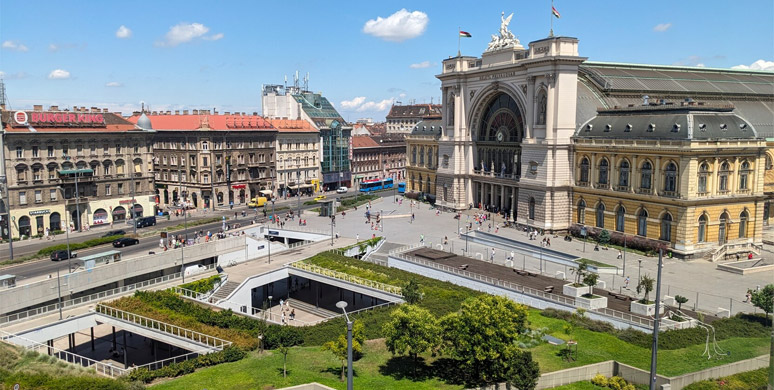
I recently found a fascinating project that examined which rail stations around the world were most stressful. Obviously commuters have different issues with the stations that they need to access on a regular basis than travelers, but there’s always some overlap. For example, I absolutely agree that Keleti Station is the most stressful transit hub in Budapest.

These graphics come from fleetlogging.com. Check out the site for looks at stations all around the world. Here’s what the creators have to say about their project:

“We compiled a list of major overground stations in each country and a list of all metro stations for London, NYC, and Sydney Metros. Then we found stations on Google Maps and extracted reviews using Google API guide. We usedTensiStrength (an academic tool that measures the stress levels of text) to measure the percentage of stressed reviews for each station.”


Posted in Asia, Europe, Maps, Public Transport, South America, Tourism, USA | Tagged , | Leave a comment

Who doesn’t love a Little Free Library

Here in the formerly free United States, bibliophiles of all ages love the Little Free Library movement, which started in 2009 when Todd H. Bol built the first Little Free Library in Hudson, Wisconsin, as a tribute to his mother.

I’m happy to report that the movement is still going strong and is bigger and better than ever. Since Bol built that first library in 2009, over 400 million books have been shared through Little Free Libraries in 128 countries! And next month, the movement is celebrating a milestone—the opening of the 200,000th Little Free Library!

Little Free Library is an nonprofit organization based in St. Paul Minnesota. On its website it explains that its mission is “to be a catalyst for building community, inspiring readers, and expanding book access for all through a global network of volunteer-led Little Free Library book-exchange boxes.”


Posted in Books, Libraries, USA | Tagged , | Leave a comment

You couldn’t pay me to go there

After years of civil war and terrorist conflict that reduced its cultural treasures to rubble, Syria is taking steps to breathe new life into its tourism industry. The nation is focusing on restoring its rich heritage, aiming to attract history lovers and cultural explorers back to war-battered historic landmarks, including UNESCO World Heritage sites.

One of the most important restoration projects is focused on Palmyra, the ancient city that was once a jewel of the Silk Road. The site, known for its grand temples and Roman-era ruins, suffered extensive damage during the war, with many of its priceless artifacts looted or destroyed by Islamic terror groups.

With efforts now in place to rebuild and preserve what remains, local experts and interim officials are working toward reopening the site to international tourists eager to experience its storied past.

Another major restoration project is Crac des Chevaliers, a medieval Crusader castle that endured airstrikes and natural disasters during the conflict. Despite its damage, the site remains open to visitors, including local tourists and historians, as careful reconstruction continues.

Along with the reconstruction of historic sites, Syria is also making travel more accessible. In May last year, the country introduced an electronic visa system to simplify entry for foreign visitors. Government officials are optimistic that a combination of restored landmarks and easier travel procedures will help bring back international interest.

Posted in Architecture, Asia, History, Middle East, Museums, Tourism | Tagged , , | Leave a comment