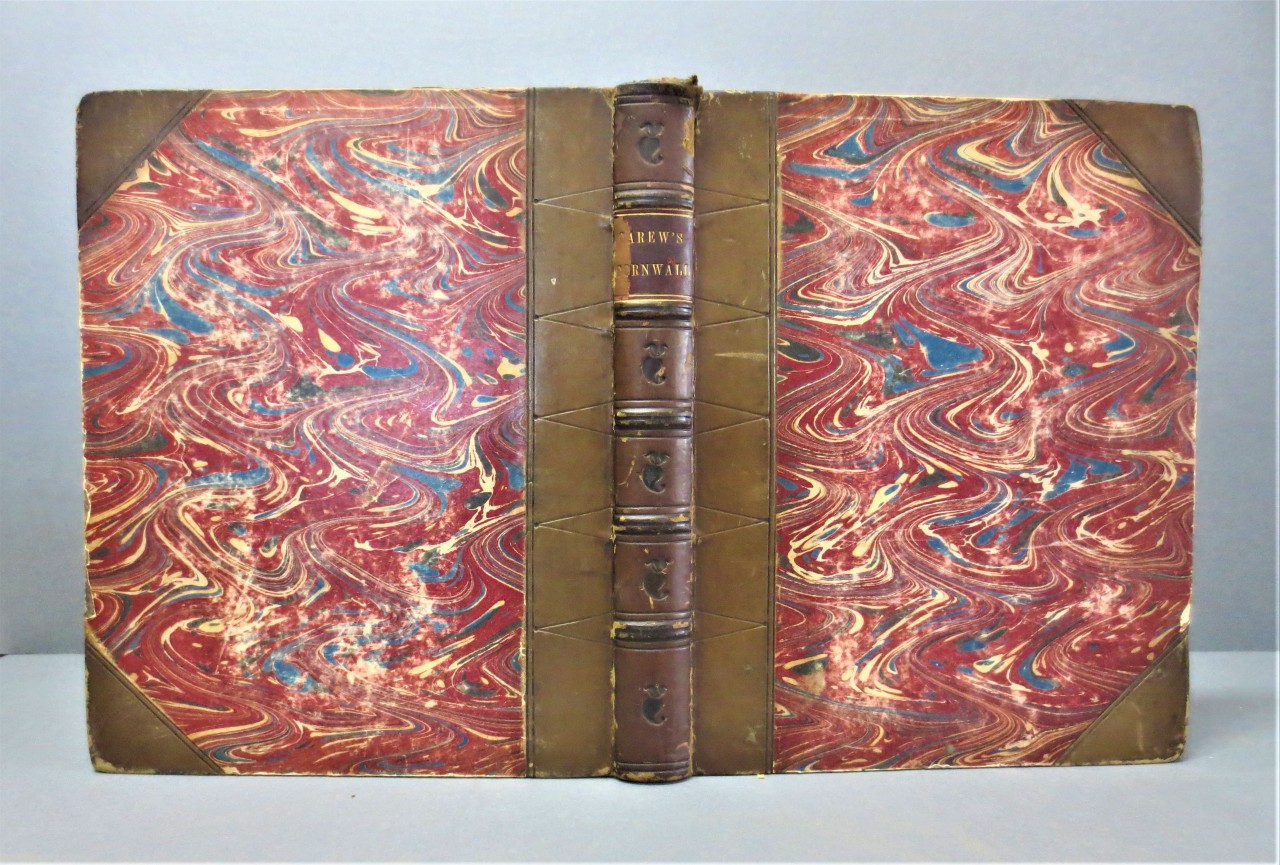
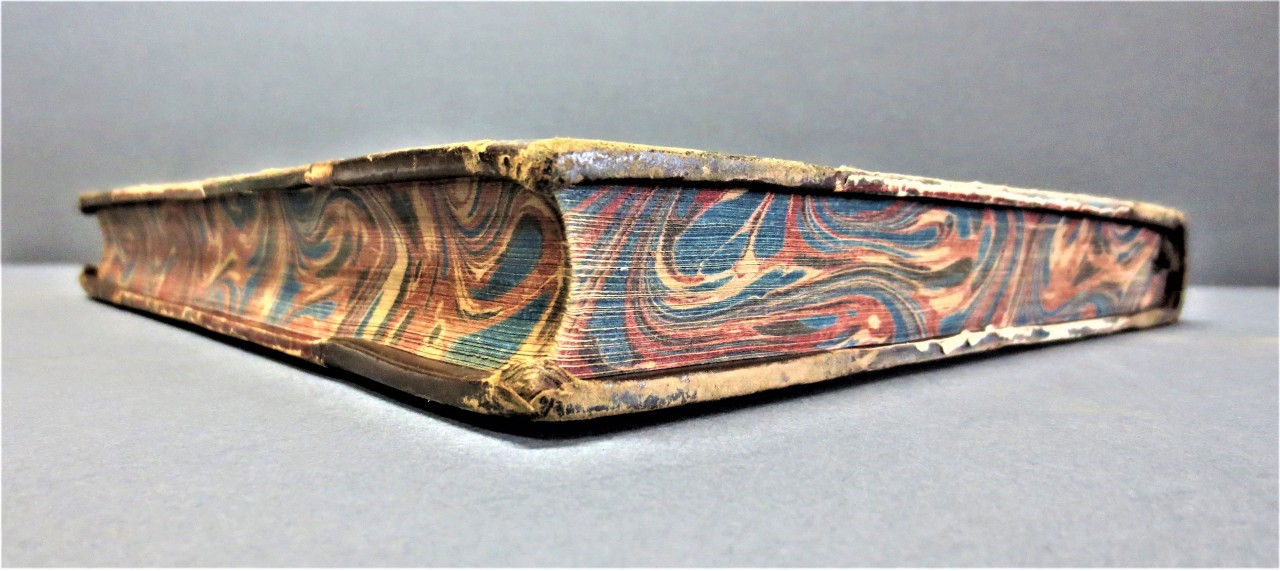
The wavy patterns on the edges, covers, and endpapers on this tooled and blind-stamped, half-bound book are from Carew’s Survey of Cornwall printed in London by Thomas Bensley for J. Faulder and Rees and Curtis in 1811. The marbled-paper pattern is what the University of Washington’s site on Patterned Papers identifies as Serpentine.

The pattern begins with a Turkish base. “A comb with one set of teeth is drawn through the bath twice vertically, once in either direction with the second pass halving the first. This step is repeated horizontally. Then the final step is to draw a comb, with one set of teeth set at slightly wider intervals, through the bath once vertically in wavy lines reminiscent of the way in which a snake moves.“ As we’ve noted before, when marbling the edges of a book, the text block is clamped tightly shut, and once dipped, the excess fluid is blown or shaken off quickly to prevent it from running into the book. Once dry, the marbled edges are burnished.

The Cornish antiquary Richard Carew (1555–1620) first published his survey of Cornwall in 1602. This 1811 edition includes Carew’s Survey with additional notes by the Cornish historian Thomas Tonkin (1678–1742), published here from Tonkin’s original manuscripts by Francis Basset, 1st Baron de Dunstanville (1757-1835), who dedicates the publication to Carew’s descendant, the British politician Reginald Pole Carew (1753-1835).
The frontispiece is a portrait of Richard Carew from 1586, rendered here as a stipple engraving by English engraver William Evans (active 1797-1856). Carew is depicted holding a book with the Latin inscription Invita Morte Vita (In spite of life and death), and in the background there is an allegorical hammer and anvil with the Italian inscription Chi’verace durerà (Who is true will last).


 Travel Between The Pages
That is a beautiful book. I can’t imagine dipping the edges of a book into anything and then making sure “…the excess fluid is blown or shaken off quickly to prevent it from running into the book.” But I guess if I knew this would be the result – maybe I’d risk it?