

A papyrus of part of the Iliad has been discovered in a Roman-era tomb of mummies in Egypt. “The papyrus contains a passage from Book II of Homer’s Iliad, specifically the section known as the ‘Catalogue of Ships’…” from the Greco-Roman era.

I am embarrassed to admit that I know next to nothing about ornithology. Don’t get me wrong, I love birds, in fact this time of the year I get a little obsessed about identifying the birds reappearing in my yard after returning from wherever they disappear to during the winter. Everyone in our household uses a terrific app called Merlin from Cornell University, but it’s not enough.
Data visualization artist Nadieh Bremer created Searching For Birds, a website which turns Google Trends data into a wonderfully scrollable exploration of which birds Americans search for — and why the rarest ones barely register at all.
Wrote Bremer, “As you scroll through through the following interactive graphics, you’ll get a glimpse at roughly 700 North American and Hawaiian species and learn about why some of them make us fall in love.”
Fair warning: there goes the day.
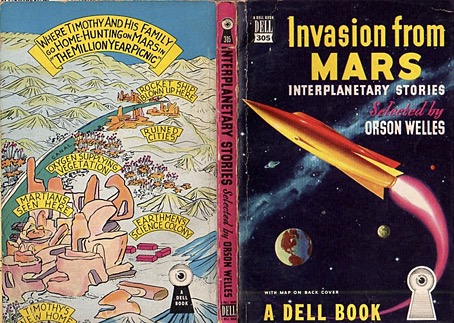
I was always intrigued by the Dell Mapbacks books. They used a clever eye-catching gimmick by adding a map for each title regardless of whether the contents warranted such a thing. Dell began life as a publisher of mysteries, hence the logo of an eye peeping through a keyhole. Maps are more justifiable if applied to a detective story, where a map may help the reader picture the layout of a location or trace the movements of a character. But once Dell branched out into other areas of fiction the maps seemed increasingly superfluous, especially those that limit themselves to the plan of an office or apartment. For some there’s also the question of accuracy. The novelization of Alfred Hitchcock’s Rope shows a map of the apartment that doesn’t correspond to the layout of the rooms as they’re seen on the screen, something that readers who’d seen the film would have been quick to recognize.
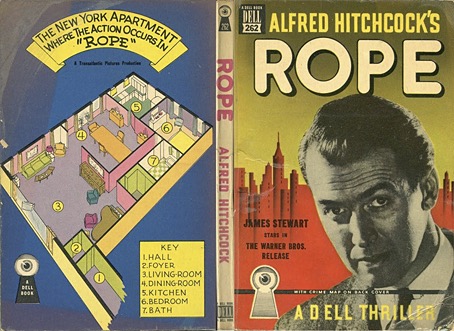
The always interesting website CrimeReads has a great article on these unusual paperbacks right here. Check it out.
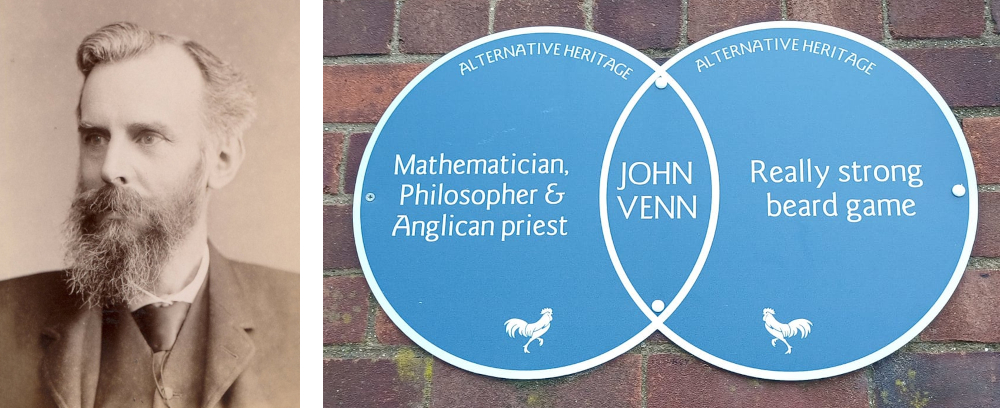
John Venn is noted for introducing Venn diagrams, which are used in logic, set theory, probability, statistics, and computer science. In 1866, Venn published The Logic of Chance, a groundbreaking book which espoused the frequency theory of probability, arguing that probability should be determined by how often something is forecast to occur as opposed to “educated” assumptions. Venn then further developed George Boole‘s theories in the 1881 work Symbolic Logic, where he highlighted what would become known as Venn diagrams.

“Cultural depictions of the 1960s seemed to split by the end of the 1980s, with some still buying into the groovy colour defined by everything from flower power to Granny Takes a Trip. The other half, in stark contrast, focused on a faded, bricks-and-mortar version (I think the truth of the decade is likely housed somewhere between the two), and there are few better examples of this than Bruce Robinson’s Withnail & I (1987).” An enquiry into Richard E Grant’s coat in the film Withnail and I.


