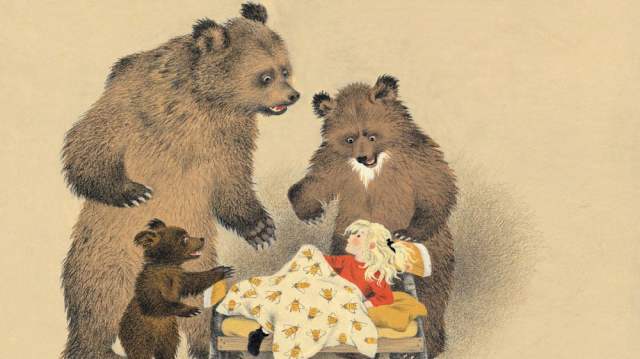
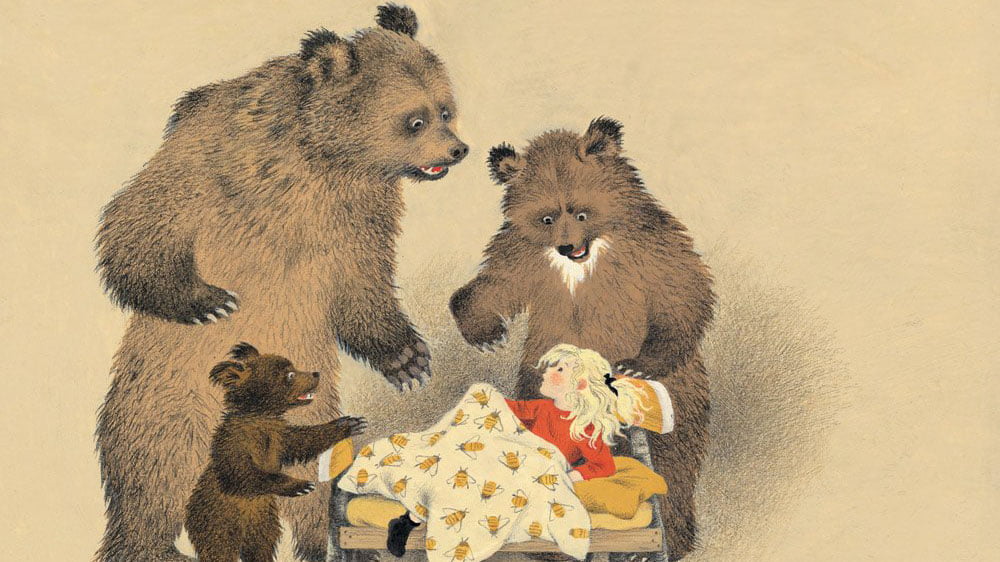
Most folks who grew up in the English-speaking know the fairy tale of “Goldilocks and the Three Bears.” In the story, an exasperating trespasser breaks into the home of three bears. The intruder eats their food and breaks furniture before being ejected. But, did you know that the housebreaker was originally an old woman, not a little girl named Goldilocks? Or, that the first Three Bears were friends instead of Mama Bear, Papa Bear and Baby Bear?
The Three Bears started as an oral tale and was first written down almost 200 years ago. Over the decades, the story has changed and grown into the tale we know today. The Osborne Collection of Early Children’s Books has materials which reveal the history of The Three Bears story.
Eleanor Mure wrote the first recorded version of The Three Bears story in 1831. Osborne Collection has Mure’s original manuscript, a handmade book created as a gift for her nephew Horace Broke. The story is set at Cecil Lodge, the Mure family estate in Hertfordshire, England. Mure’s The Story of Three Bears (1831) is told in verse and illustrated with original watercolors.

Instead of a little girl, the Bears’ house is invaded by an old woman. Mure’s old woman meets a bad end. As punishment for housebreaking, the Bears try to burn and drown the old woman. When nothing works, they “chuck her aloft on St. Paul’s church-yard steeple.”
In 1837, English poet Robert Southey released the first printed version of The Three Bears. The story appeared in Southey’s prose anthology The Doctor (1834-47). As with Mure’s family, The Three Bears was a popular story among Southey’s family. Southey likely heard The Three Bears from his uncle, William Tyler. Tyler was illiterate, but had a great memory for folktales.
Southey’s story is the first version to discuss the Bears’ size. He introduces the Three Bears as Little, Small, Wee Bear; Middle Bear; and Great, Huge Bear. The story has no illustrations, but the Bears’ size is represented by typography. Great, Huge Bear speaks in large gothic letters. Little, Small, Wee Bear speaks in tiny italics.
Unlike Mure’s telling, the Southey’s bears do not punish the intruding old woman. Instead she makes an escape through an open window. Southey speculates that she might be “sent to the House of Correction” for vagrancy, or perhaps “she broke her neck in the fall.”
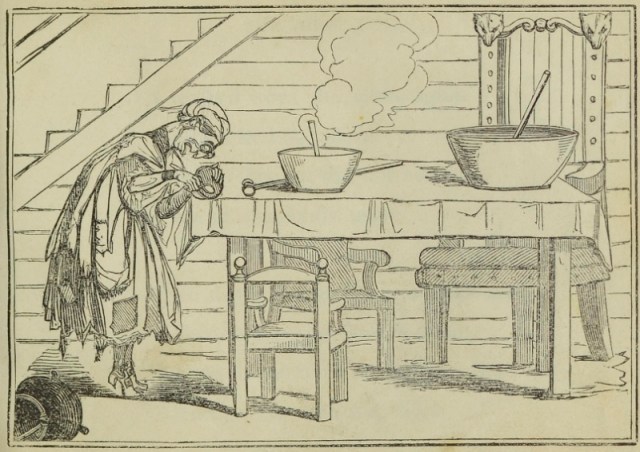
Southey’s The Three Bears was an instant hit. Within months publisher George Nicol released his own version of The Story of the Three Bears (1837). Nicol’s story was in verse, but otherwise was a direct retelling of Southey’s version.
In early tellings of The Three Bears, the protagonist was an old woman. But, in 1850 Joseph Cundall wrote the first retelling featuring a little girl. Cundall called his character Silver-Hair and justified the switch by saying “there are so many other stories of old women.” Published in A Treasury of Pleasure Books for Young Children (1850), Cundall’s retelling otherwise closely followed Southey’s version of The Three Bears.
Following Cundall’s publication, little girl protagonists named Silver-Hair became a common feature of The Three Bears retellings. The character was sometimes called Silver-Locks, Golden Hair and other variant names.

The name Goldilocks was first used for the Bears’ nemesis in two 1904 fairy tale anthologies. Old Nursery Rhymes and Stories (1904) and Old Fairy Tales for Children (1904) both feature “Little Goldilocks” as The Three Bears’ intruder. It is possible that the name Goldilocks was inspired by an entirely different fairy tale. French fairy tale writer Madame d’Aulnoy’s story The Beauty with Golden Hair is sometimes translated as The Story of Pretty Goldilocks.
In the 20th century, Goldilocks became the character’s standard name. Popular fairy tale collections like Flora Annie Steel’s English Fairy Tales (1918) used the Goldilocks name. Now the story is sometimes simply titled Goldilocks without any mention of The Three Bears.













 Travel Between The Pages