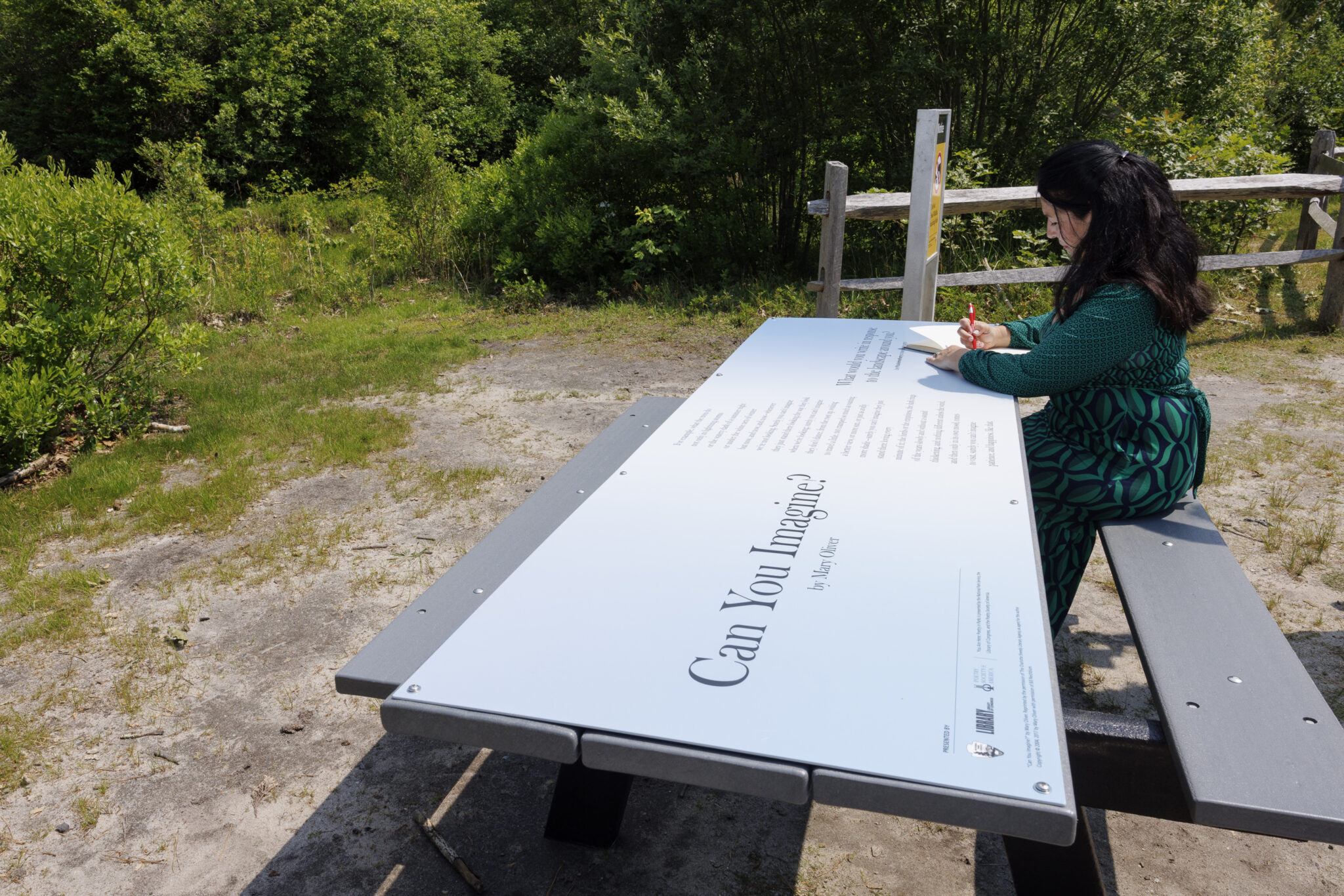
U.S. Poet Laureate Ada Limón kicks off her signature project, “You Are Here: Poetry in Parks,” with the unveiling of a poetry installation at Cape Cod National Seashore, June 14, 2024. The project, in partnership with the National Park Service and Poetry Society of America, features picnic tables in national parks decorated with poems and writing prompts for visitors.
Poetry in Parks is an initiative to install poetry on picnic tables in seven national parks. As public works of art, the picnic tables will each feature a historic American poem selected by the 24th U.S. National Poet Laureate, Ada Limón. Limón selected the poems to encourage visitors to pay deeper attention to their surroundings. Limón will travel to each of the parks in the summer and fall of 2024 to unveil the new installations.
“I want to champion the ways reading and writing poetry can situate us in the natural world. Never has it been more urgent to feel a sense of reciprocity with our environment, and poetry’s alchemical mix of attention, silence, and rhythm gives us a reciprocal way of experiencing nature—of communing with the natural world through breath and presence.”
-U.S. Poet Laureate Ada Limón
Can You Imagine?
by Mary Oliver
For example, what the trees do
not only in lightning storms
or the watery dark of a summer’s night
or under the white nets of winter
but now, and now, and now – whenever
we’re not looking. Surely you can’t imagine
they don’t dance, from the root up, wishing
to travel a little, not cramped so much as wanting
a better view, or more sun, or just as avidly
more shade – surely you can’t imagine they just
stand there loving every
minute of it, the birds or the emptiness, the dark rings
of the years slowly and without a sound
thickening, and nothing different unless the wind,
and then only in its own mood, comes
to visit, surely you can’t imagine
patience, and happiness, like that.
Sigmund Freud returned again and again to the problem of memory as he formulated his theories of psychoanalysis during the 1890s.
“What is essentially new about my theory,” Freud wrote in this letter to fellow physician and confidante Wilhelm Fliess, “is the thesis that memory is present not once but several times over, that it is laid down in various kinds of indications.” The second page of this letter sketches the progression of memory from perception (“W”) to the unconscious (“Ub (II)”) and eventually to consciousness (“Bew”).
Freud refined his theories over time in significant ways but remained committed to the notion that the past exerts a powerful influence over the present as memories embedded in the unconscious break through into consciousness through selective, altered and fluid remembering and forgetting.
Slipped into a pocket and kept close to the body, pocket notebooks are intimate, hidden and always accessible.
Freud purchased this small leather-bound notebook while vacationing in Florence in the waning summer of 1907. Its cover bears the Italian words “Ricordare è rivivere” (“to remember is to relive”). Freud owned many similar notebooks, filling them sequentially through the decades with jottings of names, addresses, expenses, ideas and observations.
Over the years I have been both the giver and recipient of some quite silly travel souvenirs, so it’s heartening to find that even the ancient Romans weren’t above bringing home the occasional humorous gift.
The Museum of London Archaeology (MOLA) reports in a blog post, a joke-inscribed iron stylus unearthed during excavations in the English capital is now on view for the first time. The tool, dated to around 70 A.D., bears a message that roughly equates to the Latin version of “I went to Rome and all I got you was this stylus.”
A more accurate translation by classicist and epigrapher Roger Tomlin actually reads: “I have come from the City. I bring you a welcome gift with a sharp point that you may remember me. I ask, if fortune allowed, that I might be able [to give] as generously as the way is long [and] as my purse is empty”—in other words, the gift is cheap, but it is all the giver can (or wants to) buy on such a slim budget.
According to the Guardian archaeologists found the stylus while conducting excavations for Bloomberg’s London headquarters between 2010 and 2014. The writing implement was one of some 14,000 artifacts discovered during the dig; other finds include 400 wax tablets documenting legal and business affairs, 200 uninscribed styluses, the first written reference to Londinium’s name, and thousands of pottery shards.
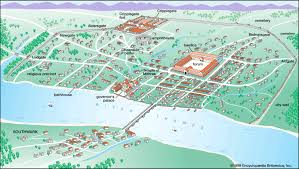
The stylus was uncovered during an excavation effort centered on a now-lost tributary of the Thames known as the river Walbrook. This area once housed part of Londinium, a Roman settlement that became an important center of commerce and governance following its establishment around 43 A.D.
“You do not need to leave your room. Remain sitting at your table and listen. Do not even listen, simply wait, be quiet still and solitary. The world will freely offer itself to you to be unmasked, it has no choice, it will roll in ecstasy at your feet.”
Everyone knows about Franz Kafka’s books, but it’s surprising how many people have never actually read the work. If you’re Kafka-curious, here are some suggestions on taking the plunge:
Start with “The Metamorphosis”: When the uninitiated consider Kafka, this is the book that usually comes to mind. “The Metamorphosis” is a good choice for the adventurous reader. It explores themes of alienation and the absurdity of human existence and encapsulates Kafka’s unique style and his ability to capture complex emotions.
Face “The Trial”: This surreal and haunting novel follows Josef K. as he faces an unknown crime and navigates a soul crushing bureaucracy and legal system. It explores themes of isolation, detachment, disenfranchisement, guilt, powerlessness, and the struggle against inhumane authority.
Discover “The Castle”: To explore Kafka’s fear of soulless bureaucracy and the impotence of the individual against government.
I have been an enormous fan of the work of novelist/poet/essayist Ursula K. Le Guin for many decades. Recently, I stumbled on this quote from her titled “Staying Awake”.
“Besides, readers aren’t viewers; they recognize their pleasure as different from that of being entertained. Once you’ve pressed the on button, the TV goes on, and on, and on, and all you have to do is sit and stare. But reading is active, an act of attention, of absorbed alertness—not all that different from hunting, in fact, or from gathering. In its silence, a book is a challenge: it can’t lull you with surging music or deafen you with screeching laugh tracks or fire gunshots in your living room; you have to listen to it in your head. A book won’t move your eyes for you the way images on a screen do. It won’t move your mind unless you give it your mind, or your heart unless you put your heart in it. It won’t do the work for you. To read a story well is to follow it, to act it, to feel it, to become it—everything short of writing it, in fact. Reading is not “interactive” with a set of rules or options, as games are; reading is actual collaboration with the writer’s mind. No wonder not everybody is up to it.”
This short New Yorker documentary about a Bulgarian tradition of dancing evil spirits away reminds us of the traditional rituals that are slowly disappearing, of the ways people develop coping mechanisms and lasting community. It’s a moving portrayal and a reminder that humans are capable of coming together to confront collective fears.
I try to avoid checking baggage when I fly, but some times it’s necessary to take that leap of faith and hope that luggage actually arrives. In the video below Sam Denby of Half as Interesting explains what goes on behind the scenes when luggage is checked in by an airline using two animated bags. The purple bag belonging to Carrie was carried onto the plane, while the yellow bag belonging to Chad made its way through the checked luggage system.









 Travel Between The Pages