Stumbling Through Saturday Around the Interwebs

I am not embarrassed at all to admit that I have spent an inordinate amount of time thinking about things in the Lord of the Rings universe such as : who is in charge of trash collection; and what are the tax rates; and who collects the taxes and decides how the revenue is spent. Well, I recently stumbled on an enlightening article online at Goldwag’s Journal on Civilization titled “The Moral Economy of the Shire.” It’s a surprisingly good read even if you are not a LOTR fanatic.

Like many a curious adolescent, my introduction to the writing of Vladimir Nabokov was by way of his controversial novel Lolita . Much later, I got around to reading some of his other less salacious works such as Transparent Things and Ada or Ardor. By far my favorite (other than Lolita) has always been Pale Fire, but to be honest, I found it to be somewhat confusing. The excellent article at UnHerd by the novelist Mary Gaitskill titled “Don’t be terrified of Pale Fire Nabokov’s masterpiece has a complex but huge heart” helps to unravel the intricate plotting of the book.

Who could possibly resist an article titled “What Frida Kahlo Kept in Her Bathroom” ?After artist Frida Kahlo’s death in 1954, her husband, painter Diego Rivera, blocked off two bathrooms in their home, La Casa Azul, on the condition that they not be opened until at least 15 years after his death.

In 2005, La Casa Azul, now part of Museo Frida Kahlo, invited fellow legendary Mexican artist Graciela Iturbide to photograph the space and the belongings inside.

You see for yourself right here.

I am not an artist, but I live with one, so I am constantly exposed to art supplies and materials of all sorts. The marvelous video below from Business Insider’s series Still Standing, is an endearing look at La Maison du Pastel, a 300-year-old Parisian company that makes pastels for artists by hand. Back in its golden age, the company supplied the likes of Monet & Degas but fell into neglect near the end of the 20th century. The newest generation of ownership has restored the company and they now offer over 1,900 different pastel colors.

What could possibly be more fun than a Dutch bicycle orchestra riding on a summer’s day in the Netherlands.

 

Posted in Art, Books, Europe, Public Transport, Tourism, Writing | Tagged , , , , , | 1 Comment

A 1000 Suns

Regular visitors to Travel Between The Pages will be well aware of my proclivity for all things Sci-Fi. My interests in the genre are wide-ranging and include everything from classic space operas to Black Mirroresque streamers. So, I was chuffed when I stumbled upon the online mini-anthology A Thousand Suns.

Described as “a mind-bending sci-fi anthology series that explores visions of humanity’s past, present and future.” The trailer says, “In the vastness of time, many stories weave into one under the light of the thousand suns.”

The series comes from filmmaker who goes by the name Macgregor, and it’s produced by a company called Blackmilk Studio. Macgregor gathered a team of team of filmmakers together to make “films that serve as a gateway to our hopes, dreams… and nightmares.”

There are a total of six anthology episodes released and the titles include Episode 1 – Ice; Episode 2 – Red; Episode 3 – Exodus; Episode 4 – Deal; Episode 5 – Bug; and Episode 6 – Tomorrow.

Here’s Episode 1 (below) and the link to the free site to see the entire webseries.


Posted in Books, Film, movies | Tagged , , | 2 Comments

You CAN get there from here

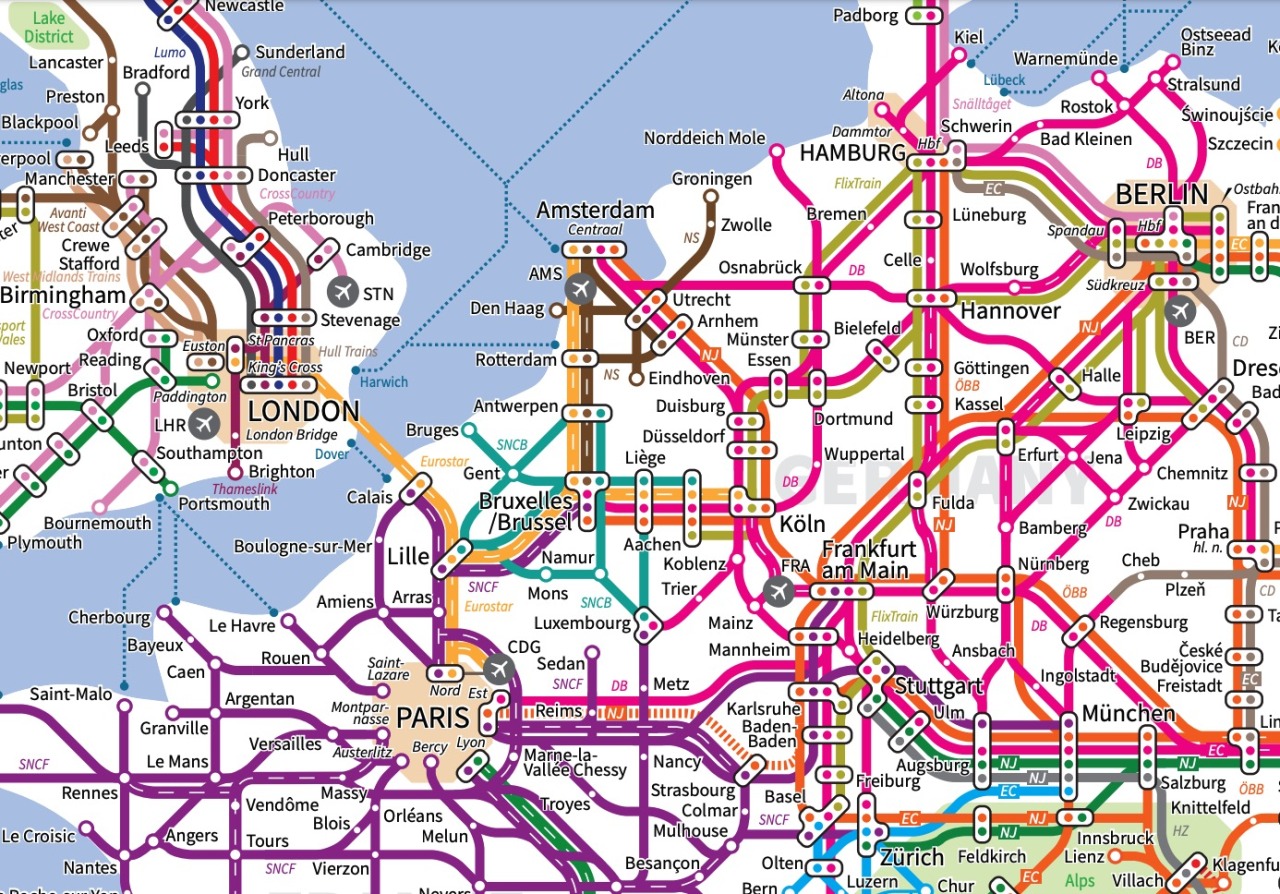
Usually you see a railway map from a local or regional perspective because it’s meant to show how you get from point A to point B. As an experiment, Zhaoxu Sui mapped major railways worldwide. It’s not comprehensive but still interesting to think about, in case you’re trying to get to China from Europe by train.

You can grab the full PDF version here.

Posted in apps, Maps, Public Transport | Tagged , | 1 Comment

Wise Thoughts For Everyday

Like many folks who were introduced to the writings of Leo Tolstoy through his novel War and Peace, I was, and remain, ambivalent about the Russian author. I found War and Peace a bit of a slog. However, I found Anna Karenina and The Death of Ivan Ilyich much more approachable. I recently ran across the fascinating recording below that was made at the author’s home in Yasnaya Polyana on October 31, 1909, when he was 81 years old. He died just over a year later. In the remarkable series of recordings Tolstoy reads a passage from his book, Wise Thoughts for Every Day, in four languages: English, German, French and Russian. Tolstoy apparently translated the passage himself. The English version sounds a bit stilted. The words are hard to make out in the recording, but he says:

That the object of life is self-perfection, the perfection of all immortal souls, that this is the only object of my life, is seen to be correct by the fact alone that every other object is essentially a new object. Therefore, the question whether thou hast done what thou shoudst have done is of immense importance, for the only meaning of thy life is in doing in this short term allowed thee, that which is desired of thee by He or That which has sent thee into life. Art thou doing the right thing?


Posted in Books, Europe, Writing | Tagged , , | 1 Comment

Have a summer reading adventure

To celebrate 75 years of the National Book Awards, the National Book Foundation has launched the Summer Reading Adventure for adults 18 and older “to lean into the nostalgic, prize-filled fun of summer reading.”

Reading activities include visiting a local bookstore or library and asking for a recommendation; re-reading a favorite book from childhood; listening to an audiobook; reading a book in an unfamiliar genre; attending a literary event in person or online; and more.

Participants who complete any of the activities will be entered to win books, hats, ice cream, reusable water bottles, and more. Participants who complete all the activities will be entered to win the grand prize–a trip to New York to the National Book Awards ceremony November 20 with airfare, hotel, and two tickets included. Everyone who submits the Adventure online or via mail by August 31 will receive Bookshop.org and Libro.fm discount codes.

Information is available online in English, Spanish, and Mandarin as well as available in person at some New York Public Library branches in Manhattan, the Bronx, and Staten Island. The Foundation will share participants’ adventures on its social platforms, with most of the action on Instagram @nationalbookfoundation.


Posted in Books, Bookstore Tourism, ebooks, Libraries, USA | Tagged , | Leave a comment

Collecting Memories

I’m hoping to get to see the manuscript treasures including Abraham Lincoln’s handwritten draft of the Gettysburg Address, a map from the Lewis and Clark Expedition, and lyrics from The Sound of Music are among more than 120 items in the new Library of Congress exhibition Collecting Memories.

Opening June 13 as the inaugural exhibition in the new David M. Rubenstein Treasures Gallery in Washington, DC and on view through December 2025, Collecting Memories will explore how cultures preserve memory, including the role of the Library in preserving collective memories representing entire societies, important moments in history and individual lives.

The new gallery is devoted to ongoing exhibitions that showcase treasures from across the national library’s collections. It’s the first major component of a multiyear plan, known as A Library for You, to create a new visitor experience with new galleries, exhibitions and interactive spaces.

Highlights include:

  • Abraham Lincoln’s handwritten draft of the Gettysburg Address in 1863
  • a letter to Elizabeth Schuyler Hamilton from her father, documenting the threat of yellow fever in 1801, from the papers of Alexander Hamilton
  • a landmark first map of the newly independent United States compiled, printed and published in America by an American, Abel Buell in 1784
  • the first printed map showing reasonably accurate geographic information about the Western U.S., from the expedition of Lewis and Clark, published in 1814
  • a unique dress made of 45 paper scrolls containing poems and illustrations paying homage to Cuban and American women poets, created by Ruth Behar and Rolando Estévez Jordán
  • Omar ibn Said’s handwritten autobiography in Arabic from 1831, telling the story of how he was captured in West Africa, enslaved and brought to South Carolina, the only known memoir of its kind
  • pioneering civil rights and women’s rights activist and educator Mary Church Terrell’s draft for her autobiography A Colored Woman in a White World
  • playwright Neil Simon’s notebook including The War of the Rosens and what appears to be his first notes for what would become Brighton Beach Memoirs
  • Sigmund Freud’s papers documenting his thoughts on how the brain processes memories
  • one of the earliest printed texts in a North American Indigenous language, a dual-language catechism written in both Spanish and Timucua, a complex and now extinct language, by Franciscan missionary Francisco Pareja in 1627
  • the camera owned by groundbreaking photographer Frances Benjamin Johnston, among the first American women to achieve prominence as a photographer
  • Oscar Hammerstein’s lyric sheet working out the words for the song Do-Re-Mi during the creation of the musical The Sound of Music

“The stories told by these items still inspire and amaze, decades or even centuries after they were created,” said Librarian of Congress Carla Hayden. Philanthropist David M. Rubenstein, who made a transformational lead gift of $10 million to support the visitor experience project, added: “I think it’s important to preserve America’s treasures because the human brain still operates more effectively when it sees something for real.”

Posted in Art, Books, History, Libraries, Maps, Museums, Tourism, USA | Tagged , , , | Leave a comment

Every day is like Sunday

I have been planning a road trip in Canada and was curious about First Nations food and restaurants. As things tend to go on the interwebs, what I did find was a great post about Native American restaurants around the U.S.. So if you’re planning a road trip check out this story about Native American restaurants on the Sweet Grass Trading website.

Folks who were fans of James S.A. Corey’s (aka authors Daniel Abraham and Ty Franck ) The Expanse, and Sci-Fi aficionados in general, can read the first chapter of an upcoming blockbuster titled Mercy of the Gods at the Polygon website.

Residents of Majorca want to end tourism to the island and re-establish control of their homeland.

“Quozl” was painted for the 1988 Alan Dean Foster novel of the same name. The novel tells the comical tale of the Quozl, rabbit-eared aliens who land on Earth to establish a settlement or “Fist Burrow.” The Quozle, like rabbits, reproduce at an alarming rate and have been forced to travel from their overcrowded home plant of Quozlene to colonize other planets…Quozl shows the moment in which a group of these aliens explore the dwelling of a typical Earthling family.

The image reproduced on the paperback book jacket stretches across the spine, so that the right-hand portion of the painting receives prominence as the front cover.

This is for all of you podcast fanatics and animal lovers.


Posted in Art, Books, Restaurants, Tourism, USA | Tagged , , , , | Leave a comment

Is there anything good to watch ?

If your household is anything like mine most evening include the question : “What are we going to watch ?” After becoming cord cutters, the question seems to come up more regularly than in the days of cable television when the shows and movies were spoonfed. An excellent new website offers simple solutions to the problem with listings for hundreds of vetted films and television shows.

A Good Movie to Watch offers a large and growing collection of movie and TV show recommendations curated by humans, not algorithms. Everything on this website will have at least a 70% user score (7/10 on IMDb for example), combined with a 70% critic approval score (on Rotten Tomatoes). “Every streaming service, every genre, every mood. Our team of experts meticulously pick the best for you, with new recommendations coming in all the time.”

Posted in Animation, apps, Film, movies, Tech | Tagged , , | Leave a comment

The infinite reading list


Posted in Asia, Books, Libraries | Tagged , | Leave a comment

Do vampires get sea sick ?

On a gloomy night in July, 1893, Bram Stoker’s mysterious Count Dracula embarked on a clandestine journey from his Transylvania home aboard the ill-fated ship Demeter. Unbeknownst to the unsuspecting crew of the Demeter, a malevolent force lay hidden in the ship’s hold—a coffin filled with the cursed soil of Dracula’s homeland, concealing the vampire lord himself.

By the time the Demeter’s ghostly silhouette loomed over the shores of Whitby, it carried with it a cargo of death. The once bustling ship had become a floating tomb, with the captain, the sole survivor, lashed to the ship’s wheel in a desperate bid to maintain control over the vessel.

You can follow Count Dracula’s frightening trip from Transylvania to England for yourself on a new interactive book map of the novel. Dracula: The Map is a project by Morgan Bishop, which plots all the locations mentioned in Bram Stoker’s Dracula. Using the ‘Character Routes’ drop-down menu you can select to view an interactive map of the journeys undertaken by each of the five main characters in the novel; Count Dracula, Jonathan Harker, his fiancée Mina Murray, Dr. Seward and Dr. Van Helsing.

The arrival of the Demeter in Bram Stoker’s Dracula serves as an important piece  the vampire’s story: the ship brings death himself to England. Stoker drew inspiration for his genre-defining horror novel from his time in Whitby, and the tragic 1885 fate of the real ship Dmitry on the town’s shore.

The death and tragedy around Stoker ultimately shaped the story that became one of the most famous pieces of English literature and set the stage for the next century of vampire lore.

During the summer of 1890, Irish novelist Bram Stoker vacationed at the seaside town of Whitby in northeast England. Despite spending only a month in the town, Stoker was enthralled by his surroundings: grand mansions and hotels lined the West Cliff while remains of the seventh century Whitby Abbey towered over the East Cliff. Nearby, the cemetery at the Parish Church also served as inspiration as the story of Dracula came to life.

Stoker was also fascinated by the many ships making harbor here. He reportedly visited the Whitby Museum to explore the history of these vessels. The author reportedly asked around the harbor about shipwrecks in Whitby, notably the Dmitry, a ship that had wrecked five years earlier.

The cargo vessel Dmitry had set sail from Narva, Russia in 1885. On October 24, the Dmitry was one of two ships run ashore at Whitby by “a storm of great violence,” according to contemporary newspaper accounts. The other vessel, the Mary and Agnes, was stranded in the raging sea and a lifeboat was sent to rescue its crew.

There were some aspects of the last voyage of the Dmitry that appear to have stood out to Stoker. The Demeter originated in Varna (an anagram for Narva, where the Dmitry originated), and similarly carried “ballast of silver sand, with only a small amount of cargo—a number of great wooden boxes filled with mould.”

In the novel, Dracula took the form of a dog to make his way from the Demeter to dry land, but there was no dog reported to have been on the Dmitry. In the novel,  “The very instant the shore was touched, an immense dog sprang up on deck from below, as if shot up by the concussion, and running forward, jumped from the bow on the sand.”

The dog, a disguised Dracula, wrought bloodshed and death from that point forward. This dog resembled the barghest, a mythical monster often associated with Yorkshire. Spellings and specific forms of barghest vary but the dog-like being foretold of pain, disaster, or even death to all who saw it. The barghest also elicited howling from dogs in its vicinity, something Dracula protagonist Mina Murray reported took place soon after the arrival of the Demeter.


The journey maps in Dracula: The Map were all created using Knight Lab’s popular StoryMapJS format.

Posted in Books, Europe, Film, Maps, Tourism, Writing | Tagged , , , , | 2 Comments