
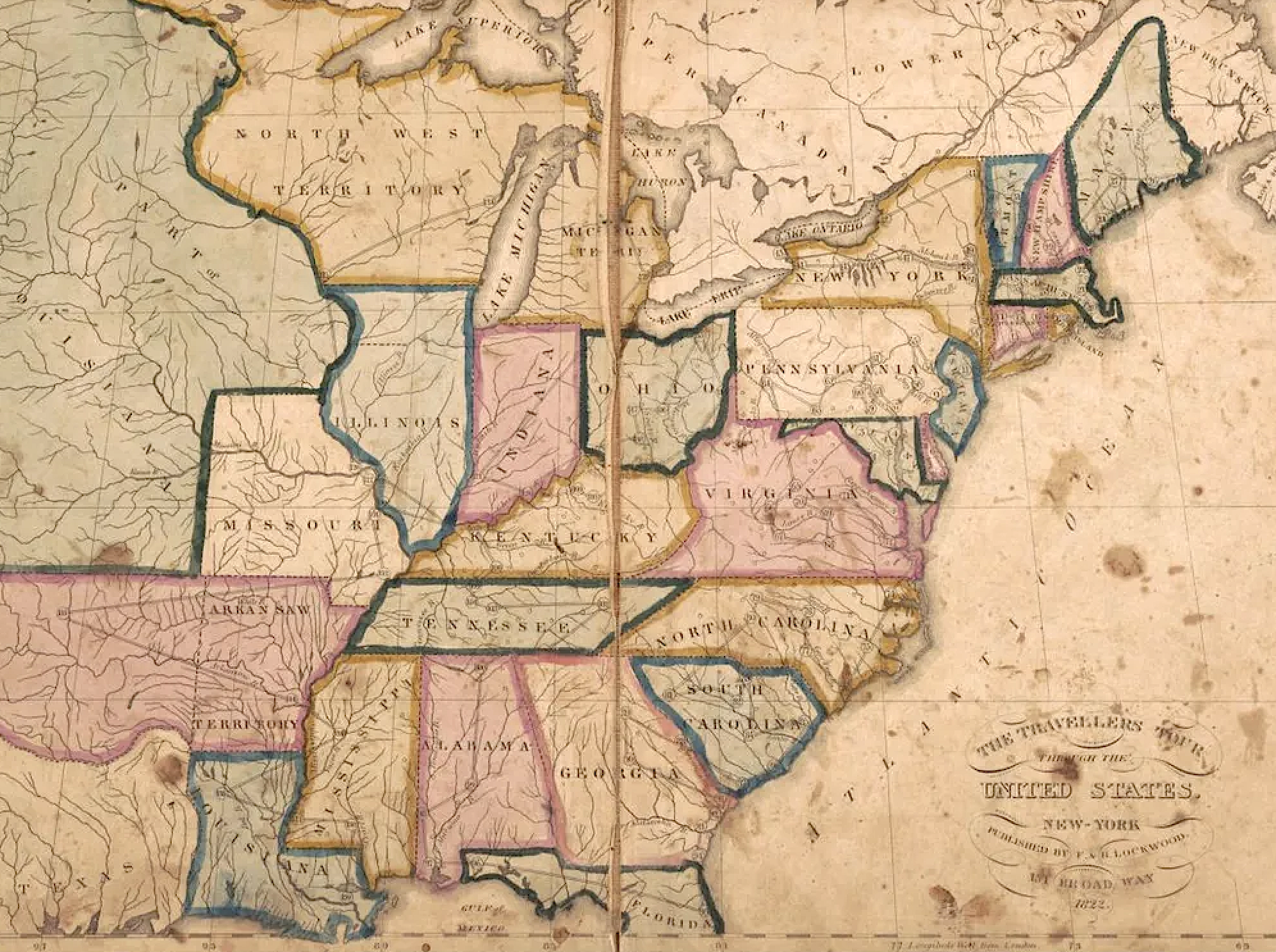
The old fashioned board game has been making a comeback in North America, especially with Gen Z. Many attribute the renewed interest in this decidedly nondigital pastime to the Covid Pandemic. Along with the iconic games such as Monopoly and Scrabble, new examples like Wingspan are adding to the multibillion dollar business. But few gamers know about the oldest American board game: Travellers’ Tour Through the United States, which came out more than a century ago, in 1822.
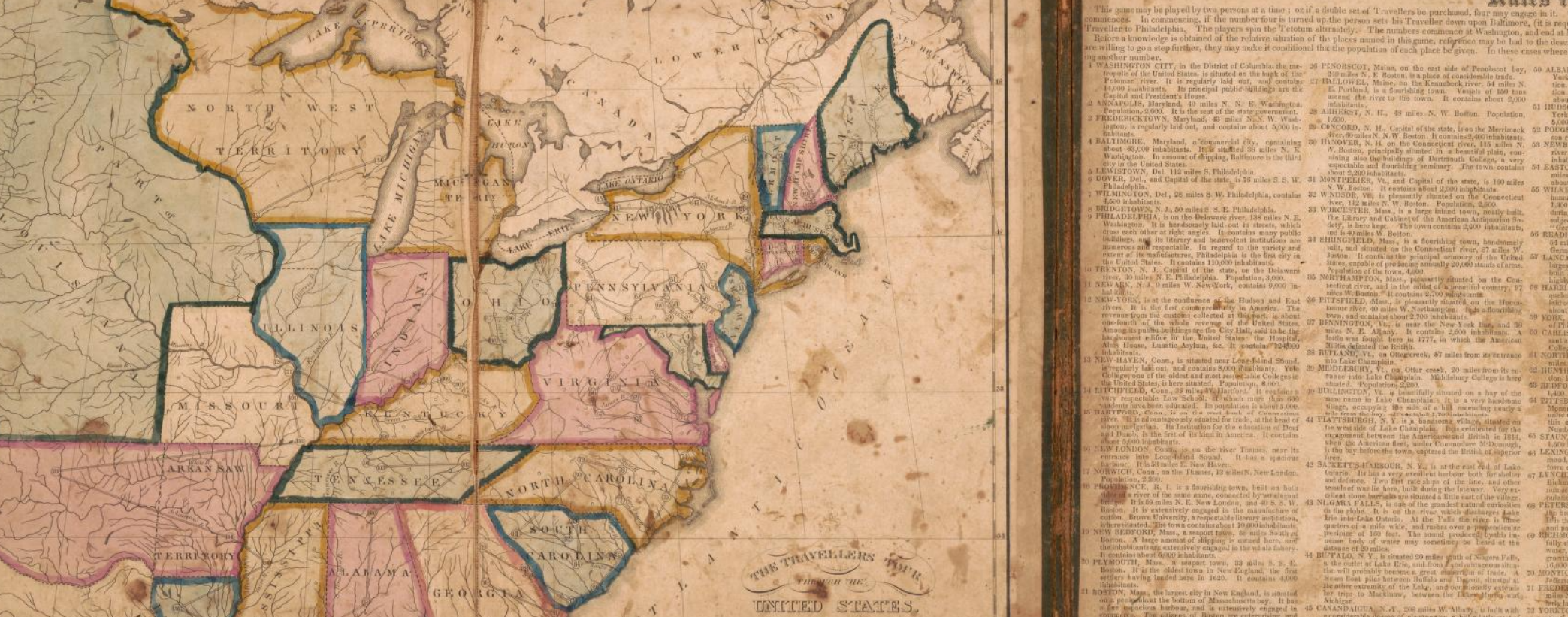
Created by the New York map company F. & R. Lockwood, the Travelers’ Tour was an imitation of earlier European geography games, a genre of educational game. These activities generally used a map for a board, and the rules involved players reciting geographic facts as they raced toward the finish.
Travelers’ Tour first appeared in 1822, making it the earliest known board game printed in the U.S. But for almost a century, another game was thought to hold that honor.
In 1894, the game manufacturer Parker Brothers acquired the rights to the Mansion of Happiness, an English game first produced in the U.S. in 1843. In its promotional materials, the company declared it “the first board game ever published in America.”
That distinction ended in 1991, when a game collector found the copy of the Travelers’ Tour in the archives of the American Antiquarian Society.
Since the Travelers’ Tour was the first board game to employ a map of the U.S., it might have been an especially interesting gift for American consumers.
It’s difficult, however, to gauge just how popular the Travelers’ Tour was in its time. No sales records are known to exist, and since so few copies remain, it likely wasn’t a big seller.
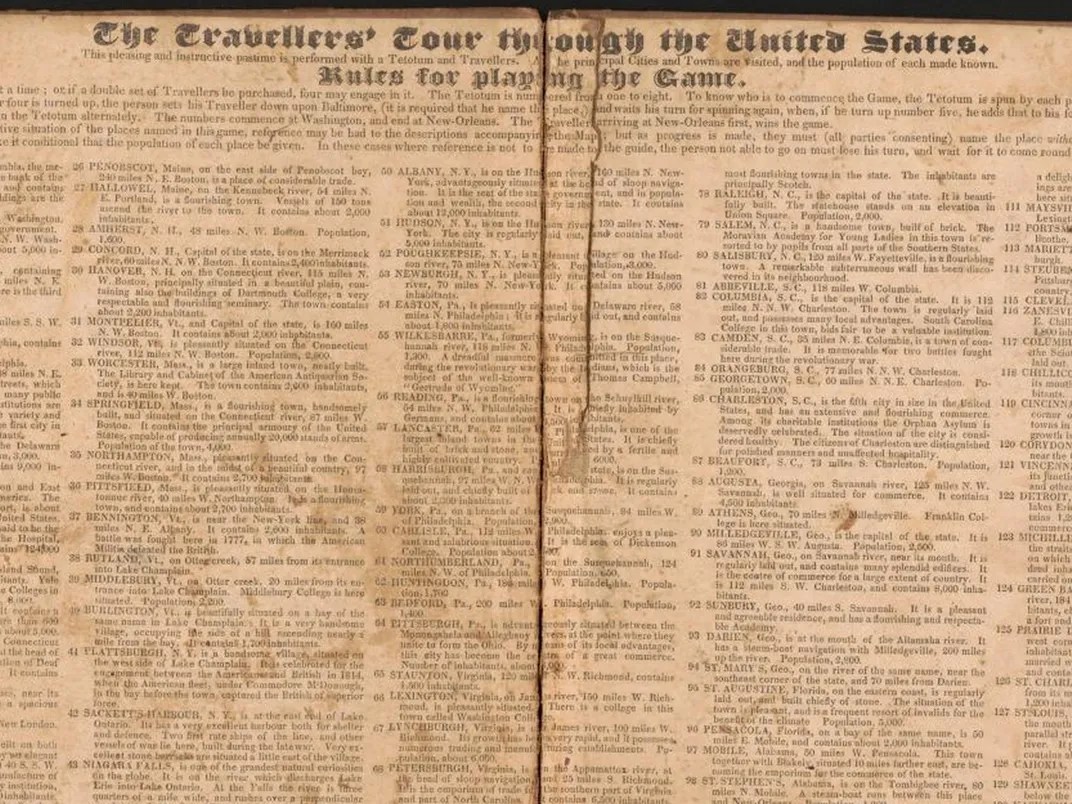
the Travelers’ Tour consists of a hand-colored map of the then-24 states and a numbered list of 139 towns and cities, ranging from New York City to New Madrid, Missouri. Beside each number is the name and description of the corresponding town.
Using a variant spelling for the device, the instructions stipulate that the game should be “performed with a Tetotum.” Small top-like devices with numbers around their sides, teetotums functioned as alternatives to dice, which were associated with immoral games of chance.
Once spun, the teetotum landed with a random side up, revealing a number. The player looked ahead that number of spaces on the map. If they could recite from memory the name of the town or city, they moved their token, or traveler, to that space. Whoever got to New Orleans first won.
Promoting the value of education, the game highlights institutions of learning. For example, Philadelphia’s “literary and benevolent institutions are numerous and respectable.” Providence boasts “Brown University, a respectable literary institution.” And Boston’s “citizens … are enterprising and liberal in the support of religious and literary institutions.”
As the game pieces meander toward New Orleans, players learn about Richmond’s “fertile backcountry” and the “polished manners and unaffected hospitality” of the citizens of Charleston. Savannah “contains many splendid edifices” and Columbia’s “South Carolina College … bids fair to be a valuable institution.”


 Travel Between The Pages