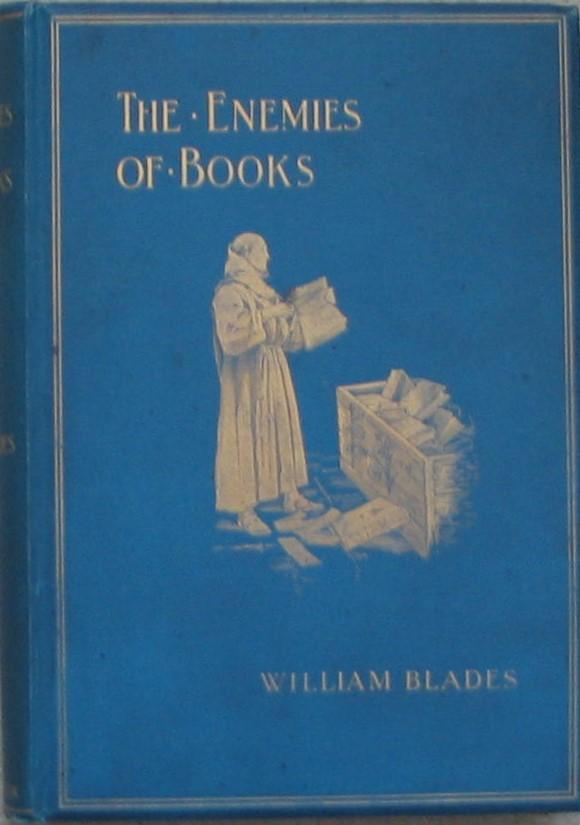
The Enemies of Books is a book on biblioclasts and book preservation by the 19th-century bibliophile and book collector William Blades. The book was first published in 1880 and has been republished in different editions many times since. In the book, Blades, a well-known collector, documented his outrage at any mistreatment of books in what became a passionate diatribe against biblioclasts, human and non-human, wherever he found them.
The book includes chapters on the following enemies of books: fire, water, gas and heat, dust and neglect, ignorance and bigotry, the bookworm, bookbinders, book collectors, other vermin (such as rats or flies), servants, and children. The book ends with a passionate call for reverence for old books, something he felt was lacking during his life.
You can read the entire book on the Gutenberg website, but here’s a sample:
“Ignorance and Bigotry”
from
William Blades’
The Enemies of Books
IGNORANCE, though not in the same category as fire and water, is a great destroyer of books. At the Reformation so strong was the antagonism of the people generally to anything like the old idolatry of the Romish Church, that they destroyed by thousands books, secular as well as sacred, if they contained but illuminated letters. Unable to read, they saw no difference between romance and a psalter, between King Arthur and King David; and so the paper books with all their artistic ornaments went to the bakers to heat their ovens, and the parchment manuscripts, however beautifully illuminated, to the binders and boot makers.
There is another kind of ignorance which has often worked destruction, as shown by the following anecdote, which is extracted from a letter written in 1862 by M. Philarete Chasles to Mr. B. Beedham, of Kimbolton:—
“Ten years ago, when turning out an old closet in the Mazarin Library, of which I am librarian, I discovered at the bottom, under a lot of old rags and rubbish, a large volume. It had no cover nor title-page, and had been used to light the fires of the librarians. This shows how great was the negligence towards our literary treasure before the Revolution; for the pariah volume, which, 60 years before, had been placed in the Invalides, and which had certainly formed part of the original Mazarin collections, turned out to be a fine and genuine Caxton.”
I saw this identical volume in the Mazarin Library in April, 1880. It is a noble copy of the First Edition of the “Golden Legend,” 1483, but of course very imperfect.
Among the millions of events in this world which cross and re-cross one another, remarkable coincidences must often occur; and a case exactly similar to that at the Mazarin Library, happened about the same time in London, at the French Protestant Church, St. Martin’s-le-Grand. Many years ago I discovered there, in a dirty pigeon hole close to the grate in the vestry, a fearfully mutilated copy of Caxton’s edition of the Canterbury Tales, with woodcuts. Like the book at Paris, it had long been used, leaf by leaf, in utter ignorance of its value, to light the vestry fire. Originally worth at least L800, it was then worth half, and, of course, I energetically drew the attention of the minister in charge to it, as well as to another grand Folio by Rood and Hunte, 1480. Some years elapsed, and then the Ecclesiastical Commissioners took the foundation in hand, but when at last Trustees were appointed, and the valuable library was re-arranged and catalogued, this “Caxton,” together with the fine copy of “Latterbury” from the first Oxford Press, had disappeared entirely. Whatever ignorance may have been displayed in the mutilation, quite another word should be applied to the disappearance.
The following anecdote is so apropos, that although it has lately appeared in No. 1 of The Antiquary, I cannot resist the temptation of re-printing it, as a warning to inheritors of old libraries. The account was copied by me years ago from a letter written in 1847, by the Rev. C. F. Newmarsh, Rector of Pelham, to the Rev. S. R. Maitland, Librarian to the Archbishop of Canterbury, and is as follows:—
“In June, 1844, a pedlar called at a cottage in Blyton and asked an old widow, named Naylor, whether she had any rags to sell. She answered, No! but offered him some old paper, and took from a shelf the ‘Boke of St. Albans’ and others, weighing 9 lbs., for which she received 9d. The pedlar carried them through Gainsborough tied up in string, past a chemist’s shop, who, being used to buy old paper to wrap his drugs in, called the man in, and, struck by the appearance of the ‘Boke,’ gave him 3s. for the lot. Not being able to read the Colophon, he took it to an equally ignorant stationer, and offered it to him for a guinea, at which price he declined it, but proposed that it should be exposed in his window as a means of eliciting some information about it. It was accordingly placed there with this label, ‘Very old curious work.’ A collector of books went in and offered half-a-crown for it, which excited the suspicion of the vendor. Soon after Mr. Bird, Vicar of Gainsborough, went in and asked the price, wishing to possess a very early specimen of printing, but not knowing the value of the book. While he was examining it, Stark, a very intelligent bookseller, came in, to whom Mr. Bird at once ceded the right of pre-emption. Stark betrayed such visible anxiety that the vendor, Smith, declined setting a price. Soon after Sir C. Anderson, of Lea (author of Ancient Models), came in and took away the book to collate, but brought it back in the morning having found it imperfect in the middle, and offered L5 for it. Sir Charles had no book of reference to guide him to its value. But in the meantime, Stark had employed a friend to obtain for him the refusal of it, and had undertaken to give for it a little more than any sum Sir Charles might offer. On finding that at least L5 could be got for it, Smith went to the chemist and gave him two guineas, and then sold it to Stark’s agent for seven guineas. Stark took it to London, and sold it at once to the Rt. Hon. Thos. Grenville for seventy pounds or guineas.
“I have now shortly to state how it came that a book without covers of such extreme age was preserved. About fifty years since, the library of Thonock Hall, in the parish of Gainsborough, the seat of the Hickman family, underwent great repairs, the books being sorted over by a most ignorant person, whose selection seems to have been determined by the coat. All books without covers were thrown into a great heap, and condemned to all the purposes which Leland laments in the sack of the conventual libraries by the visitors. But they found favour in the eyes of a literate gardener, who begged leave to take what he liked home. He selected a large quantity of Sermons preached before the House of Commons, local pamphlets, tracts from 1680 to 1710, opera books, etc. He made a list of them, which I found afterwards in the cottage. In the list, No. 43 was ‘Cotarmouris,’ or the Boke of St. Albans. The old fellow was something of a herald, and drew in his books what he held to be his coat. After his death, all that could be stuffed into a large chest were put away in a garret; but a few favourites, and the ‘Boke’ among them remained on the kitchen shelves for years, till his son’s widow grew so ‘stalled’ of dusting them that she determined to sell them. Had she been in poverty, I should have urged the buyer, Stark, the duty of giving her a small sum out of his great gains.”
Such chances as this do not fall to a man’s lot twice; but Edmond Werdet relates a story very similar indeed, and where also the “plums” fell into the lap of a London dealer.
In 1775, the Recollet Monks of Antwerp, wishing to make a reform, examined their library, and determined to get rid of about 1,500 volumes—some manuscript and some printed, but all of which they considered as old rubbish of no value.
At first they were thrown into the gardener’s rooms; but, after some months, they decided in their wisdom to give the whole refuse to the gardener as a recognition of his long services.
This man, wiser in his generation than these simple fathers, took the lot to M. Vanderberg, an amateur and man of education. M. Vanderberg took a cursory view, and then offered to buy them by weight at sixpence per pound. The bargain was at once concluded, and M. Vanderberg had the books.
Shortly after, Mr. Stark, a well-known London bookseller, being in Antwerp, called on M. Vanderberg, and was shown the books. He at once offered 14,000 francs for them, which was accepted. Imagine the surprise and chagrin of the poor monks when they heard of it! They knew they had no remedy, and so dumbfounded were they by their own ignorance, that they humbly requested M. Vanderberg to relieve their minds by returning some portion of his large gains. He gave them 1,200 francs.
The great Shakespearian and other discoveries, which were found in a garret at Lamport Hall in 1867 by Mr. Edmonds, are too well-known and too recent to need description. In this case mere chance seems to have led to the preservation of works, the very existence of which set the ears of all lovers of Shakespeare a-tingling.
In the summer of 1877, a gentleman with whom I was well acquainted took lodgings in Preston Street, Brighton. The morning after his arrival, he found in the w.c. some leaves of an old black-letter book. He asked permission to retain them, and enquired if there were any more where they came from. Two or three other fragments were found, and the landlady stated that her father, who was fond of antiquities, had at one time a chest full of old black-letter books; that, upon his death, they were preserved till she was tired of seeing them, and then, supposing them of no value, she had used them for waste; that for two years and a-half they had served for various household purposes, but she had just come to the end of them. The fragments preserved, and now in my possession, are a goodly portion of one of the most rare books from the press of Wynkyn de Worde, Caxton’s successor. The title is a curious woodcut with the words “Gesta Romanorum” engraved in an odd-shaped black letter. It has also numerous rude wood-cuts throughout. It was from this very work that Shakespeare in all probability derived the story of the three caskets which in “The Merchant of Venice” forms so integral a portion of the plot. Only think of that cloaca being supplied daily with such dainty bibliographical treasures!
In the Lansdowne Collection at the British Museum is a volume containing three manuscript dramas of Queen Elizabeth’s time, and on a fly-leaf is a list of fifty-eight plays, with this note at the foot, in the handwriting of the well-known antiquary, Warburton:
“After I had been many years collecting these Manuscript Playes, through my own carelessness and the ignorance of my servant, they was unluckely burned or put under pye bottoms.”
Some of these “Playes” are preserved in print, but others are quite unknown and perished for ever when used as “pye-bottoms.”
Mr. W. B. Rye, late Keeper of the Printed Books at our great National Library, thus writes:—
“On the subject of ignorance you should some day, when at the British Museum, look at Lydgate’s translation of Boccaccio’s ‘Fall of Princes,’ printed by Pynson in 1494. It is ‘liber rarissimus.’ This copy when perfect had been very fine and quite uncut. On one fine summer afternoon in 1874 it was brought to me by a tradesman living at Lamberhurst. Many of the leaves had been cut into squares, and the whole had been rescued from a tobacconist’s shop, where the pieces were being used to wrap up tobacco and snuff. The owner wanted to buy a new silk gown for his wife, and was delighted with three guineas for this purpose. You will notice how cleverly the British Museum binder has joined the leaves, making it, although still imperfect, a fine book.”
Referring to the carelessness exhibited by some custodians of Parish Registers,
Mr. Noble, who has had great experience in such matters, writes:—
“A few months ago I wanted a search made of the time of Charles I in one of the most interesting registers in a large town (which shall be nameless) in England. I wrote to the custodian of it, and asked him kindly to do the search for me, and if he was unable to read the names to get some one who understood the writing of that date to decipher the entries for me. I did not have a reply for a fortnight, but one morning the postman brought me a very large unregistered book-packet, which I found to be the original Parish Registers! He, however, addressed a note with it stating that he thought it best to send me the document itself to look at, and begged me to be good enough to return the Register to him as soon as done with. He evidently wished to serve me—his ignorance of responsibility without doubt proving his kindly disposition, and on that account alone I forbear to name him; but I can assure you I was heartily glad to have a letter from him in due time announcing that the precious documents were once more locked up in the parish chest. Certainly, I think such as he to be ‘Enemies of books.’ Don’t you?”
Bigotry has also many sins to answer for. The late M. Muller, of Amsterdam, a bookseller of European fame, wrote to me as follows a few weeks before his death:—
“Of course, we also, in Holland, have many Enemies of books, and if I were happy enough to have your spirit and style I would try and write a companion volume to yours. Now I think the best thing I can do is to give you somewhat of my experience. You say that the discovery of printing has made the destruction of anybody’s books difficult. At this I am bound to say that the Inquisition did succeed most successfully, by burning heretical books, in destroying numerous volumes invaluable for their wholesome contents. Indeed, I beg to state to you the amazing fact that here in Holland exists an Ultramontane Society called ‘Old Paper,’ which is under the sanction of the six Catholic Bishops of the Netherlands, and is spread over the whole kingdom. The openly-avowed object of this Society is to buy up and to destroy as waste paper all the Protestant and Liberal Catholic newspapers, pamphlets and books, the price of which is offered to the Pope as ‘Deniers de St. Pierre.’ Of course, this Society is very little known among Protestants, and many have denied even its existence; but I have been fortunate enough to obtain a printed circular issued by one of the Bishops containing statistics of the astounding mass of paper thus collected, producing in one district alone the sum of L1,200 in three months. I need not tell you that this work is strongly promoted by the Catholic clergy. You can have no idea of the difficulty we now have in procuring certain books published but 30, 40, or 50 years ago of an ephemeral character. Historical and theological books are very rare; novels and poetry of that period are absolutely not to be found; medical and law books are more common. I am bound to say that in no country have more books been printed and more destroyed than in Holland. W. MULLER.”
The policy of buying up all objectionable literature seems to me, I confess, very short-sighted, and in most cases would lead to a greatly increased reprint; it certainly would in these latitudes.
From the Church of Rome to the Church of England is no great leap, and Mr. Smith, the Brighton bookseller, gives evidence thus:—
“It may be worth your while to note that the clergy of the last two centuries ought to be included in your list (of Biblioclasts). I have had painful experience of the fact in the following manner. Numbers of volumes in their libraries have had a few leaves removed, and in many others whole sections torn out. I suppose it served their purpose thus to use the wisdom of greater men and that they thus economised their own time by tearing out portions to suit their purpose. The hardship to the trade is this: their books are purchased in good faith as perfect, and when resold the buyer is quick to claim damage if found defective, while the seller has no redress.”
Among the careless destroyers of books still at work should be classed Government officials. Cart-loads of interesting documents, bound and unbound, have been sold at various times as waste-paper, (1) when modern red-tape thought them but rubbish. Some of them have been rescued and resold at high prices, but some have been lost for ever.
 (1) Nell Gwyn's private Housekeeping Book was among them, containing
most curious particulars of what was necessary in the time of Charles I
for a princely household. Fortunately it was among the rescued, and is
now in a private library.
In 1854 a very interesting series of blue books was commenced by the authorities of the Patent Office, of course paid for out of the national purse. Beginning with the year 1617 the particulars of every important patent were printed from the original specifications and fac-simile drawings made, where necessary, for the elucidation of the text. A very moderate price was charged for each, only indeed the prime cost of production. The general public, of course, cared little for such literature, but those interested in the origin and progress of any particular art, cared much, and many sets of Patents were purchased by those engaged in research. But the great bulk of the stock was, to some extent, inconvenient, and so when a removal to other offices, in 1879, became necessary, the question arose as to what could be done with them. These blue-books, which had cost the nation many thousands of pounds, were positively sold to the paper mills as wastepaper, and nearly 100 tons weight were carted away at about L3 per ton. It is difficult to believe, although positively true, that so great an act of vandalism could have been perpetrated, even in a Government office. It is true that no demand existed for some of them, but it is equally true that in numerous cases, especially in the early specifications of the steam engine and printing machine, the want of them has caused great disappointment. To add a climax to the story, many of the “pulped” specifications have had to be reprinted more than once since their destruction.



















 Travel Between The Pages