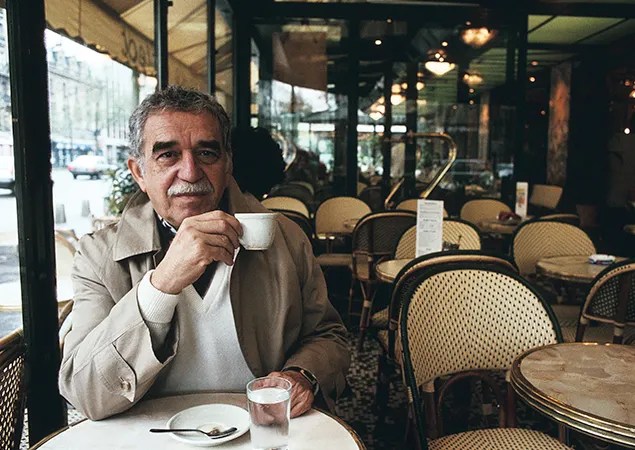
“One of These Days”
by Gabriel García Márquez
translated by J.S. Bernstein
Monday dawned warm and rainless. Aurelio Escovar, a dentist without a degree, and a very early riser, opened his office at six. He took some false teeth, still mounted in their plaster mold, out of the glass ease and put on the table a fistful of instruments which he arranged in size order, as if they were on display. He wore a collarless striped shirt, closed at the neck with a golden stud, and pants held up by suspenders. He was erect and skinny, with a look that rarely corresponded to the situation, the way deaf people have of looking.
When he had things arranged on the table, he pulled the drill toward the dental chair and sat down to polish the false teeth. He seemed not to be thinking about what he was doing, but worked steadily, pumping the drill with his feet, even when he didn’t need it.
After eight he stopped for a while to look at the sky through the window, and he saw two pensive buzzards who were drying themselves in the sun on the ridgepole of the house next door. He went on working with the idea that before lunch it would rain again. The shrill voice of his eleven-year-old son interrupted his concentration.
“Papá”
“What?”
“The Mayor wants to know if you’ll pull his tooth.”
“Tell him I’m not here.”
He was polishing a gold tooth. He held it at arm’s length, and examined it with his eyes half closed. His son shouted again from the little waiting room.
“He says you are, too, because he can hear you.”
The dentist kept examining the tooth. Only when he had put it on the table with the finished work did he say:
“So much the better.”
He operated the drill again. He took several pieces of a bridge out of a cardboard box where he kept the things he still had to do and began to polish the gold.
“Papá.”
“What?”
He still hadn’t changed his expression.
“He says if you don’t take out his tooth, he’ll shoot you.”
Without hurrying, with an extremely tranquil movement, he stopped pedaling the drill, pushed it away from the chair, and pulled the lower drawer of the table all the way out. There was a revolver. “O.K.,” he said. “Tell him to come and shoot me.”
He rolled the chair over opposite the door, his hand resting on the edge of the drawer. The Mayor appeared at the door. He had shaved the left side of his face, but the other side, swollen and in pain, had a five-day-old beard. The dentist saw many nights of desperation in his dull eyes. He closed the drawer with his fingertips and said softly:
“Sit down.”
“Good morning,” said the Mayor.
“Morning,” said the dentist.
While the instruments were boiling, the Mayor leaned his skull on the headrest of the chair and felt better. His breath was icy. It was a poor office: an old wooden chair, the pedal drill, a glass case with ceramic bottles. Opposite the chair was a window with a shoulder-high cloth curtain. When he felt the dentist approach, the Mayor braced his heels and opened his mouth.
Aurelio Escovar turned his head toward the light. After inspecting the infected tooth, he closed the Mayor’s jaw with a cautious pressure of his fingers.
“It has to be without anesthesia,” he said.
“Why?”
“Because you have an abscess.”
The Mayor looked him in the eye. “All right,” he said, and tried to smile. The dentist did not return the smile. He brought the basin of sterilized instruments to the worktable and took them out of the water with a pair of cold tweezers, still without hurrying. Then he pushed the spittoon with the tip of his shoe, and went to wash his hands in the washbasin. He did all this without looking at the Mayor. But the Mayor didn’t take his eyes off him.
It was a lower wisdom tooth. The dentist spread his feet and grasped the tooth with the hot forceps. The Mayor seized the arms of the chair, braced his feet with all his strength, and felt an icy void in his kidneys, but didn’t make a sound. The dentist moved only his wrist. Without rancor, rather with a bitter tenderness, he said:
“Now you’ll pay for our twenty dead men.”
The Mayor felt the crunch of bones in his jaw, and his eyes filled with tears. But he didn’t breathe until he felt the tooth come out. Then he saw it through his tears. It seemed so foreign to his pain that he failed to understand his torture of the five previous nights.
Bent over the spittoon, sweating, panting, he unbuttoned his tunic and reached for the handkerchief in his pants pocket. The dentist gave him a clean cloth.
“Dry your tears,” he said.
The Mayor did. He was trembling. While the dentist washed his hands, he saw the crumbling ceiling and a dusty spider web with spider’s eggs and dead insects. The dentist returned, drying his hands. “Go to bed,” he said, “and gargle with salt water.” The Mayor stood up, said goodbye with a casual military salute, and walked toward the door, stretching his legs, without buttoning up his tunic.
“Send the bill,” he said.
“To you or the town?”
The Mayor didn’t look at him. He closed the door and said through the screen:
“It’s the same damn thing















 Travel Between The Pages