
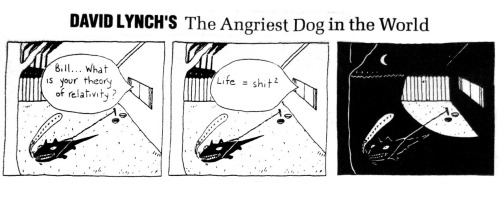
Filmmaker David Lynch sadly passed away last week. I was today years old when I discovered that he had created a newspaper comic strip called ‘The Angriest Dog in the World’.

Filmmaker David Lynch sadly passed away last week. I was today years old when I discovered that he had created a newspaper comic strip called ‘The Angriest Dog in the World’.

I have heard from some TBTP followers outside of North America who are baffled by the new status quo in the United States. The video and synopsis below go a long way in explaining the morass that we now find ourselves in over here.
or over two decades, I and a handful of others — Sheldon Wolin, Noam Chomsky, Chalmers Johnson, Barbara Ehrenreich and Ralph Nader — warned that the expanding social inequality and steady erosion of our democratic institutions, including the media, the Congress, organized labor, academia and the courts, would inevitably lead to an authoritarian or Christian fascist state. My books — “American Fascists: The Christian Right and the War on America” (2007), “Empire of Illusion: The End of Literacy and the Triumph of Spectacle” (2009), “Death of the Liberal Class” (2010), “Days of Destruction, Days of Revolt” (2012), written with Joe Sacco, “Wages of Rebellion” (2015) and “America: The Farewell Tour” (2018) were a succession of impassioned pleas to take the decay seriously. I take no joy in being correct.
“The rage of those abandoned by the economy, the fears and concerns of a beleaguered and insecure middle class, and the numbing isolation that comes with the loss of community, would be the kindling for a dangerous mass movement,” I wrote in “American Fascists” in 2007. “If these dispossessed were not reincorporated into mainstream society, if they eventually lost all hope of finding good, stable jobs and opportunities for themselves and their children — in short, the promise of a brighter future — the specter of American fascism would beset the nation. This despair, this loss of hope, this denial of a future, led the desperate into the arms of those who promised miracles and dreams of apocalyptic glory.”
President-elect Donald Trump does not herald the advent of fascism. He heralds the collapse of the veneer that masked the corruption within the ruling class and their pretense of democracy. He is the symptom, not the disease. The loss of basic democratic norms began long before Trump, which paved the road to an American totalitarianism. Deindustrialization, deregulation, austerity, unchecked predatory corporations, including the health-care industry, wholesale surveillance of every American, social inequality, an electoral system that is plagued by legalized bribery, endless and futile wars, the largest prison population in the world, but most of all feelings of betrayal, stagnation and despair, are a toxic brew that culminate in an inchoate hatred of the ruling class and the institutions they have deformed to exclusively serve the rich and the powerful. The Democrats are as guilty as the Republicans.
“Trump and his coterie of billionaires, generals, half-wits, Christian fascists, criminals, racists, and moral deviants play the role of the Snopes clan in some of William Faulkner’s novels,” I wrote in “America: The Farewell Tour.” “The Snopeses filled the power vacuum of the decayed South and ruthlessly seized control from the degenerated, former slaveholding aristocratic elites. Flem Snopes and his extended family — which includes a killer, a pedophile, a bigamist, an arsonist, a mentally disabled man who copulates with a cow, and a relative who sells tickets to witness the bestiality — are fictional representations of the scum now elevated to the highest level of the federal government. They embody the moral rot unleashed by unfettered capitalism.”
“The usual reference to ‘amorality,’ while accurate, is not sufficiently distinctive and by itself does not allow us to place them, as they should be placed, in a historical moment,” the critic Irving Howe wrote of the Snopeses. “Perhaps the most important thing to be said is that they are what comes afterwards: the creatures that emerge from the devastation, with the slime still upon their lips.”
“Let a world collapse, in the South or Russia, and there appear figures of coarse ambition driving their way up from beneath the social bottom, men to whom moral claims are not so much absurd as incomprehensible, sons of bushwhackers or muzhiks drifting in from nowhere and taking over through the sheer outrageousness of their monolithic force,” Howe wrote. “They become presidents of local banks and chairmen of party regional committees, and later, a trifle slicked up, they muscle their way into Congress or the Politburo. Scavengers without inhibition, they need not believe in the crumbling official code of their society; they need only learn to mimic its sounds.”
The political philosopher Sheldon Wolin called our system of governance “inverted totalitarianism,” one that kept the old iconography, symbols and language, but had surrendered power to corporations and oligarchs. Now we will shift to totalitarianism’s more recognizable form, one dominated by a demagogue and an ideology grounded in the demonization of the other, hypermasculinity and magical thinking.
Fascism is always the bastard child of a bankrupt liberalism.
“We live in a two-tiered legal system, one where poor people are harassed, arrested and jailed for absurd infractions, such as selling loose cigarettes — which led to Eric Garner being choked to death by the New York City police in 2014 — while crimes of appalling magnitude by the oligarchs and corporations, from oil spills to bank fraud in the hundreds of billions of dollars, which wiped out 40 percent of the world’s wealth, are dealt with through tepid administrative controls, symbolic fines, and civil enforcement that give these wealthy perpetrators immunity from criminal prosecution,” I wrote in “America: The Farewell Tour.”
The utopian ideology of neoliberalism and global capitalism is a vast con. Global wealth, rather than being spread equitably, as neoliberal proponents promised, was funneled upward into the hands of a rapacious, oligarchic elite, fueling the worst economic inequality since the age of the robber barons. The working poor, whose unions and rights were stripped from them and whose wages have stagnated or declined over the past 40 years, have been thrust into chronic poverty and underemployment. Their lives, as Barbara Ehrenreich chronicled in “Nickel and Dimed,” are one long, stress-ridden emergency. The middle class is evaporating. Cities that once manufactured products and offered factory jobs are boarded-up-wastelands. Prisons are overflowing. Corporations have orchestrated the destruction of trade barriers, allowing them to stash $1.42 trillion in profits in overseas banks to avoid paying taxes.
Neoliberalism, despite its promise to build and spread democracy, swiftly gutted regulations and hollowed out democratic systems to turn them into corporate leviathans. The labels “liberal” and “conservative” are meaningless in the neoliberal order, evidenced by a Democratic presidential candidate who bragged about an endorsement from Dick Cheney, a war criminal who left office with a 13 percent approval rating. The attraction of Trump is that, although vile and buffoonish, he mocks the bankruptcy of the political charade.
The illusions peddled on our screens — including the fictitious persona created for Trump on The Apprentice — have replaced reality. Politics is burlesque as Kamala Harris’ vapid, celebrity-filled campaign illustrated. It is smoke and mirrors created by the army of agents, publicists, marketing departments, promoters, script writers, television and movie producers, video technicians, photographers, bodyguards, wardrobe consultants, fitness trainers, pollsters, public announcers and television news personalities. We are a culture awash in lies.
It is not going to get better. The tools to shut down dissent have been cemented into place. Our democracy cratered years ago. We are in the grip of what Søren Kierkegaard called “sickness unto death” — the numbing of the soul by despair that leads to moral and physical debasement. All Trump has to do to establish a naked police state is flip a switch. And he will.
“The worse reality becomes, the less a beleaguered population wants to hear about it,” I wrote at the conclusion of “Empire of Illusion,” “and the more it distracts itself with squalid pseudo-events of celebrity breakdowns, gossip and trivia. These are the debauched revels of a dying civilization.”

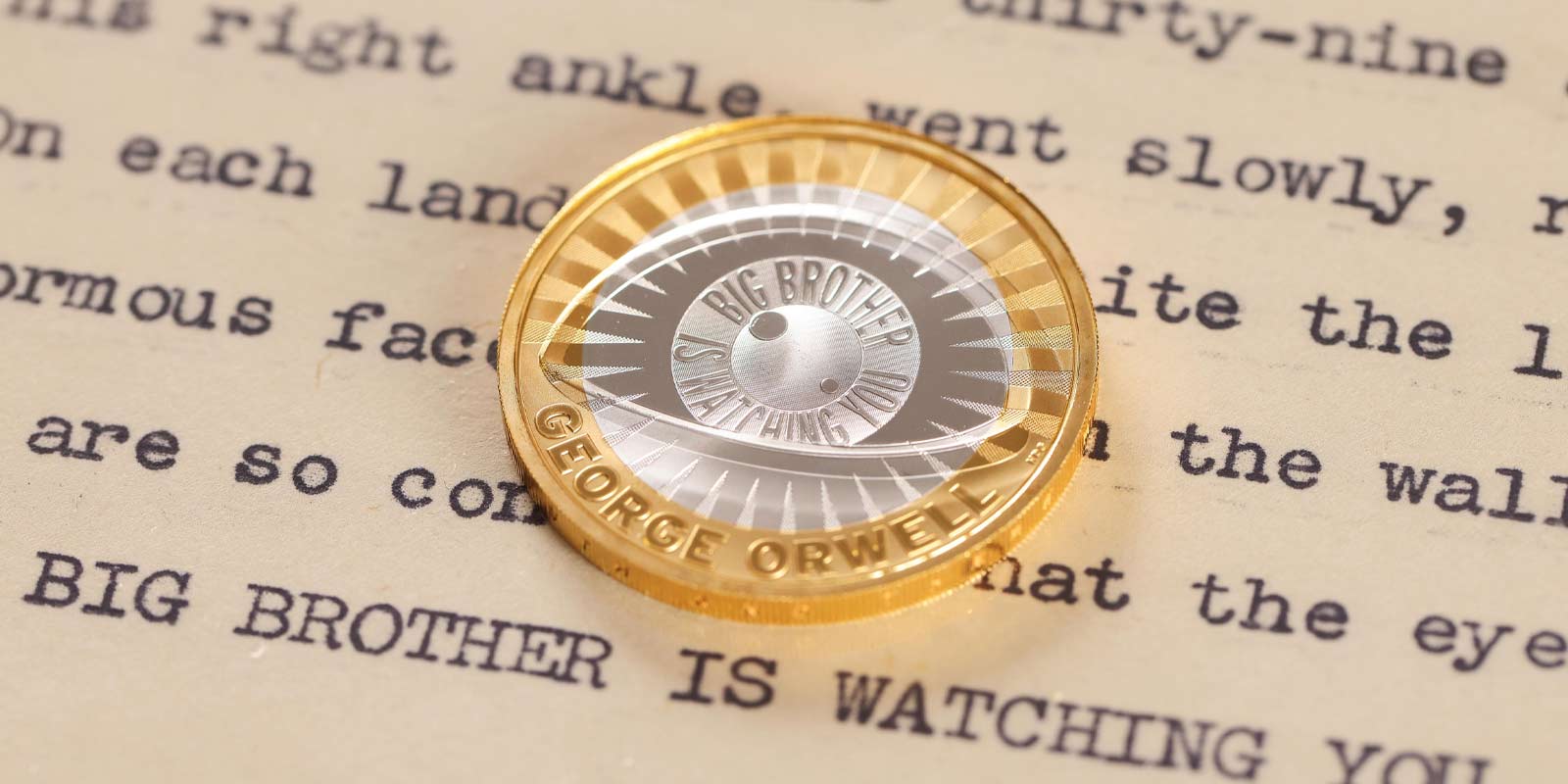
I thought that I had stumble on something from The Onion when I saw a story about a £2 George Orwell commemorative coin being minted in the UK. Shockingly, it was a true story. The Royal Mint will honor author George Orwell with a new £2 coin, released in commemoration of the 75th anniversary of his death.
“One of the most influential literary figures of the 20th century, George Orwell, will be honoured on a new £2 coin, The Royal Mint has revealed today.
Released in commemoration of the 75th anniversary of the author’s death, the reverse (tails) design pays tribute to one of his most famous novels, 1984. Experienced coin artist Henry Gray (The Who, Buckingham Palace) has created what appears to be an eye but is in fact a camera lens at the centre.
The quote, ‘Big Brother is Watching You’ encircles the camera lens, while the coin’s edge inscription reads ‘THERE WAS TRUTH AND THERE WAS UNTRUTH’, another quote from the novel.
The £2 coin is one the most favoured denominations among collectors. Since its introduction to the definitive coinage of the United Kingdom in 1998, the £2 coin has seen over 50 reverse designs, including coins commemorating other literary figures including William Shakespeare, Jane Austen, and JRR Tolkien.”
I am shocked that the Orwell Foundation agreed to this crass commercialization of George Orwell’s work and legacy.


No writer has the ability to evoke a sense of horror and dread more effectively than Edgar Allan Poe, born on January 19, 1809, in Boston, Massachusetts. Poe’s parents were actors. Their brilliant and unstable son grew up to be a romantic poet, a master of macabre tales, the originator of the modern detective story, and an acute literary critic, editor, and journalist. Orphaned at age two, Poe grew up in the Richmond, VirginiaExternal home of a childless couple, merchant John Allan and his wife Frances. His foster parents treated him well, though Frances was Poe’s primary source of affection. Allan paid for Poe’s education at schools in England and in Virginia. Poe showed an early gift for language and Allan enrolled him in the University of Virginia in February 1826.
Oh, horror upon horror! the ice opens suddenly…and we are whirling dizzily, in immense concentric circles, round and round the borders of a gigantic amphitheatre, the summit of whose walls is lost in the darkness…But little time will be left me to ponder upon my destiny…we are plunging madly within the grasp of the whirlpool and amid a roaring, and bellowing, and shrieking of ocean and of tempest, the ship is quivering, oh God! and going down.
Before the year was out, Poe, maintaining the lifestyle of a Virginia gentleman of substance, had accumulated a debt of $2,000. Poe angered his foster father—accusing him of providing inadequate financial support for his university expenses. Allan paid Poe’s charges to Charlottesville merchants, but refused to pay his gambling debts, regarded at that time by young gentlemen as “debts of honor.” When Poe returned to Richmond for Christmas, Allan refused to send him back to the university. For two months the pair argued at home, culminating in a huge fight in March 1827 that prompted Poe to move to Boston. In May, Poe enlisted in the army under an assumed name. While training as a soldier, he found time to write romantic poetry in the tradition of Lord Byron. His first volume of poems was published in 1827 as Tamerlane and Other PoemsExternal, “By a Bostonian.”
Allan and Poe were not in contact after Poe moved to Boston. Early in 1829, however, Poe’s regimental commanding officer, acting as intermediary, helped them reestablish communication. The death of Poe’s foster mother on February 28, 1829, sealed Allan and Poe’s reconciliation.
Poe was discharged from the army in April 1829. In May he took up residence in Baltimore with his grandmother Poe, and his aunt Maria Clemm and her children. He supported himself by holding odd jobs. In December 1829, a Baltimore publisher brought out Poe’s second volume of poetry, Al Aaraaf, Tamerlane, and Minor PoemsExternal.
Allan, who had resumed his financial support of Poe, assisted him in financing his entrance into the U.S. Military Academy. Poe enrolled in the Academy on July 1, 1830. Within the year, Poe’s academic career and his relations with Allan again ran aground. Poe drank to excess and ran up debts at West Point. By this time, Allan, who had remarried in October 1830, was more interested in starting a new family than dealing with the ongoing problems of his foster son. He again severed relations with Poe, this time permanently.
During the 1830s Poe’s writing began to attract notice. He published stories in the Philadelphia Courier, the Baltimore Sunday Visitor, and Godey’s Ladies Book. In 1835 he moved back to Richmond where he became editor and contributor to the Southern Literary Messenger. Shortly thereafter, he married his thirteen-year-old cousin Virginia Clemm. Between 1835 and 1837, during his tenure with the Messenger, Poe published more than one hundred reviews and editorials in a regular literary column, and also brought out many new poems and stories. In 1838 he published his one full-length piece of fiction, Narrative of A. Gordon Pym.
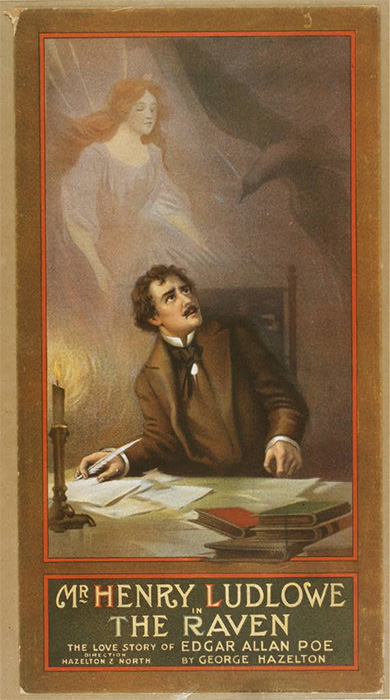
From 1838 until 1844, Poe lived with his wife and mother-in-law in Philadelphia. During these productive years, he served as editor of Burton’s Gentleman’s Magazine, which became Graham’s Lady’s and Gentleman’s Magazine, publishing incisive literary criticism and some of his finest fiction, including “The Pit and the Pendulum”External, “The Tell-Tale Heart”External, and “The Fall of the House of Usher”External. In 1840 Poe’s stories were published in two volumes as Tales of the Grotesque and Arabesque. The publication of “The Gold-Bug”External and “The Black Cat”External in the summer of 1843 produced a literary sensation. He received even wider acclaim with the publication of “The Raven” in 1845.
Once upon a midnight dreary, while I pondered, weak and weary,
Over many a quaint and curious volume of forgotten lore,
While I nodded, nearly napping, suddenly there came a tapping,
As of some one gently rapping, rapping at my chamber door.
“‘Tis some visiter,” I muttered, “tapping at my chamber door —
Only this, and nothing more.”“The Raven”. In The Raven, by Edgar Allan Poe. New York, E.P. Dutton, 1884. Selected Digitized Books. General Collections, The Library of Congress
Simultaneous with his development of gothic themes of terror, Poe experimented with the pleasure of logical analysis, which flowered in the creation of a new type of literature. Poe called the new genre the “tale of ratiocination.” The first story of this type, The Murders in the Rue MorgueExternal, featured an apparently inexplicable crime and a step-by-step analysis by the rational Frenchman Dupin, as narrated by his admiring and baffled sidekick. From this formula, which proved to be amenable to endless variations, arose the widely popular genre of the mystery novel and detective story.
In the spring of 1846, Poe and his wife, who had long been seriously ill, moved to a cottage in Fordham, New York. Virginia Clemm Poe died there the following January. During the next two years, Poe pursued a number of erratic romantic attachments with unavailable women, drank heavily, and made himself ill.
Increasingly incapacitated, Poe experienced bouts of delusion and paranoia. On October 3, 1849, he was found in a state of semiconsciousness at Gunner’s Hall tavern in Baltimore. First thinking him to be intoxicated, physicians soon realized that his illness was of a more serious nature. Poe died in delirium at Washington College Hospital four days later. The official cause of death was reported by the Baltimore Clipper as “congestion of the brain”.
Poe’s romantic tales and poems had often involved the morbid dread of loss of an idealized female love object. This theme seems to have arisen from Poe’s grief over the early loss of his mother, followed by the deaths of his friend’s mother, when he was fifteen years old, and of his foster mother, when he was twenty. In the months before his own death he had penned several versions of one of his most famous and haunting poems on this theme.
“Annabel Lee” was published in the Richmond Examiner, the New York Tribune, and the Southern Literary Messenger, along with Poe’s obituary notice.
For the moon never beams without bringing me dreams
Of the beautiful Annabel Lee;
And the stars never rise but I see the bright eyes
Of the beautiful Annabel Lee;
And so, all the night-tide, I lie down by the side
Of my darling, my darling, my life and my bride
In her sepulchre there by the sea —
In her tomb by the side of the sea.Edgar Allan Poe, “Annabel LeeExternal.” Southern Literary Messenger, November 1849, p. 697

via loc.gov

Emirates is leading the way for neurodiversity needs, becoming the first airline in the world to achieve Autism Certification with a landmark recognition by the International Board of Credentialing and Continuing Education Standards (IBCCES). By early 2025, the company plans to have over 30,000 cabin crew and ground staff trained to understand and support travelers across the spectrum, a pivotal shift for the aviation industry.
To earn the certification, Emirates says it worked closely with IBCCES, conducting surveys with over 14,000 people with disabilities and gathering input from 1,200 industry experts. This extensive research informed the airline’s training programs, equipping staff to recognize sensory triggers and respond effectively to individual needs.
The certification also covers in-flight and ground services, ensuring that passengers with autism have a smooth experience from check-in to arrival.
For a first-class experience, Emirates is introducing sensory guides. These digital tools provide detailed information about environments passengers may encounter during their journey, such as noise levels, lighting, and potential sensory triggers. The resource empowers travelers to plan ahead, minimizing stress and uncertainty.
Additionally, Emirates will offer in-flight sensory aids, including fidget toys and calming tools, to help passengers stay comfortable and focused during their trip.
With this approach, Emirates is aligning itself with Dubai’s goals of becoming the most accessible destination in the world. In December 2023, Dubai International Airport itself achieved its own milestone by becoming the first international airport designated as a Certified Autism Center.

Once upon a time…
korean: “back when tigers used to smoke” (호랑이 담배 피우던 시절에)
czech: “beyond seven mountain ranges, beyond seven rivers” (za sedmero horami a sedmero řekami)
georgian: “there was, and there was not, there was…” (იყო და არა იყო რა, იყო…)
hausa: “a story, a story. let it go, let it come.”
romanian: “there once was, (as never before)… because if there wasn’t, it wouldn’t have been to told” (A fost odată, ca niciodată că dacă n-ar fi fost, nu s-ar mai povesti…)
lithuanian: “beyond nine seas, beyond nine lagoons: (už devynių jūrų, už devynių marių)
catalan: “see it here that in that time in which beasts spoke and people were silent…” (vet aquí que en aquell temps que les bèsties parlaven i les persones callaven…)
turkish: “Once there was, and once there wasn’t. In the long-distant days of yore, when haystacks winnowed sieves, when genies played jereed in the old bathhouse, [when] fleas were barbers, [when] camels were town criers, [and when] I softly rocked my baby grandmother to sleep in her creaking cradle, there was/lived, in an exotic land, far, far away, a/an…* (Bir varmış, bir yokmuş. Evvel zaman içinde, kalbur saman içinde, cinler cirit oynar iken eski hamam içinde, pireler berber [iken], develer tellal [iken], ben ninemin beşiğini tıngır mıngır sallar iken, uzak diyarların birinde…)

First Snow by Mary Oliver
The snow
began here
this morning and all day
continued, its white
rhetoric everywhere
calling us back to why, how,
whence such beauty and what
the meaning…
The silence
is immense,
and the heavens still hold
a million candles, nowhere
the familiar things:
stars, the moon,
the darkness we expect
and nightly turn from. Trees
glitter like castles
of ribbons, the broad fields
smolder with light, a passing
creekbed lies
heaped with shining hills;
and though the questions
that have assailed us all day
remain — not a single
answer has been found –
walking out now
into the silence and the light
under the trees,
and through the fields,
feels like one.

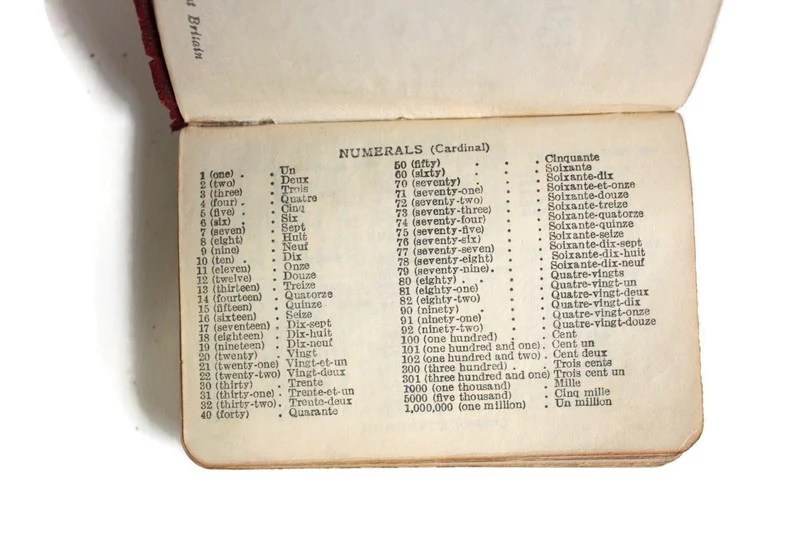
The 1937 phrasebook Collins’ Pocket Interpreters: France paints an alarming picture of a typical visit to France:
I cannot open my case.
I have lost my keys.
I did not know that I had to pay.
I cannot find my porter.
Excuse me, sir, that seat is mine.
I cannot find my ticket!
I have left my gloves (my purse) in the dining car.
I feel sick.
The noise is terrible.
Did you not get my letter?
I cannot sleep at night, there is so much noise.
There are no towels here.
The sheets on this bed are damp.
I have seen a mouse in the room.
These shoes are not mine.
The radiator doesn’t work.
This is not clean, bring me another.
I can’t eat this. Take it away!
The water is too hot, you are scalding me!
It doesn’t work.
This doesn’t smell very nice.
There is a mistake in the bill.
I am lost.
Someone robbed me.
I shall call a policeman.
That man is following me everywhere.
There has been an accident!
She has been run over.
He is losing blood.
He has lost consciousness.
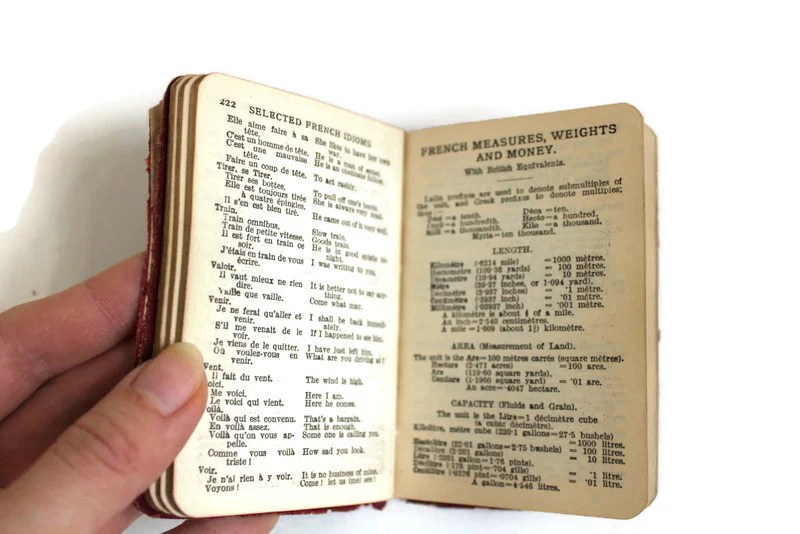
James Thurber, who came upon the book in a London bookshop, described it as a “melancholy narrative poem” and “a dramatic tragedy of an overwhelming and original kind.” “I have come across a number of these helps-for-travelers,” he wrote, “but none has the heavy impact, the dark, cumulative power of Collins’. … The volume contains three times as many expressions to use when one is in trouble as when everything is going all right.”

I’m no Luddite, but I have serious reservations about self-driving automobile technology. This recent news story seems to prove me right. Last week, Mike Johns was on his way to the Phoenix, Arizona airport in a Waymo autonomous taxi to catch a flight back to Los Angeles. However, the self-driving taxi had other, very autonomous plans and, after Johns had fastened his seatbelt in the back seat, began driving in circles in a parking lot . As a passenger, there is apparently nothing more you can do than call Waymo support, who also seemed rather helpless at first. But somehow things went forward and Mike got his flight after all.


 Travel Between The Pages