Poems on Various Subjects

On September 1, 1773, Phillis Wheatley’s Poems on Various Subjects, Religious and Moral was published in London, England. Wheatley’s collection was the first volume of poetry by an African-American poet to be published. Regarded as a prodigy by her contemporaries, Wheatley was approximately twenty at the time of the book’s publication.

Born in the Senegambia region of West Africa, she was sold into slavery and transported to Boston at age seven or eight. Purchased off the slave ship by prosperous merchant John Wheatley and his wife Susanna in 1761, the young Phillis was soon copying the English alphabet on a wall in chalk.

Rather than fearing her precociousness, the Wheatleys encouraged it, allowing their daughter Mary to tutor Phillis in reading and writing. She also studied English literature, Latin, and the Bible—a strong education for any eighteenth-century woman. Wheatley’s first published poem, “On Messrs. Hussey and Coffin,” was published in Rhode Island’s Newport Mercury newspaper on December 21, 1767.

To pursue the publication of a book of her poetry, the poet sailed to London in 1773 with the Wheatleys’ son, Nathaniel. Her reputation preceded her. She met many influential people, including the Lord Mayor of London who presented her with a copy of Milton’s Paradise Lost. Her volume of poetry was published under the patronage of Selina Hastings, Countess of Huntingdon.

Learning of Mrs. Wheatley’s ill health, Phillis Wheatley returned to Boston prior to the book’s appearance. Arriving in Boston in September 1773, she nursed her mistress until Susanna Wheatley died the following March. Wheatley continued to write. In 1776, she sent her poem “To his Excellency General Washington,” later published in the Pennsylvania Magazine, to the commander in chief of the Continental army. General Washington thanked her for the poem in a letter:

I thank you most sincerely for your polite notice of me, in the elegant Lines you enclosed; and however undeserving I may be of such encomium and panegyrick, the style and manner exhibit a striking proof of your great poetical Talents. In honour of which, and as a tribute justly due to you, I would have published the Poem, had I not been apprehensive, that, while I only meant to give the World this new instance of your genius, I might have incurred the imputation of Vanity. This and nothing else, determined me not to give it place in the public Prints.

George Washington to Phillis Wheatley, February 28, 1776. Series 3, Varick Transcripts, 1775-1785, Subseries 3H, Personal Correspondence, 1775-1783, Letterbook 1: May 31, 1775-Dec. 25, 1779. George Washington Papers. Manuscript Division.

Although she had been emancipated, Phillis Wheatley continued to live with various members of the Wheatley family until 1778. After the death of John Wheatley and his daughter, Phillis moved to her own home. She soon married John Peters, a free black Bostonian who held a variety of jobs before falling into debt. She bore the frequently absent Peters three children. Beset with financial problems, she sold her volume of Milton to help pay his debts. To support herself and her only surviving child, Phillis Wheatley worked in a Boston boarding house. Both the poet and her child died there on December 5, 1784.

via LOC


Posted in Africa, Books, History, USA, Writing | Tagged , , | Leave a comment

Who doesn’t love a good Dorling Cartogram

World Population Flags is a Dorling cartogram in which country flags are sized by population. The cartogram is used to visualize where people live around the world and the relative size of each country’s population. Take for a spin.

A Dorling cartogram is a thematic map that is used to visualize quantitative data. On a Dorling cartogram areas are represented by circles rather than their actual geographic boundaries. The size of each circle is proportional to the variable being represented. In the case of World Population Flags the variable being represented by the circles is country populations.

Dorling cartograms are particularly useful for making it easy to compare values across regions, especially when the actual geographic area sizes are misleading or irrelevant to the data being displayed. For example in World Population Flags the world’s biggest country in land area, Russia, appears to be roughly the same size as Bangladesh (which is much smaller in terms of geographic area) because both countries share a similar population size.

The Dorling cartogram in Word Population Flags is used in a scrollytelling presentation to take a closer look at population trends in the world’s populated continents. As you scroll through World Population Flags the map zooms and pans automatically to illustrate the relative size of each continent’s population. At the end of the presentation you can explore the cartogram for yourself, and hover over individual circles to view each country’s population.

Why use a Dorling Cartogram ?

Advantages and Limitations

Dorling cartograms are particularly useful for:

  • Displaying data where the shapes of geographic units are not crucial or familiar to the audience.
  • Highlighting overall geographic patterns rather than precise locations.
  • Representing a single variable effectively across different regions.

However, they have limitations:

  • They do not preserve exact geographic relationships or shapes.
  • They are best suited for displaying a single variable, though some adaptations can represent sub-variables

via 

Posted in Africa, Asia, Maps, Tech, USA | Tagged , | Leave a comment

Managing Your Book Addiction


Posted in Books, Writing | Tagged | 1 Comment

A short description of European people

The chart below was created in Germany in the 18th century to describe the character traits of the various European peoples. Hardly insulting at all.

Posted in Europe | Tagged | 2 Comments

Even a bad day of hiking is a day you’ll remember

Exactly forty years ago on this day I was tent camping in the Swiss alps. It’s one of those indelible travel memories that tends to stick out among all of the many trips. Filmmaker Reinis Kaspars spent two weeks hiking alone in the Swiss Alps, and managed to shoot a gorgeous short film about the experience as he went along.  Kaspars delivers a quiet monologue throughout the film that manages the neat trick of being inspirational without seeming cloying or clichéd. Watch on full screen.


Posted in Europe, Film, Tourism | Tagged , | Leave a comment

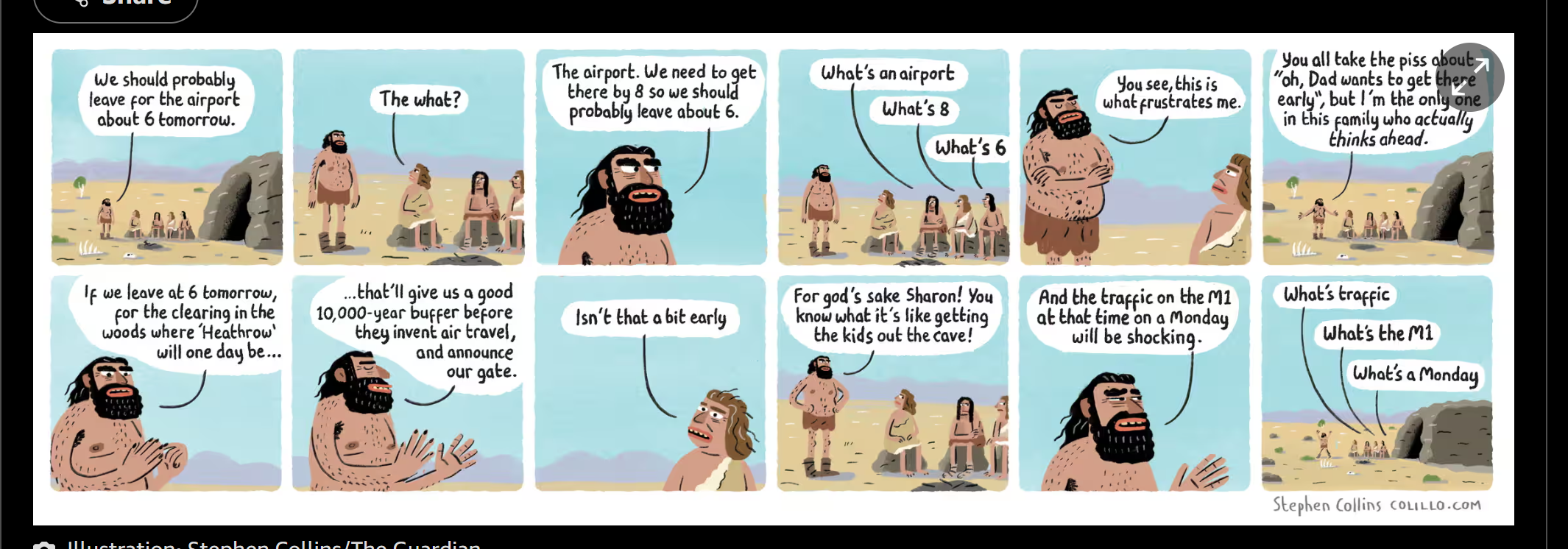
consternation at the departure gate

SONG OF THE DISGRACED PERSON

Jack Underwood

As a fire axe waits in its little shop window
As a tongue returns raw to the lozenge
It’s not your fault you’re like this, but you are
As consternation at the departure gate
As drinking water to find it creamy
As the linseed head of an ant might contain
a social code in play
As suffering comes home from work
with the same names as yesterday
As you forget to taste
As you borrow a sigh from the same cubic meters of air
As a too-slow handshake might signal sarcasm
It’s not who you are but who you are and can’t undo
As you shit in a room without water
As you cry in a room without light
We send our love
We send an invoice attached as requested
As if everything were intended for you

Posted in USA, Writing | Tagged | Leave a comment

Monday, Monday, can’t trust that day

,

In 1974, Saturday Review magazine asked some of the world’s leading thinkers (Isaac Asimov, Jacques Cousteau, Andrei Sakharov, etc.) what the world of 2024 would look like. Here’s what they got right (internet) and wrong (factories on the Moon)

“The most regretful people on earth are those who felt the call to creative work, who felt their own creative power restive and uprising, and gave to it neither power nor time.”
― Mary Oliver

The photo above includes a rental library inside a general Store. A rental library (also know as lending library ) was a commercially operated library that lent books at a fixed charge per book per day.  In 1923, of 1,100 cities in the US, only 200 had free public libraries. Rental Libraries were a popular solution and they changed bookselling. The now defunct chain Waldenbooks started as a Rental Library chain in 1933 by Lawrence W. Holt and Melvin T. Kafka. By 1948, they had 250 rental libraries doing a brisk business, as well as many leased book departments in stores selling books. In 1962 the first “Walden Book Store” was launched and by the late 1989 there were over 1200 stores across the county.

The air pressure forces the molecules to go tiny.


Posted in Books, Libraries, USA | Tagged , , | Leave a comment

Heaven’s Gate

“A Society of Scoundrels”

by

Franz Kafka

Translated by Michael Hofmann


There was once a society of scoundrels, or rather not scoundrels per se, just ordinary, average people. They always stuck together. When one of them had perpetrated some rascally act, or rather, nothing really rascally, just averagely bad, he would confess it to the others, and they investigated it, condemned it, imposed penalties, forgave him, etc. This wasn’t corrupt — the interests of the individual and the society were kept in balance and the confessor received the punishment he asked for. So they always stuck together, and even after their death they didn’t abandon their society, but ascended to heaven in a troop. It was a sight of childlike innocence to see them flying. But since everything at heaven’s gate is broken up into its component parts, they plunged down like so many rocks.

Posted in Books, Europe, Writing | Tagged , , | 1 Comment

Bibliolyte, destroyer of books

In The Book Hunter (1863), John Hill Burton identifies five types of “persons who meddle with books”:

  • “A bibliognoste, from the Greek, is one knowing in title-pages and colophons, and in editions; the place and year when printed; the presses whence issued; and all the minutiae of a book.”
  • “A bibliographe is a describer of books and other literary arrangements.”
  • “A bibliomane is an indiscriminate accumulator, who blunders faster than he buys, cock-brained and purse-heavy.”
  • “A bibliophile, the lover of books, is the only one in the class who appears to read them for his own pleasure.”
  • “A bibliotaphe buries his books, by keeping them under lock, or framing them in glass cases.”

These groups seem to have been proposed by French librarian Jean Joseph Rive. Bibliographer Gabriel Peignot added four more:

  • bibliolyte, a destroyer of books
  • bibliologue, one who discourses about books
  • bibliotacte, a classifier of books
  • bibliopée, “‘l’art d’écrire ou de composer des livres,’ or, as the unlearned would say, the function of an author.”
Posted in Books, Writing | Tagged , , | Leave a comment

It was a dark and stormy night

“She had a body that reached out and slapped my face like a five-pound ham-hock tossed from a speeding truck.” 2024 Grand Prize Winner

Founded in 1982 at San Jose State University in California, the Bulwer-Lytton Fiction Contest challenges entrants to compose opening sentences to the worst of all possible novels. 

The BLFC was the brainchild of Professor Scott Rice. Sentenced to write a seminar paper on a minor Victorian novelist, he chose the man with the funny hyphenated name, Edward George Bulwer-Lytton. Best known for The Last Days of Pompeii, his novel Paul Clifford began with the famous opener that has been plagiarized repeatedly by the cartoon beagle, Snoopy.

Crime & Detective

Winner

She was poured into the red latex dress like Jello poured into a balloon, almost bursting at the seams, and her zaftig shape was awesome to behold, but I knew from the look on her face and the .45 she held pointing at me, that this was no standard client of my detective agency, but a new collection agency tactic to get me to pay my long-overdue phone bill.

You can find all of this year’s groaners, I mean winners, right here.


Posted in Books, USA, Writing | Tagged , | Leave a comment