A Slice of Life

For decades there was one thing that all New Yorkers could rally around: the dollar slice of pizza. It has been a given that one could depend on a tasty and inexpensive slice of New York-style pizza in all five boroughs of the city. The price has varied slightly over the years, but the quality never changed. The wonderful little documentary below looks at our enduring love affair with the slice.


Posted in Film, Restaurants, USA | Tagged , | Leave a comment

Read a little poetry

I can trace my love of poetry back to my 7th grade English teacher. For reasons lost to the fog of time, one day Natalie Fine handed me a book of poems by Langston Hughes and simply said, “I think you will get these.” I did, and I still do.

Recently, I found the wonderful website Read A Little Poetry which is a labor of love by the Manila based writer and poet T. De Los Reyes. The selection of poems are always intriguing, as is the marginalia that accompanies them. The newsletter is ad-hoc – so it’s like having random treats delivered to your inbox – but the website has a meticulous archive sorted by poets and themes, alongside a tab for generating random poems.

A Dream Deferred
Langston Hughes

What happens to a dream deferred?

Does it dry up
like a raisin in the sun?
Or fester like a sore–
And then run?
Does it stink like rotten meat?
Or crust and sugar over–
like a syrupy sweet?

Maybe it just sags
like a heavy load.

Or does it explode?

Bluebird
Charles Bukowski

there’s a bluebird in my heart that
wants to get out
but I’m too tough for him,
I say, stay in there, I’m not going
to let anybody see
you.

there’s a bluebird in my heart that
wants to get out
but I pour whiskey on him and inhale
cigarette smoke
and the whores and the bartenders
and the grocery clerks
never know that
he’s
in there.

there’s a bluebird in my heart that
wants to get out
but I’m too tough for him,
I say,
stay down, do you want to mess
me up?
you want to screw up the
works?
you want to blow my book sales in
Europe?

there’s a bluebird in my heart that
wants to get out
but I’m too clever, I only let him out
at night sometimes
when everybody’s asleep.
I say, I know that you’re there,
so don’t be sad.

then I put him back,
but he’s still singing a little
in there, I haven’t quite let him
die
and we sleep together like
that
with our
secret pact
and it’s nice enough to
make a man
weep, but I don’t
weep, do
you?


Posted in Books, Writing | Tagged , , , , | Leave a comment

Paris with Eugène Atget

While searching for early Paris photographs for a project, I ran across the marvelous video below. The short film pairs the images by the pioneering street photographer Eugène Atget with the music of Wim Mertens.

NB: If the video fails to open in your browser please click here.


Posted in Europe, Film, Music, Photography | Tagged , | Leave a comment

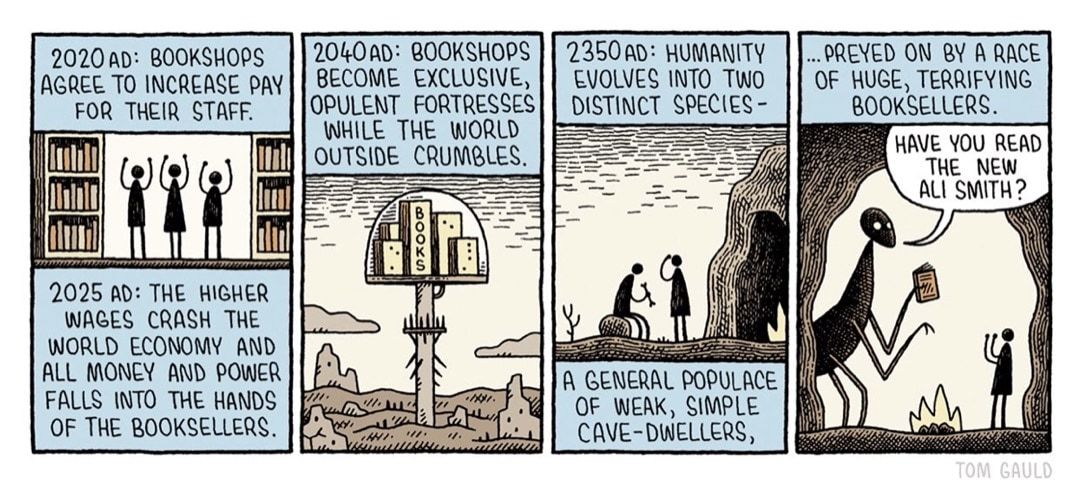
Time Travel Philosophy

source


Posted in Animation, Art, Books | Tagged , , | Leave a comment

Airport Lost and Found

Have you ever experienced that sinking feeling when your luggage failed to appear on the airport carousel ? Or have you ever reached your destination and realized that you left your headphones or other valuables in the airline seat pocket ? I recently ran across this informative and entertaining video from the folks at National Geographic explaining what happens to all of that lost stuff.


Posted in Air Travel, Film, Tourism | Tagged , | 1 Comment

Darkness Visible

I recently read Nick Harkaway’s exciting novel Titanium Noir. The blurb above is a better recommendation for the book than any review that I could ever post. If you haven’t read Harkaway, it’s not a bad place to start. After reading the book I was reminded of a marvelous infographic about Noir films that I ran across a few years ago. Designer Melanie Patrick and writer Adam Frost have, at the behest of the British Film Institute, come up with a handy infographic (click here to view it in a larger format) that explains and visualizes the particulars of the “shadowy world of one of classic Hollywood’s most beloved subgenres.”


Posted in Books, Film, movies, Writing | Tagged , , , | 1 Comment

It was a bright cold day in April, so sweaters were necessary

Every knitter and Orwell fan that you know will want this free download: a knitting pattern for a sweater depicting the cover of the iconic Penguin Classics version of George Orwell’s 1984. “The pattern includes extra alphabet charts so that you can customise the title and author to your favourite book.”


Posted in Art, Books, Writing | Tagged , , | Leave a comment

it had been overrun by religious stupefiers, mountebanks, charlatans, obfuscators, and other dedicated misleaders,

“When young and full of fellow feeling, Professor Joseph Skizzen had been tormented by the thought that the human race (which he naïvely believed was made up of great composers, a few harmlessly lecherous painters, maybe a mathematician or a scientist, a salon of writers, all aiming at higher things however they otherwise carried on) … that such an ennobled species might not prosper, indeed, might not survive in any serious way—symphonies sinking like torpedoed ships, murals spray-canned out of sight, statues toppled, books burned, plays updated by posturing directors; but now, older, wiser—more jaundiced, it’s true—he worried that it might (now that he saw that the human world was packed with politicians who could not even spell “scruple”; now that he saw that it was crammed with commercial types who adored only American money; now that he saw how it had been overrun by religious stupefiers, mountebanks, charlatans, obfuscators, and other dedicated misleaders, as well as corrupt professionals of all kinds—ten o’clock scholars, malpracticing doctors, bribed judges, sleepy deans, callous munitions makers and their pompous generals, pedophilic priests, but probably not pet lovers, not arborists, not gardeners—but Puritans, squeezers, and other assholes, ladies bountiful, ladies easy, shoppers diligent, lobbyists greedy, Eagle Scouts, racist cops, loan sharks, backbiters, gun runners, spies, Judases, philistines, vulgarians, dumbbells, dolts, boobs, louts, jerks, jocks, creeps, yokels, cretins, simps, pipsqueaks—not a mensch among them—nebbechs, scolds, schlemiels, schnorrers, schnooks, schmucks, schlumps, dummkopfs, potato heads, klutzes, not to omit pushers, bigots, born-again Bible bangers, users, conmen, ass kissers, Casanovas, pimps, thieves and their sort, rapists and their kind, murderers and their ilk—the pugnacious, the miserly, the envious, the litigatious, the avaricious, the gluttonous, the lubricious, the jealous, the profligate, the gossipacious, the indifferent, the bored), well, now that he saw it had been so infested, he worried that the race might … might what? … the whole lot might sail on through floods of their own blood like a proud ship and parade out of the new Noah’s ark in the required pairs—for breeding, one of each sex—sportscasters, programmers, promoters, polluters, stockbrokers, bankers, body builders, busty models, show hosts, stamp and coin collectors, crooners, glamour girls, addicts, gamblers, shirkers, solicitors, opportunists, insatiable developers, arrogant agents, fudging accountants, yellow journalists, ambulance chasers and shysters of every sleazy pursuit, CEOs at the head of a whole column of white-collar crooks, psychiatrists, osteopaths, snake oilers, hucksters, fawners, fans of funerals, fortune-tellers and other prognosticators, road warriors, chieftains, Klansmen, Shriners, men and women of any cloth and any holy order—at every step moister of cunt and stiffer of cock than any cock or cunt before them, even back when the world was new, now saved and saved with spunk enough to couple and restock the pop … the pop … the goddamn population.”

From William H. Gass’s novel Middle C.

Posted in Books, USA, Writing | Tagged , | Leave a comment

Middle Earth Obsession

Like many Travel Between The Pages readers, I’m a big J.R.R.Tolkien fan. I can date my interest in Middle Earth back to a bit of graffiti that I saw on a wall in New York City’s Greenwich Village neighborhood when I was 15 years old. Frodo Lives tweaked my attention and the rest is history. But my interest in all things Middle Earth pales when compared to the obsession of Swedish engineer Emil Johanssen’s fascination with “data visualization and the wonderful world created by J.R.R. Tolkien.” His LOTR Project is a masterclass in Tolkien’s fantasy world.


Even folks who have just a passing interest in the LOTR universe will find Johanssen’s project fascinating. Along with original interactive maps, data visualizations, timelines, statistics, and graphs, he offers a deep dive into the demographics of Tolkien’s world with an indepth  analysis of the 982 characters that populate The Hobbit, the Lord of the Rings trilogy, The Silmarillion, and other posthumously published works.


Posted in Art, Books, Film, Maps, movies, Writing | Tagged , , , , | Leave a comment

Oh, horror upon horror!

Few writers have the ability to evoke a sense of horror and dread more effectively than Edgar Allan Poe, born on January 19, 1809, in Boston, Massachusetts. Poe’s parents were actors. Their bright but unstable son grew up to be a romantic poet, a master of macabre tales, the originator of the modern detective story, and an acute literary critic, editor, and journalist. Orphaned at age two, Poe grew up in the Richmond, Virginia home of a childless couple, merchant John Allan and his wife Frances. His foster parents treated him well. Allan paid for Poe’s education at schools in England and in Virginia. Poe showed an early gift for language and Allan enrolled him in the University of Virginia in February 1826.

Before the year was out, Poe, maintaining the lifestyle of a Virginia gentleman of substance, had accumulated a debt of $2,000. Poe angered his foster father—accusing him of providing inadequate financial support for his university expenses. Allan paid Poe’s charges to Charlottesville merchants, but refused to pay his gambling debts, regarded at that time by young gentlemen as “debts of honor.” When Poe returned to Richmond for Christmas, Allan refused to send him back to the university. For two months the pair argued at home, culminating in a huge fight in March 1827 that prompted Poe to move to Boston. In May, Poe enlisted in the army under an assumed name. While training as a soldier, he found time to write romantic poetry in the tradition of Lord Byron. His first volume of poems was published in 1827 as Tamerlane and Other PoemsExternal, “By a Bostonian.”

Allan and Poe were not in contact after Poe moved to Boston. Early in 1829, however, Poe’s regimental commanding officer, acting as intermediary, helped them reestablish communication. The death of Poe’s foster mother on February 28, 1829, sealed Allan and Poe’s reconciliation.

Poe was discharged from the army in April 1829. In May he took up residence in Baltimore with his grandmother Poe, and his aunt Maria Clemm and her children. He supported himself by holding odd jobs. In December 1829, a Baltimore publisher brought out Poe’s second volume of poetry, Al Aaraaf, Tamerlane, and Minor PoemsExternal.

Allan, who had resumed his financial support of Poe, assisted him in financing his entrance into the U.S. Military Academy. Poe enrolled in the Academy on July 1, 1830. Within the year, Poe’s academic career and his relations with Allan again ran aground. Poe drank to excess and ran up debts at West Point. By this time, Allan, who had remarried in October 1830, was more interested in starting a new family than dealing with the ongoing problems of his foster son. He again severed relations with Poe, this time permanently.

During the 1830s Poe’s writing began to attract notice. He published stories in the Philadelphia Courier, the Baltimore Sunday Visitor, and Godey’s Ladies Book. In 1835 he moved back to Richmond where he became editor and contributor to the Southern Literary Messenger. Shortly thereafter, he married his thirteen-year-old cousin Virginia Clemm. Between 1835 and 1837, during his tenure with the Messenger, Poe published more than one hundred reviews and editorials in a regular literary column, and also brought out many new poems and stories. In 1838 he published his one full-length piece of fiction, The Narrative of Arthur Gordon PymExternal.

From 1838 until 1844, Poe lived with his wife and mother-in-law in Philadelphia. During these productive years, he served as editor of Burton’s Gentleman’s Magazine, which became Graham’s Lady’s and Gentleman’s Magazine, publishing incisive literary criticism and some of his finest fiction, including “The Pit and the Pendulum”ExternalThe Tell-Tale HeartExternal, and “The Fall of the House of Usher”External. In 1840 Poe’s stories were published in two volumes as Tales of the Grotesque and ArabesqueExternal. The publication of “The Gold-Bug”External and “The Black Cat”External in the summer of 1843 produced a literary sensation. He received even wider acclaim with the publication of “The Raven” in 1845.

Simultaneous with his development of gothic themes of terror, Poe experimented with the pleasure of logical analysis, which flowered in the creation of a new type of literature. Poe called the new genre the “tale of ratiocination.” The first story of this type, The Murders in the Rue MorgueExternal, featured an apparently inexplicable crime and a step-by-step analysis by the rational Frenchman Dupin, as narrated by his admiring and baffled sidekick. From this formula, which proved to be amenable to endless variations, arose the widely popular genre of the mystery novel and detective story.

In the spring of 1846, Poe and his wife, who had long been seriously ill, moved to a cottage in Fordham, New York. Virginia Clemm Poe died there the following January. During the next two years, Poe pursued a number of erratic romantic attachments with unavailable women, drank heavily, and made himself ill.

Increasingly incapacitated, Poe experienced bouts of delusion and paranoia. On October 3, 1849, he was found in a state of semiconsciousness at Gunner’s Hall tavern in Baltimore. First thinking him to be intoxicated, physicians soon realized that his illness was of a more serious nature. Poe died in delirium at Washington College Hospital four days later. The official cause of death was reported by the Baltimore Clipper as “congestion of the brain.”

Poe’s romantic tales and poems had often involved the morbid dread of loss of an idealized female love object. This theme seems to have arisen from Poe’s grief over the early loss of his mother, followed by the deaths of his friend’s mother, when he was fifteen years old, and of his foster mother, when he was twenty. In the months before his own death he had penned several versions of one of his most famous and haunting poems on this theme.

“Annabel Lee” was published in the Richmond Examiner, the New York Tribune, and the Southern Literary Messenger, along with Poe’s obituary notice.

For the moon never beams without bringing me dreams
Of the beautiful Annabel Lee;
And the stars never rise but I see the bright eyes
Of the beautiful Annabel Lee;
And so, all the night-tide, I lie down by the side
Of my darling, my darling, my life and my bride
In her sepulchre there by the sea —
In her tomb by the side of the sea.

Source: LOC.gov


Posted in Books, History, Museums, USA, Writing | Tagged , , | Leave a comment