
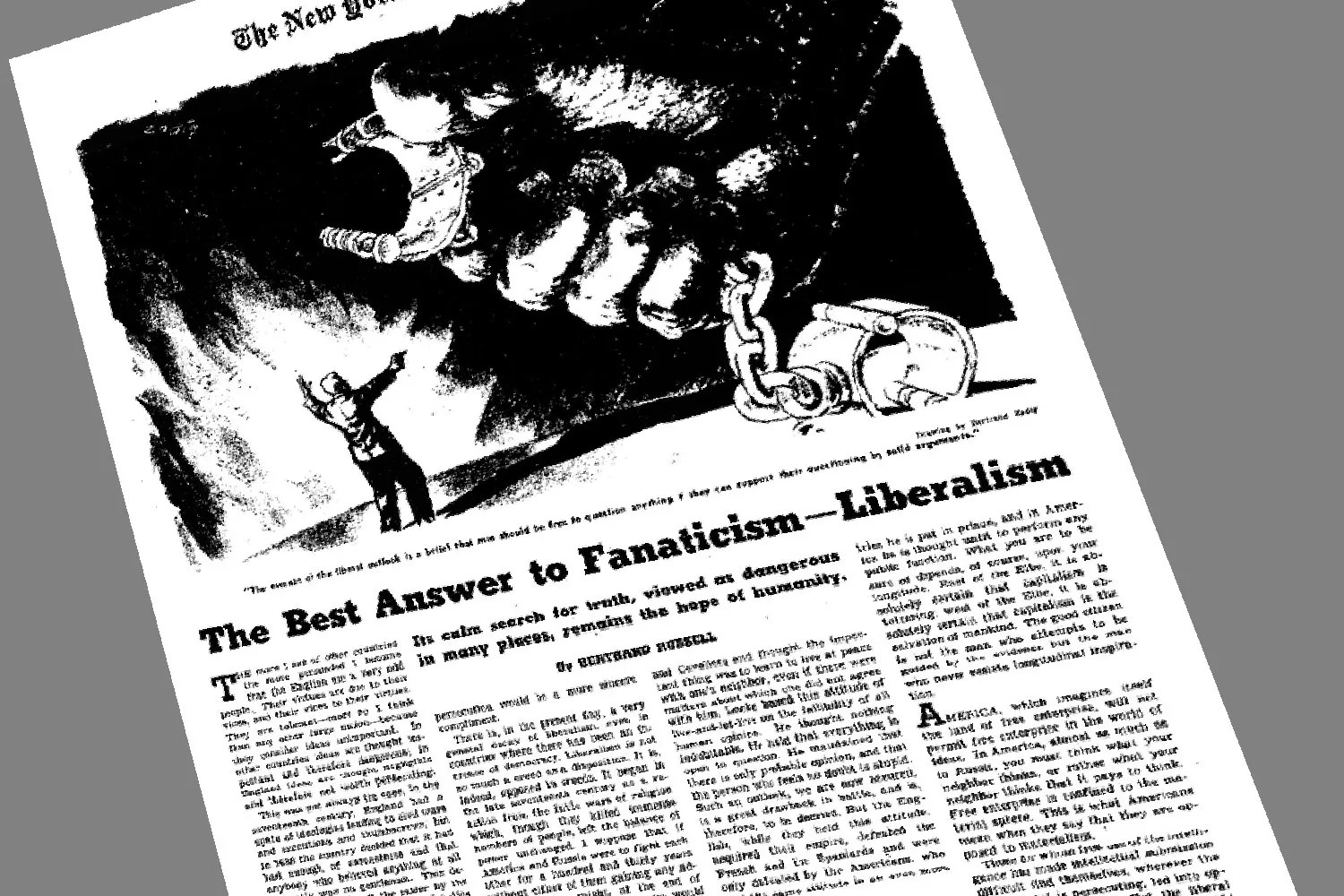
In 1951, British philosopher Bertrand Russell wrote an article titled “The Best Answer to Fanaticism—Liberalism” in The New York Times Magazine.
Sadly, the piece could have easily been written this week. Russell wasn’t advocating for any particular political party or economic system. Instead, he promoted a mindset of intellectual humility, openness to evidence, and tolerance for dissenting views. He saw this approach as humanity’s best defense against fanaticism and authoritarianism.
It concludes with Russell’s “New Decalogue”—ten commandments for a free mind:
1) Do not feel absolutely certain of anything.
2) Do not think it worthwhile to produce belief by concealing evidence, for the evidence is sure to come to light.
3) Never try to discourage thinking, for you are sure to succeed.
4) When you meet with opposition, even if it should be from your husband or your children, endeavor to overcome it by argument and not by authority, for a victory dependent upon authority is unreal and illusory.
5) Have no respect for the authority of others, for there are always contrary authorities to be found.
6) Do not use power to suppress opinions you think pernicious, for if you do the opinions will suppress you.
7) Do not fear to be eccentric in opinion, for every opinion now accepted was once eccentric.
8) Find more pleasure in intelligent dissent than in passive agreement, for, if you value intelligence as you should, the former implies a deeper agreement than the latter.
9) Be scrupulously truthful, even when truth is inconvenient, for it is more inconvenient when you try to conceal it.
10) Do not feel envious of the happiness of those who live in a fool’s paradise, for only a fool will think that it is happiness.


 Travel Between The Pages