
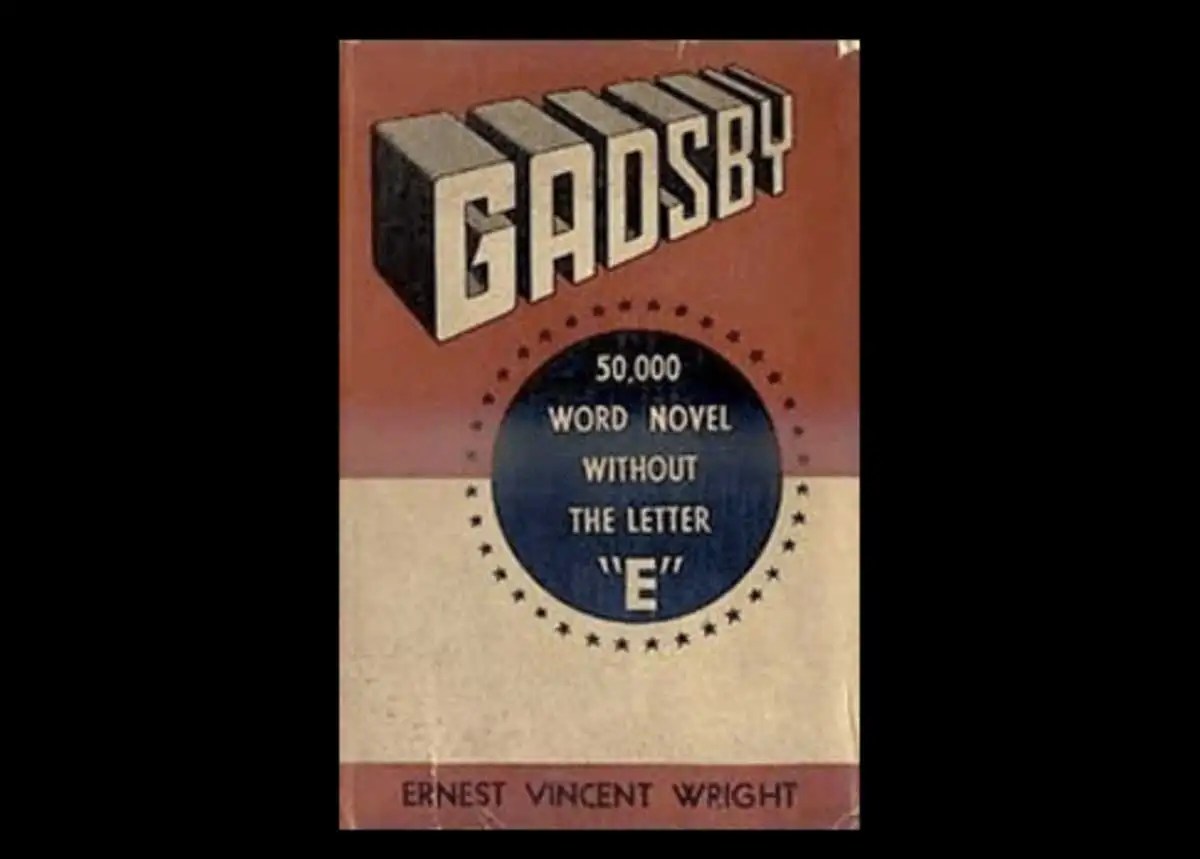
I was today years old when I learned about Ernest Vincent Wright’s 1939 novel written without a single letter e. The 50,000-word self-published book Gadsby tells the tale of a determined 50-year-old who rallies young people to revitalize his dying town of Branton Hills. Wright had to perform linguistic gymnastics to create a book without using the most common letter in English. He couldn’t use simple words like “the,” “he,” or “she.” Numbers one, three, five and everything between six and thirty were off-limits. To write in past tense without “-ed” endings, he relied on creative constructions like “did walk” instead of “walked.” He transformed famous quotes into lipograms. Instead of William Congreve’s original line, “Musick has charms to soothe a savage breast”, Wright writes that music “hath charms to calm a wild bosom.” And Keats’ “a thing of beauty is a joy forever” became “a charming thing is a joy always.”

La Disparition (A Void) is a 1969 lipogrammatic French novel partly inspired by Gadsby that likewise omits the letter “e” and is 50,000 words long. Its author, Georges Perec, was introduced to Wright’s book by a friend of his in Oulipo, a multinational constrained-writing group. Perec was aware from Wright’s lack of success that publication of such a work “was taking a risk” of finishing up “with nothing [but] a Gadsby“. As a nod to Wright, La Disparition contains a character named “Lord Gadsby V. Wright”, a tutor to protagonist Anton Voyl; in addition, a composition attributed to Voyl in La Disparition is actually a quotation from Gadsby.


 Travel Between The Pages
Amazing!
Ah thanks! I love La Disparition, but had completely forgotten the link to this book!