Our perceptual relationship with the world works because we trust prior stories. We could not fully perceive a tree if we did not know (because others have told us) that it is the product of a long growth process and that it does not grow overnight. This certainty is part of our “understanding” that a tree is a tree, and not a flower. We accept a story that our ancestors have handed down to us as being true, even though today we call these ancestors scientists.
No one lives in the immediate present; we link things and events thanks to the adhesive function of memory, both personal and collective (history and myth). We rely upon a previous tale when, in saying “I,” we do not question that we are the natural continuation of an individual who (according to our parents or the registry office) was born at that precise time, on that precise day, in that precise year, and in that precise place. Living with two memories (our individual memory, which enables us to relate what we did yesterday, and the collective memory, which tells us when and where our mother was born), we often tend to confuse them, as if we had witnessed the birth of our mother (and also Julius Caesar’s) in the same way we “witnessed” the scenes of our own past experiences.
This tangle of individual and collective memory prolongs our life, by extending it back through time, and appears to us as a promise of immortality. When we partake of this collective memory (through the tales of our elders or through books), we are like Borges gazing at the magical Aleph—the point that contains the entire universe: in the course of our lifetime we can, in a way, shiver along with Napoleon as a sudden gust of cold wind sweeps over Saint Helena, rejoice with Henry V over the victory at Agincourt, and suffer with Caesar as a result of Brutus’ betrayal.
And so it is easy to understand why fiction fascinates us so. It offers us the opportunity to employ limitlessly our faculties for perceiving the world and reconstructing the past. Fiction has the same function that games have. In playing, children learn to live, because they simulate situations in which they may find themselves as adults. And it is through fiction that we adults train our ability to structure our past and present experience.
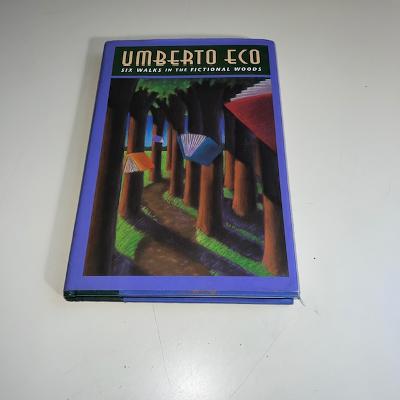
From Umberto Eco’s lecture “Fictional Protocols,” part of Six Walks in the Fictional Woods.


 Travel Between The Pages