
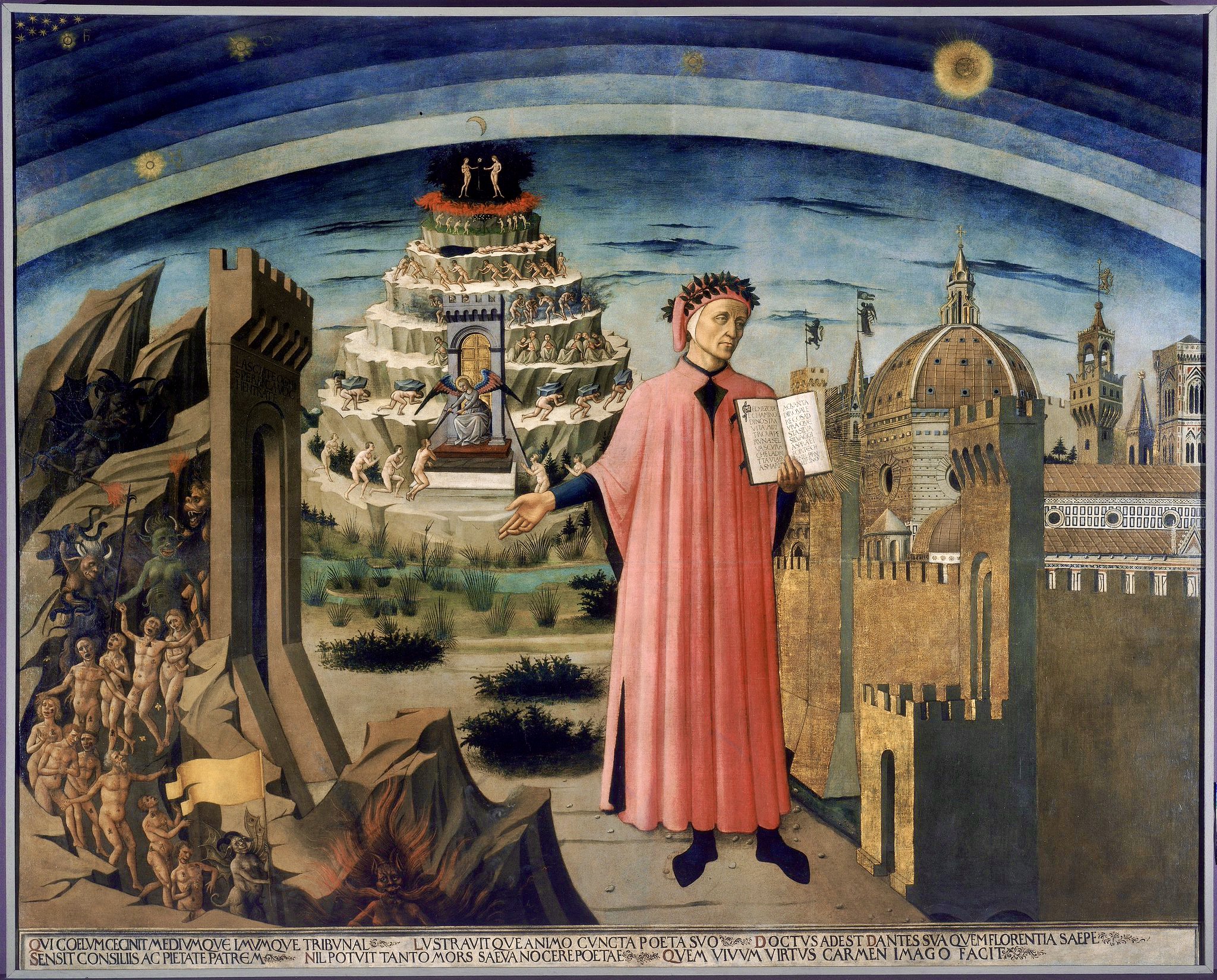
“Inferno I, 32” — Jorge Luis Borges
In the following short story, originally published in 1955, Borges remarks on the use of a leopard in the first canto of The Divine Comedy. What follows is, characteristic of Borges’ short prose, a concise, humorous piece that manages to touch on a variety of unfathomably weighty themes, such as consciousness, belief, authorship, truth, storytelling, etc, etc, etc.
Borges’ story is especially interesting within the context of Literature Humanities because it, I think, points us to a questioning of (among many things) the search for meaning and understanding that carries us through our lives and, not insignificantly, through the texts we engage with. That Borges does this by taking up the fleeting moment of Dante’s sighting a leopard—the moment that begins his journey to the underworld—seems a completely perfect fit and one that I think probably influenced my reading of the first few pages of the Inferno.
Inferno I, 32
From the half-light of dawn to the half-light of evening, the eyes of a leopard, in the last years of the twelfth century, looked upon a few wooden boards, some vertical iron bars, some varying men and women, a blank wall, and perhaps a stone gutter littered with dry leaves. The leopard did not know, could not know, that it yearned for love and cruelty and the hot pleasure of tearing flesh and a breeze with the scent of deer, but something inside it was suffocating and howling in rebellion, and God spoke to it in a dream: You shall live and die in this prison, so that a man that I have knowledge of may see you a certain number of times and never forget you and put your figure and your symbol into a poem, which has its exact place in the weft of the universe. You suffer captivity, but you shall have given a word to the poem. In the dream, God illuminated the animal’s rude understanding and the animal grasped the reasons and accepted its fate, but when it awoke there was only an obscure resignation in it, a powerful ignorance, because the machine of the world is exceedingly complex for the simplicity of a savage beast.
Years later, Dante was to die in Ravenna, as unjustified and alone as any other man. In a dream, God told him the secret purpose of his life and work; Dante, astonished, learned at last who he was and what he was, and he blessed the bitternesses of his life. Legend has it that when he awoke, he sensed that he had received and lost an infinite thing, something he would never be able to recover, or even to descry from afar, because the machine of the world is exceedingly complex for the simplicity of men.
(Borges, trans. Andrew Hurley, Collected Fictions, 323)


