
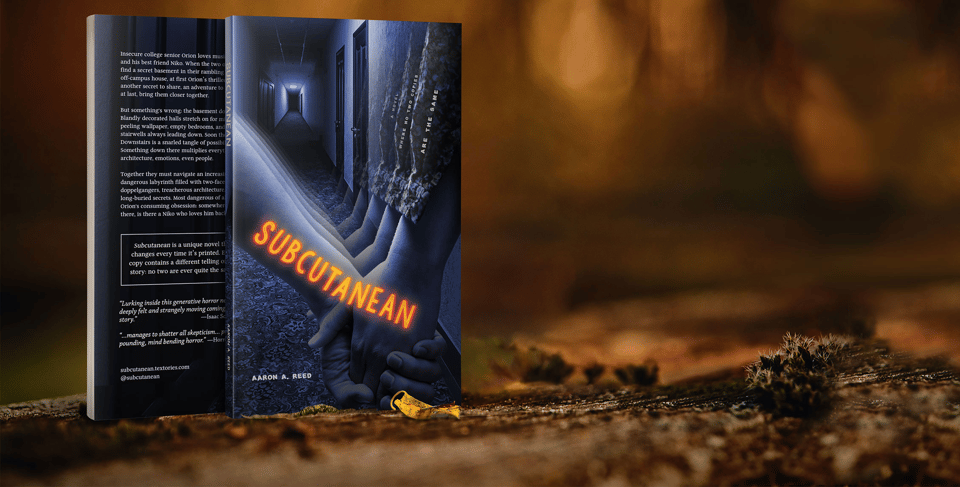
Subcutanean is a coming-of-age horror novel that Aaron Reed published in 2020, which tells of a college senior who discovered a secret basement beneath his house.
The wild thing is that every copy of the novel is slightly different. Reed wrote software that let him slightly change the text on a word-by-word and passage-by-passage level every time he printed a copy for sale.
Don’t expect entirely different novels. Each version of Subcutanean has the same number of chapters, for instance, and each chapter has essentially the same beats: there’s no branching paths or radically alternate endings. You might think of each version as a different draft of the same book. As a data point, my master copy with all possible versions is about 100,000 words long: any particular rendering will contain about 62,000 words.
This is not to say all the changes are purely cosmetic, though. Each of the 17 chapters has at least one major moment that differs from version to version: some versions might include extra scenes or entirely different ones, or have pivotal moments that can play out in meaningfully different ways. Some of these alternates have a 50/50 chance of showing up: others are more rare, maybe appearing in only one book out of ten. All told this makes for several hundred thousand possible combinations of the major variants alone—with countless more once you factor in all the smaller alternates, of which there are generally at least one per paragraph, sometimes far more.
To write the novel, Reed created his own custom markup language — .quant — that let him write a passage while quickly denoting possible word/clause substitutions and their probabilities of being generated. His essay about the process is incredibly interesting. For example, this line can produce either the sentence “In the end, I almost forgave him” or “In the end, I forgave” — which hit in very different ways …


