
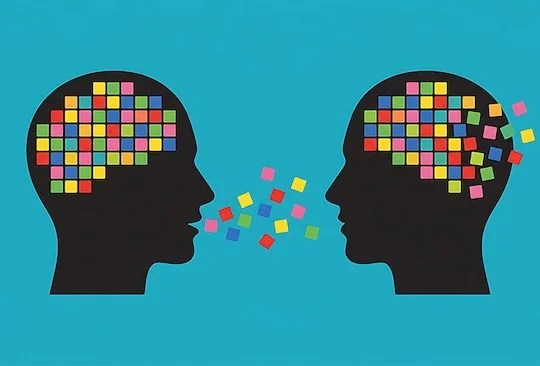
I am terrible at learning languages. Over the years, I’ve struggled to get by with high school French and the bits and pieces of Spanish that I picked up living in South Florida. Before trips, I have crammed traveler’s Greek, Italian, Russian, and even Japanese, but I have never gotten beyond basics. Needless to say, I am in awe of folks who are bilingual or even multilingual. But how do they do it.
Now science may be providing some answers. The article “How do bilingual brains navigate between languages? Scientists discover ‘geometric neural map.’” describes new research just published in Cell, and it begins with the below paragraph:
“Anyone who speaks more than one language knows the feeling of expressing the same thought through entirely different linguistic lenses. A new study by researchers at Rice University and Baylor College of Medicine reveals that the key to this translation ability is a shared geometric map of neural responses in the hippocampus.”
It also discusses how neuroscience and AI may be converging on similar conclusions or underlying principles. This is fascinating research. However, the research was based on only four speakers of English and Spanish. Still, it leaves many questions to consider.
– Does the conceptual map somehow exist independent of language, or is it created with the learning of your first language? I would bet on the latter.
– English and Spanish share Indo-European structure and Latin-alphabet orthography. Does the mapping differ if you have completely different phonetics (e.g., Chinese) or very different grammar (e.g., Japanese)? Only one or the other? Both? If so, is there a threshold for “different”?
– One of the study’s senior authors described the brain as “keeping languages distinct enough to avoid interference.” But that refers to the proposed neural geometry of meaning, not necessarily to every retrieval slip we make while speaking—and multilingual people do mix things up.


Thanks, I do speak several languages, and can read even more. I will read these articles. Even as a very young girl I was attracted by foreign languages, though we only spoke French in my family.I studied 3 foreign languages at school (fairly common fact in France), then taught myself several more.I can read 4 alphabets, and am working on Japanese for reading – I manage the two basic ones, but the kanji learning is a lifetime project, lol.The more languages you learn, the easiest it gets. And once you know 2 alphabets, the easier it gets to read more alphabets as well.The first months I was learning kanji, I could literally feel physically that something different/new was going on in my brain (because basically to learn kanji, you need to work on audio and visual memory at the same time, plus memorize a story/scenario to memorize the design sound and meaning of that kanji, all at the same time). Fun!
You have convinced me to abandon any thoughts of learning kanji before I make a return visit to Japan. I will continue to rely on Google Translate and the Papago app. Ironically, after I published the post on the bilingual brain, It dawned on me that as a child I actually was bilingual; I could read, write and speak Hebrew with some fluency. While I still can read Hebrew, my speaking skills are nonexistent. Use it or lose it as they say.
You actually don’t completely lose it. If you were fluent, it won’t take much for you to reactivate these zones in your brain, and you will be surprised how quickly things come back. I have experienced it myself, and I often do with some of my students who tell me thay haven’t spoken French for years.
Darn, I certainly didn’t plan on discouraging you from learning kanji, it’s so fantasti. The best tool EVER is wanikani: https://www.wanikani.com/
The first chapters are free, so you could try to see how it works.
I did a post on my favorite tools: https://wordsandpeace.com/2023/08/09/my-top-resources-to-learn-japanese/