I am not a Bot (but this is)

The Latest Bot is an online magazine that is compiled fully automatically by a bot. From the choice of subjects to advertisements, to the texts and photos. No human work is involved. According to the creators, it is an experiment on the impact of artificial intelligence on journalism.

I am not a Luddite, but I am uncomfortable with the onslaught of AI bots unsurping the role of journalists, authors, and artists. Still, I am fascinated by the technology and its applications. What do you think?

How it works

“This is a digital publication that utilizes natural language processing technology (openai and chatGPT technologies) to generate written content.

To generate the actual content of the articles, we start with the titles that have been generated by the algorithm. These titles serve as the jumping-off point for the chatbot to create the texts and images that will be included in the articles. To do this, the chatbot will use its natural language processing capabilities to understand the meaning and context of the titles, and then generate written content and images that are relevant and informative for the reader. The result is a fully-formed article that is ready to be published and shared with the magazine’s audience.

Yes, this text is also autogenerated.”
Posted in apps, Tech, Travel Writing, Writing | Tagged , | 3 Comments

As the world turns

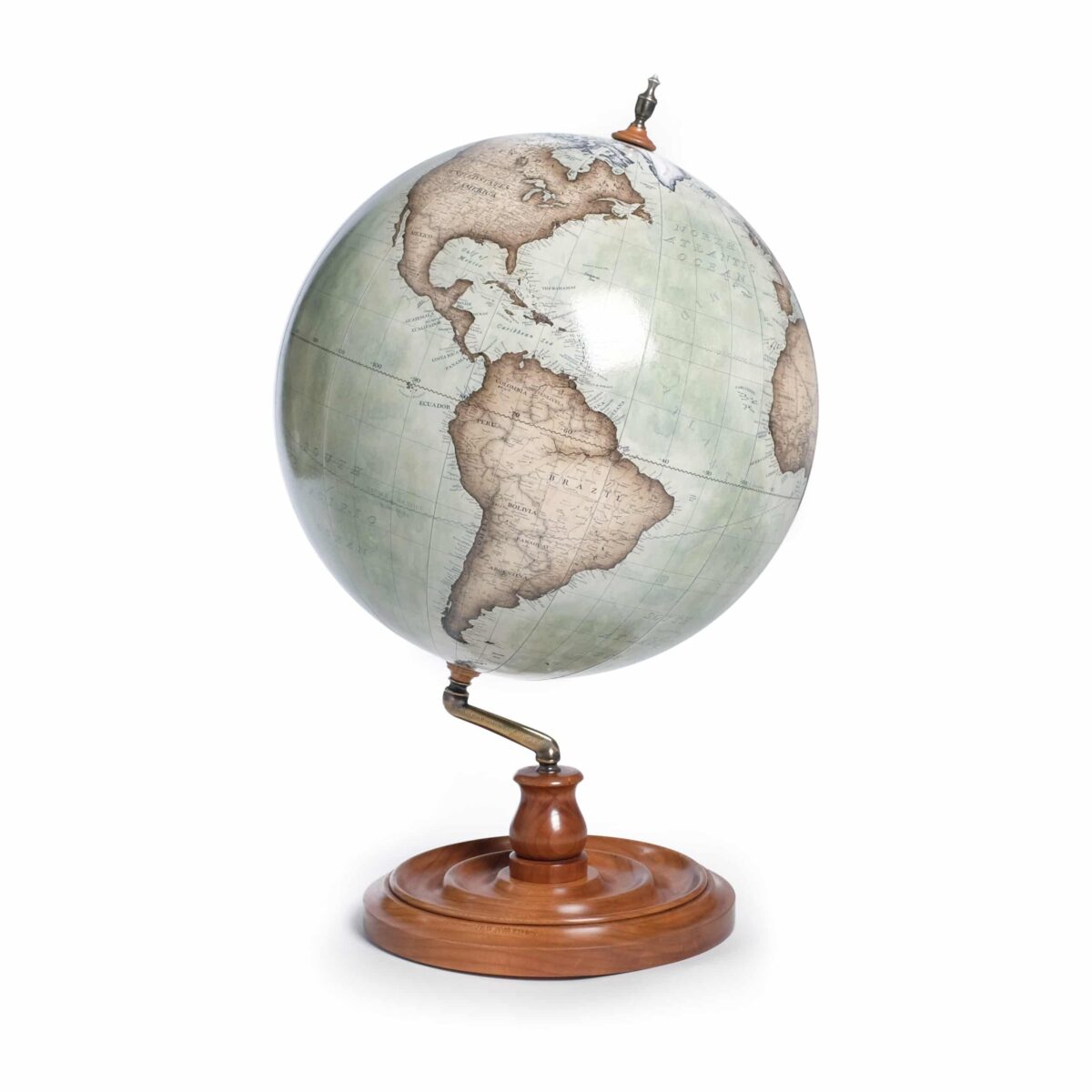
Frequent vistors to Travel Between The Pages are well aware of my life-long fascination with globes and maps. As a young child, I was gifted a small globe much like the one above, albeit much less expensive and detailed, which sat on my bedside table. It was the first thing that I saw each morning and the last that I saw each night. My little globe inspired years of daydreaming about distant lands and a longing for travel. I recently was reminded of my little globe when I ran across a short promotional video (see below) from Bellerby & Co Globemakers.

“…we have a small team of highly trained Globemakers, painters, woodworkers and cartographers, all leaders in their field. Together we create the hand made globes that Bellerby & Co. has come to be recognised for. It is born from a belief that we never compromise. From the wooden and metal bases, to the artwork, the painting and map-making, each piece is expertly crafted using traditional and modern globe-making techniques, and is lovingly produced in our North London studio; each piece is an individual model of style and grandeur and our globes are works of art in their own right.”

https://youtu.be/b17q-NgC7EA

The video is just a vignette.  Here’s the story of Bellerby & Co Globemakers.

Posted in Art, Film, Maps, Tech, Tourism | Tagged , , | 4 Comments

Enough with the GOATs

It’s that time of the year when the faculty of Lake Superior State University releases an annual list of words that they say deserve to be “banished” from our vocabularies over “misuse, overuse and uselessness.”

“Our nominators insisted, and our Arts and Letters faculty judges concurred, that to decree the Banished Words List 2023 as the GOAT is tantamount to gaslighting. Does that make sense?” said Rodney S. Hanley, the university’s president, in a very serious statement announcing the new list.

“Irregardless, moving forward, it is what it is: an absolutely amazing inflection point of purposeless and ineptitude that overtakes so many mouths and fingers,” Hanley added.

Here’s the full list of the school’s banished words for this year:

  1. GOAT
  2. Inflection point
  3. Quiet quitting
  4. Gaslighting
  5. Moving forward
  6. Amazing
  7. Does that make sense?
  8. Irregardless
  9. Absolutely
  10. It is what it is
Posted in Books, USA, Writing | Tagged | Leave a comment

In the midst of hate, I found there was, within me, an invincible love.

On this day in 1960, Albert Camus, French author, philospopher and journalist, died in an automobile accident at age 46. In his coat pocket lay an unused train ticket. Camus had intense Motorphobia (fear of automobiles), and thus avoided riding in cars as much as possible. Instead, he took trains everywhere, as much as he could. He had planned to travel by train with his wife and children, but at the last minute accepted his publisher’s request to travel with him by car. And so it goes.

“In the midst of hate, I found there was, within me, an invincible love.

In the midst of tears, I found there was, within me, an invincible smile.

In the midst of chaos, I found there was, within me, an invincible calm.

I realized, through it all, that…

In the midst of winter, I found there was, within me, an invincible summer.

And that makes me happy. For it says that no matter how hard the world pushes against me, within me, there’s something stronger – something better, pushing right back.”

Albert Camus, The Stranger


Posted in Books, Europe, Public Transport, Writing | Tagged , , , , | 3 Comments

A Library Is A Spaceship

I have been a fan of the wildly imaginative writing of Isaac Asimov since I was a child. Recently I ran across a charming story about the iconic sci-fi author and a letter that he wrote in 1971. He sent the message below to celebrate the opening of a new library in Troy, Michigan. His letter addressed the children of the Troy, Michigan as follows: “Congratulations on the new library, because it isn’t just a library. It is a space ship that will take you to the farthest reaches of the Universe, a time machine that will take you to the far past and the far future, a teacher that knows more than any human being, a friend that will amuse you and console you—and most of all, a gateway, to a better and happier and more useful life.”


Posted in Books, Libraries, USA, Writing | Tagged , | Leave a comment

Running Into A New Year

Running Into A New Year

I am running into a new year
and the old years blow back
like a wind
that I catch in my hair
like strong fingers like
all my old promises and
it will be hard to let go
of what I said to myself
about myself
when I was sixteen and
twentysix and thirtysix
even thirtysix but
I am running into a new year
and i beg what I love and
I leave to forgive me

— Lucille Clifton (1936-2010)

Posted in Books, USA, Writing | Tagged , | Leave a comment

“The Best Things In Life Are Free”

Today copyrighted works from 1927 will enter the US public domain. They will be free for all to copy, share, and build upon. These include Virginia Woolf’s To The Lighthouse and the final Sherlock Holmes stories by Arthur Conan Doyle, the German science-fiction film Metropolis and Alfred Hitchcock’s first thriller, compositions by Louis Armstrong and Fats Waller, and a novelty song about ice cream.

Jennifer Jenkins of Duke University’s Center for the Public Domain has painstaking researched highlights from the coming year’s entrants, including many works of literature that Travel Between The Pages followers may be interested in reading.

  • Virginia Woolf, To the Lighthouse
  • Arthur Conan Doyle, The Case-Book of Sherlock Holmes
  • Willa Cather, Death Comes for the Archbishop
  • Countee Cullen, Copper Sun
  • A. A. Milne, Now We Are Six, illustrations by E. H. Shepard
  • Thornton Wilder, The Bridge of San Luis Rey
  • Ernest Hemingway, Men Without Women (collection of short stories)
  • William Faulkner, Mosquitoes
  • Agatha Christie, The Big Four
  • Edith Wharton, Twilight Sleep
  • Herbert Asbury, The Gangs of New York (the original 1927 publication)
  • Franklin W. Dixon (pseudonym), The Tower Treasure (the first Hardy Boys book)
  • Hermann Hesse, Der Steppenwolf (in the original German)
  • Franz Kafka, Amerika (in the original German)
  • Marcel Proust, Le Temps retrouvé (the final installment of In Search of Lost Time, in the original French)

These are just a handful of the thousands of books entering the public domain in 2023. There is a lot to celebrate: a modernist masterpiece, poetry from the Harlem Renaissance, children’s verses featuring Winnie-the-Pooh and other characters, and early works from Hemingway and Faulkner. Copyright will also expire over Arthur Conan Doyle’s final Sherlock Holmes stories.

You can check out the entire list at the Duke website.


Posted in Art, Books, Film, History, Music, Photography, Theater, USA, Writing | Tagged , , , , | 1 Comment

Hymn to Time

HYMN TO TIME
by Ursula K. Le Guin

Time says “Let there be”
every moment and instantly
there is space and the radiance
of each bright galaxy.

And eyes beholding radiance.
And the gnats’ flickering dance.
And the seas’ expanse.
And death, and chance.

Time makes room
for going and coming home
and in time’s womb
begins all ending.

Time is being and being
time, it is all one thing,
the shining, the seeing,
the dark abounding.

Posted in Books, USA, Writing | Tagged , | Leave a comment

Mystery of the Big Book

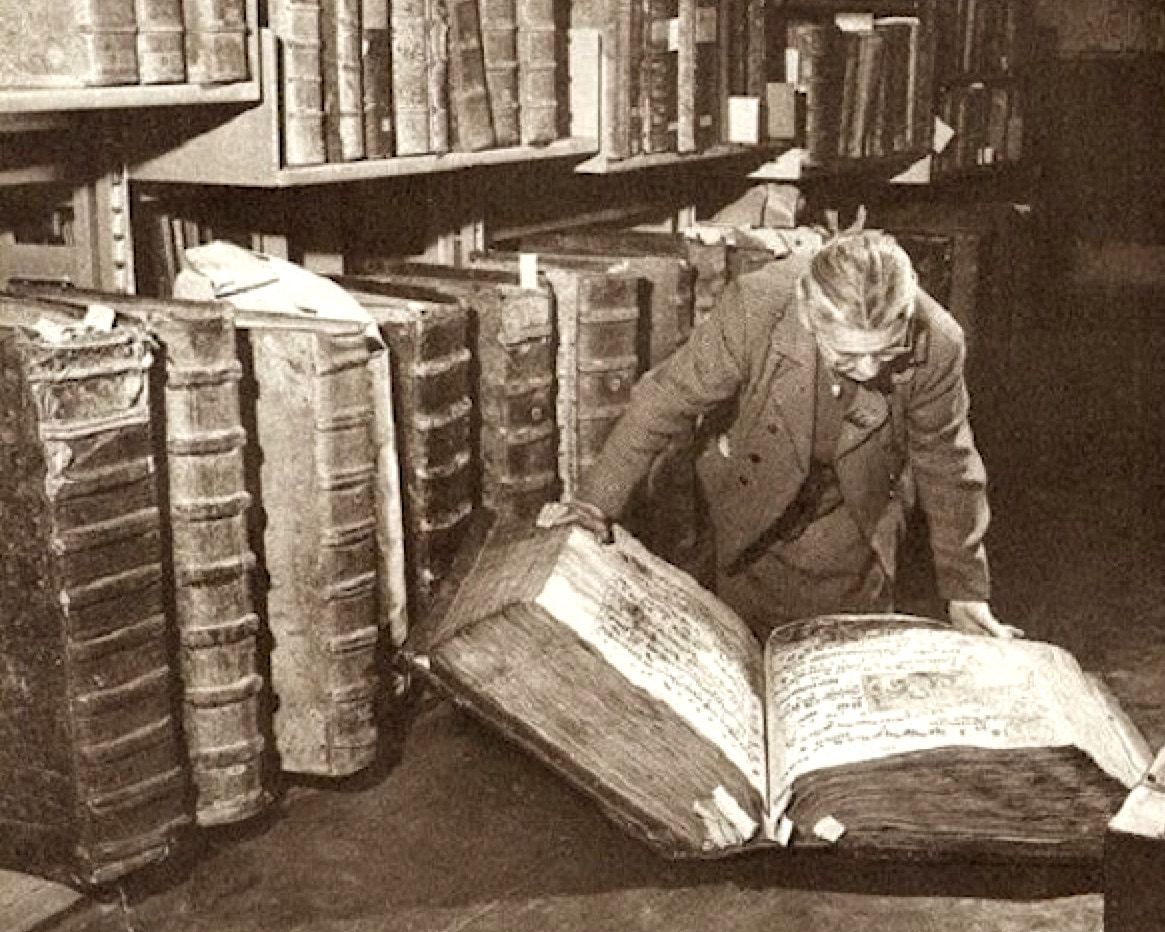
Over the years, the photograph above has appeared on numerous blogs and websites, usually captioned as “man with large book at Prague Castle, 1940s” or “c. 1940s: Man with books.” However, bibliophiles and antiquarians have long questioned the image’s description and sought a more accurate attribution. Well, it seems that the only thing that the original captions correctly identified was the location as Prague.

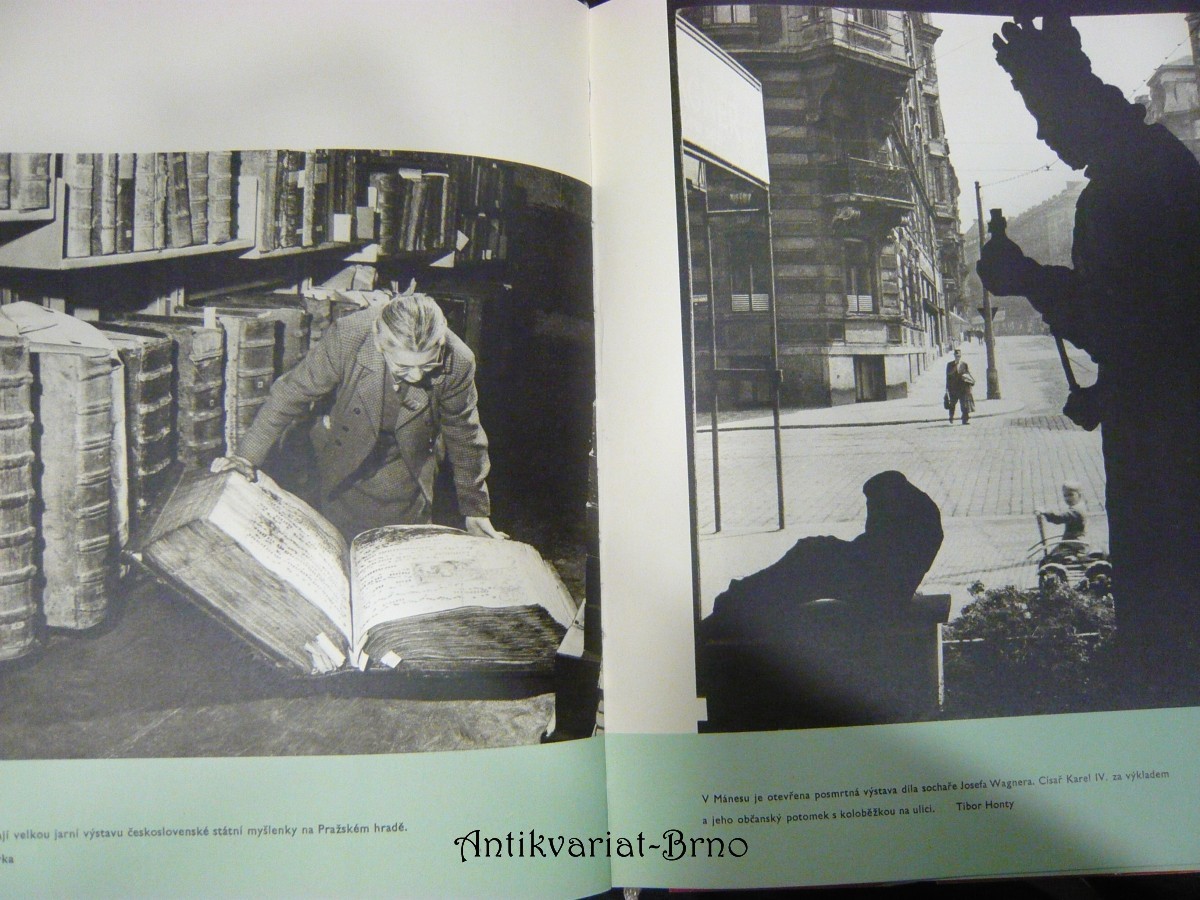
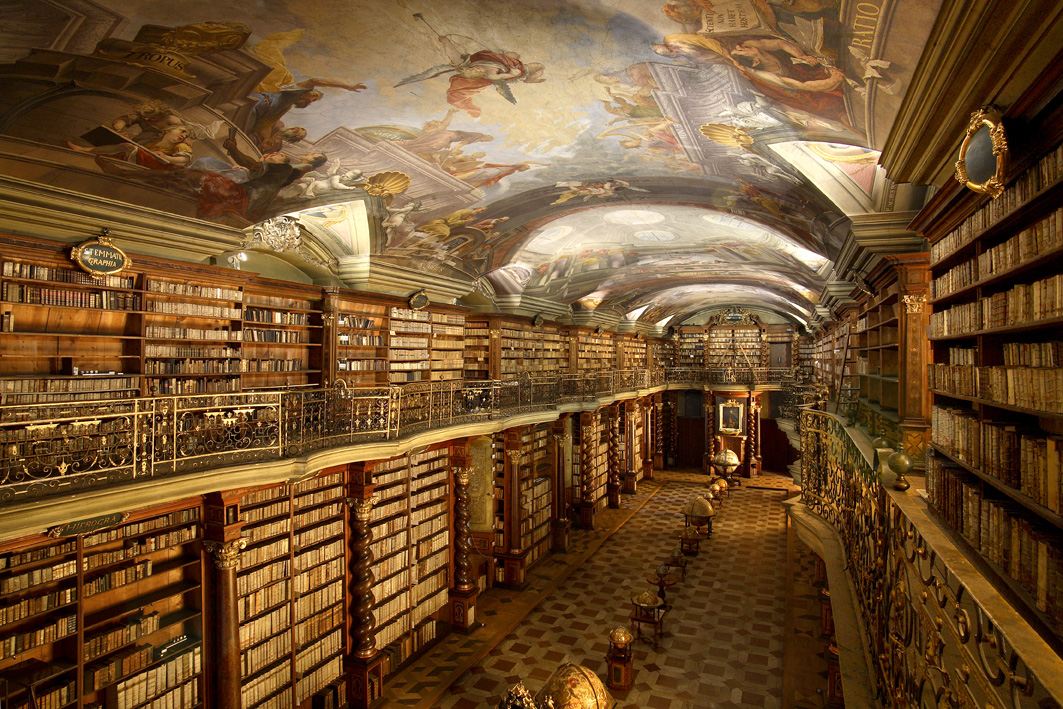
Recently internet sleuths have tracked the first publication of the photo to a Czech publication Fotorok, Volume 58, Issue 1, published in 1959, page 35. The image was taken by a Prague-based photographer named Miroslav Peterka who took the picture at the National Library of the Czech Republic at the Clementinum. Originally the image’s caption read “Archivy chystají velkou jarní výstavu československé státní myšlenky na Pražském hradě.” It translates to “The archives are preparing for a large spring exhibition of the Czechoslovak state idea at Prague Castle.”

While the mystery of the actual location of the photo has been solved, we still don’t know the name of the woman archivist in the image, or if the giant book is still in the beautiful Baroque library, which is a part of The National Library of the Czech Republic.

I would be happy to return to Praha and spend a week or two attempting to solve the remaining mysteries of the big book.

Posted in Architecture, Books, Europe, History, Libraries, Museums, Photography, Uncategorized | Tagged , , , , | 3 Comments

Breaking the Dickens Code

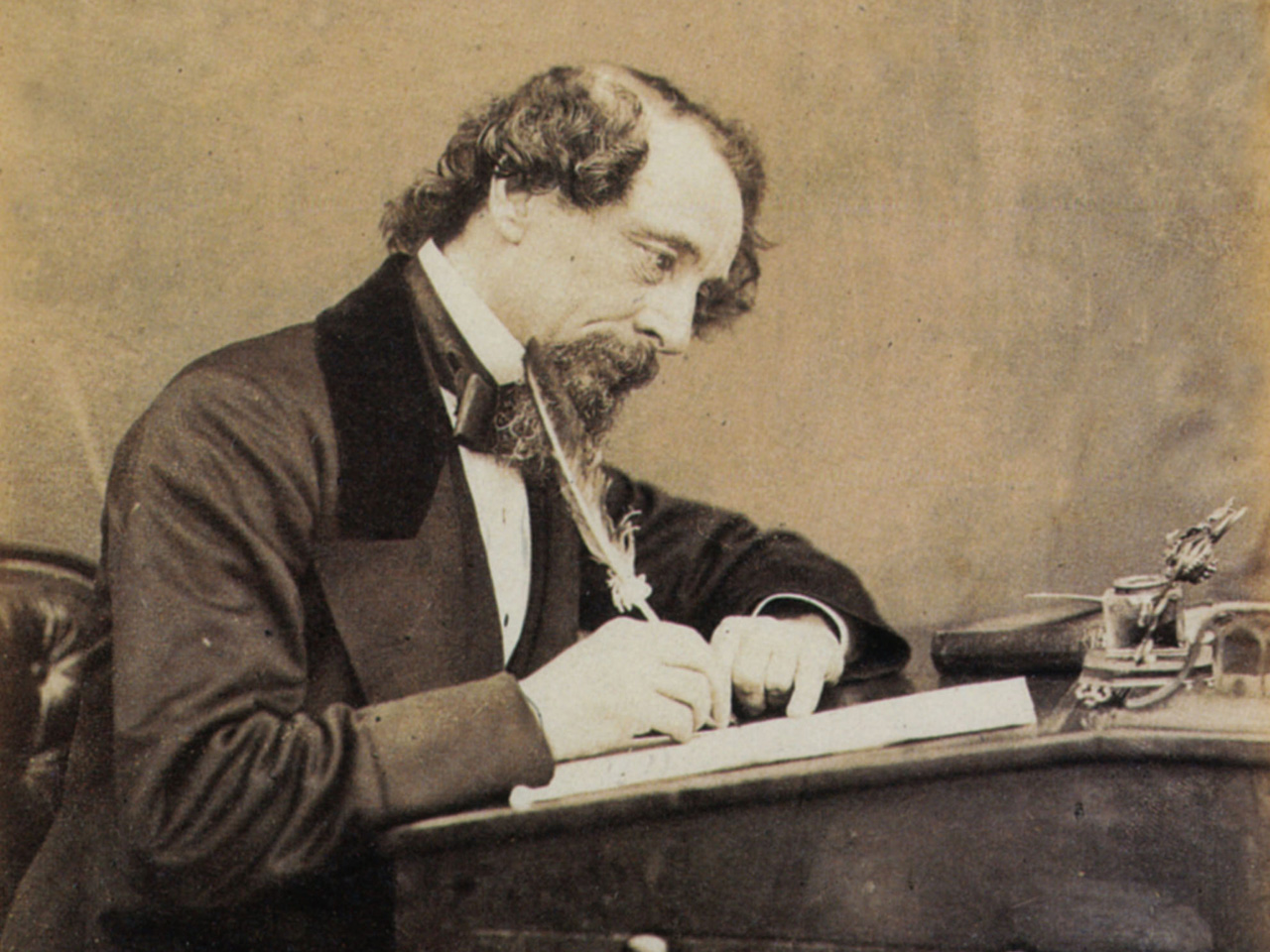
An international campaign to decipher the complex code that Charles Dickens used to write his notes has won a Times Higher Education Award, one of the most prestigious prizes in UK Higher Education.

The University of Leicester, in collaboration with the University of Foggia took home the Research Project of the Year: Arts, Humanities and Social Sciences trophy at the eighteenth annual THE Awards on 17 November.

The THE Awards, widely referred to as the “Oscars of higher education,” attracts  hundreds of brilliant entries from individuals, teams and institutions, and from around the UK and Ireland.

The winner of the award for Research Project of the Year: Arts, Humanities and Social Sciences was the AHRC-funded Dickens Code, led by Dr Claire Wood in the School of Arts in collaboration with Professor Hugo Bowles at the University of Foggia. Charles Dickens is one of the mostly widely read authors in the English language, but there are texts in Dickens’s own hand that remain unread, because they were written in his own form of shorthand. To solve this 150-year-old mystery, they combined the efforts of the Dickens Decoders – volunteers from across the world with an interest in puzzles and codes – with contextual research by academics to enable crowd-created transcription of two of Dickens’s mysterious shorthand texts.

The judges described the project as an “inspirational development of a small-scale research problem”. They were impressed by its “imaginative deployment of interdisciplinary expertise, the international liaison, the use of ‘crowd-creation’ to find solutions, and the exemplary communication and exploitation of results.“It is an exciting model of how localised research can be vividly extended into other domains addressing far-sighted objectives.”

Dr Claire Wood of the School of Arts at the University of Leicester said: “I am beyond thrilled to accept this award on behalf of the Dickens Code team. It is testimony, both to the enduring global interest in Dickens’s life and works, and to the efforts of the Dickens Decoders, who approached the challenges of Dickens’s mysterious shorthand with such imagination and tenacity. It also demonstrates the power of international, interdisciplinary collaboration and the use of public engagement to solve complex research questions. We’d like to thank everyone who has supported the project, including members of our academic network, our museum and library partners, and our followers around the world!”


Posted in Books, Europe, History, Libraries, Writing | Tagged , , | Leave a comment