Ghosts, Goblins and Samurai

Here he goes again blathering on about Japan. Anyway, I ran across this marvelous title that is resplendent with a series of wonderful illustrations by the British artist Evelyn Paul . The impressive  Myths & Legends of Japan, a guide to Japanese folklore was written by F. Hadland Davis and published in London by George G. Harrap.

The hard to find book is available online at the Internet Archive for free. It’s worth a peek even if you are only mildly interested in Japan or Japanese culture. You can also find the title at the Project Gutenberg website where it is described as:

“Myths & Legends of Japan” by F. Hadland Davis is a collection of folk tales and mythical stories, likely written in the early 20th century. The work explores the rich tapestry of Japanese mythology, featuring various deities, legendary figures, and transformative narratives that reflect the culture and beliefs of Japan. Readers will find themselves immersed in fascinating tales that celebrate the gods, spirits, and heroes unique to this enchanting land. At the start of the book, the reader is introduced to the foundational cosmogony of Japanese mythology, describing the primordial state of Heaven and Earth and the creation of the deities like Izanagi and Izanami. This cosmic narrative is followed by a deeper exploration of key figures such as the sun goddess Ama-terasu and her siblings. The opening portion sets the stage for subsequent stories about various legends, including the deeds of heroic figures intertwined with the struggles between good and evil, all while emphasizing the importance of nature and divine influence in Japan’s tradition. Through these tales, Davis brings to life the uniqueness of Japanese cultural heritage and mythos. “

Evelyn Paul’s illustrations strive to balance the traditional elements of ukiyo-e print-making with the watercolor style that was a common feature of illustrated books at this time. The combination doesn’t always work as well as it might—the nebulosity of watercolor painting runs counter to the definition and flatness of woodcut prints—but her illustrations still look more Japanese than European.


Posted in Uncategorized | Tagged , , , | Leave a comment

Summer Reading List

Former President Obama has released his annual summer reading list. On Instagram, he wrote, “Reading has always been an important part of my journey, which is why I couldn’t be more excited that we’ll have a new branch of the Chicago Public Library at the Obama Presidential Center when it opens next year. For now, I figured I’d share some of the books I’ve read recently, along with some notes about why I liked them–and why you might, too. Take a look and let me know what I should check out next.”

Obama’s list:

Mark Twain by Ron Chernow
The Book of Records by Madeleine Thien
King of Ashes by S.A. Cosby
Abundance by Ezra Klein & Derek Thompson
Rosarita by Anita Desai
Audition by Katie Kitamura
The Buffalo Hunter Hunter by Stephen Graham Jones
A Marriage at Sea by Sophie Elmhirst
Who Is Government? by Michael Lewis
The Sirens’ Call by Chris Hayes

Posted in Uncategorized | Tagged , , , | Leave a comment

Denmark is saving bookshops and inspiring readers

I was recently shocked to see many news stories about the dramatic decline in literacy in Denmark. Surveys have shown that reading skills of the nation’s children were in a steep decline. According to the New York Times, the Denmark’s leadership is taking steps to make reading more attractive to its citizens.

Currently, there’s a 25% tax on books, which any reader will tell you was already frigging expensive. It’s one of the highest tax rates on goods in Europe. So, Denmark is axing the tax on paperbacks, folio editions, and every kind of book in between. For funsies, they’ve included digital books in the mix, too:

“The gift of reading and being able to concentrate on a book is something we should give to the younger generations,” Mr. Engel-Schmidt [Denmark’s culture minister] said.

Encouraging people to read, he added, would promote literacy as well as the development of Danish culture. He pointed to worries over the overuse of social media, and said that in some cases, a book could cost more than the monthly charge for a streaming service.


Posted in Books, Bookstore Tourism, Europe, Uncategorized, Writing | Tagged , , , , | Leave a comment

History will vindicate us


Posted in Uncategorized | Tagged , , , | Leave a comment

Book Club for the People

This autumn, the highly respected television network C-SPAN is launching America’s Book Club, a weekly primetime TV series hosted by David M. Rubenstein. C-SPAN will tape America’s Book Club before live audiences at major public libraries and cultural landmarks, including the Library of Congress, the Folger Shakespeare Library, the Enoch Pratt Library, and the National Archives.

Rubenstein is an author, lawyer, co-founder of the Carlyle Group, principal owner of the Baltimore Orioles, former chairman of the Kennedy Center, chairman of the National Gallery of Art and the Council on Foreign Relations, a TV and podcast host, among other positions. He will interview “leading authors, policymakers, business innovators, and cultural figures–exploring the ideas that shaped America’s past, challenge the nation’s present, and inspire our future,” C-SPAN noted. Guests and historic venues for the initial season include:

U.S. Supreme Court Justice Amy Coney Barrett at the Library of Congress
John Grisham at the Library of Congress
Henry Louis Gates at the Library of Congress
David Grann at the Folger Shakespeare Library
Arthur Brooks at the Library of Congress
Walter Isaacson at the National Archives
Stacy Schiff at the National Archives
José Andrés at the Library of Congress

“Books provide the foundation of American ideals, progress, and vision,” said Rubenstein. “Since I was a youngster growing up in Baltimore, books have fueled my imagination and knowledge. I look forward to sharing these ideas with others.”

“C-SPAN is taking an ambitious step forward with America’s Book Club,” said CEO Sam Feist. “We are proud to launch a flagship series featuring guests of the highest stature in American letters and public thought, interviewed by David Rubenstein, a lover of history and an engaging interviewer. This program is a landmark cultural initiative designed to inspire, inform, and engage viewers with the ideas and thought leaders shaping our nation’s future.”

Senior executive producers of America’s Book Club are Peter Slen, who has been senior executive producer of Book TV for nearly two decades; and Marie Arana, author, former editor of the Washington Post Book World, as well as inaugural literary director of the Library of Congress. Brian Rokus, a 25-year CNN veteran, is senior producer on the program.

Posted in Uncategorized | Tagged , , , | Leave a comment

No one should be writing poetry In times like these

HAZARD RESPONSE

Tom Clark

As in that grey exurban wasteland in Gatsby
When the white sky darkens over the city
Of ashes, far from the once happy valley,
This daze spreads across the blank faces
Of the inhabitants, suddenly deprived
Of the kingdom’s original promised gift.
Did I say kingdom when I meant place
Of worship? Original when I meant
Damaged in handling? Promised when
I meant stolen? Gift when I meant
Trick? Inhabitants when I meant slaves?
Slaves when I meant clowns
Who have wandered into test sites? Test
Sites when I meant contagious hospitals?
Contagious hospitals when I meant clouds
Of laughing gas? Laughing gas
When I meant tears? No, it’s true,
No one should be writing poetry
In times like these, Dear Reader,
I don’t have to tell you of all people why.
It’s as apparent as an attempted
Punch in the eye that actually
Catches only empty air—which is
The inside of your head, where
The green ritual sanction
Of the poem has been cancelled.


Posted in Uncategorized | Tagged , | Leave a comment

What makes a book a book

What makes a book a book? Is it just anything that stores and communicates information? Or does it have to do with paper, binding, font, ink, its weight in your hands, the smell of the pages? To answer these questions, Julie Dreyfuss goes back to the start of the book as we know it to show how these elements came together to make something more than the sum of their parts.

I highly recommend this video history lesson from TED Ed: The evolution of the book.


Posted in Uncategorized | Tagged , , , | 1 Comment

Inspired by Miyazaki

In case you were wondering, yes I’m still captivated by all things Japan. The marvelously atmospheric video below was inspired by Hayao Miyazaki’s beloved film Princess Mononoke. Last year, director Steve Atkins took a hike through Yakushima’s forest, which is known to be inhabited by spirits. That walk resulted in this remarkable film of a moss-covered wooded landscape with ancient cedars in abundance.  The haunting soundtrack is  Rob Martland .

Note: If the video doesn’t open in your browser, click HERE .


Posted in Uncategorized | Tagged , , , | Leave a comment

More words for booklovers

A big tip of the hat to TBTP subscriber Joe Coffee (not their real name) who sent this list of book and reading related terms to follow-up the recent post titled “Destroyer of Books”. My fav comes from the late, great Douglas Adams.

ABIBLIOPHOBIA: The the fear of running out of things to read.
BALLYCUMBER: Coined by writer Douglas Adams, “One of the six half-read books lying somewhere in your bed.”
BIBLIOBIBULI: “The sort of people who read too much,” created in 1957 by H. L. Mencken.
BIBLIOGNOST: One who has comprehensive knowledge of books.
BIBLIOKLEPT: One who steals books.
BIBLIOLATER: One overly devoted to books.
BIBLIOPHAGIST: An avid or voracious reader.
BIBLIOPOLE: A dealer especially in rare or curious books
BIBLIOSMIA: An unofficial term for the aroma of a book.
BIBLIOTHERAPY: The practice of using books to aid people in solving the issues they are facing.
BOOKARAZZI: Slang for someone who takes photos of their books and posts them online.
BOOK-BOSOMED: Attributed to Sir Walter Scott, meaning someone who carries a book all the time.
BOOK SHELFIE (and library shelfie): A self-portrait with books that is shared on social media.
EPEOLATRY: The worship of words.
HAMARTIA: Aristotle introduced the word in Poetics to describe the error of judgment which brings about a tragic hero’s downfall.
LIBROCUBICULARIST: A person who reads books in bed.
LOGOMACHIST: One given to disputes over or about words; one given to logomachy.
LOGOPHILE: If you’re a logophile, you already know this means a lover of words.
OMNILEGENT: Reading or having read everything, characterized by encyclopedic reading
PANAGRAM: A short sentence that contains all 26 letters of the English language, as in: The quick brown fox jumps over the lazy dog.
SCRIPTURIENT: Having a strong urge to write.
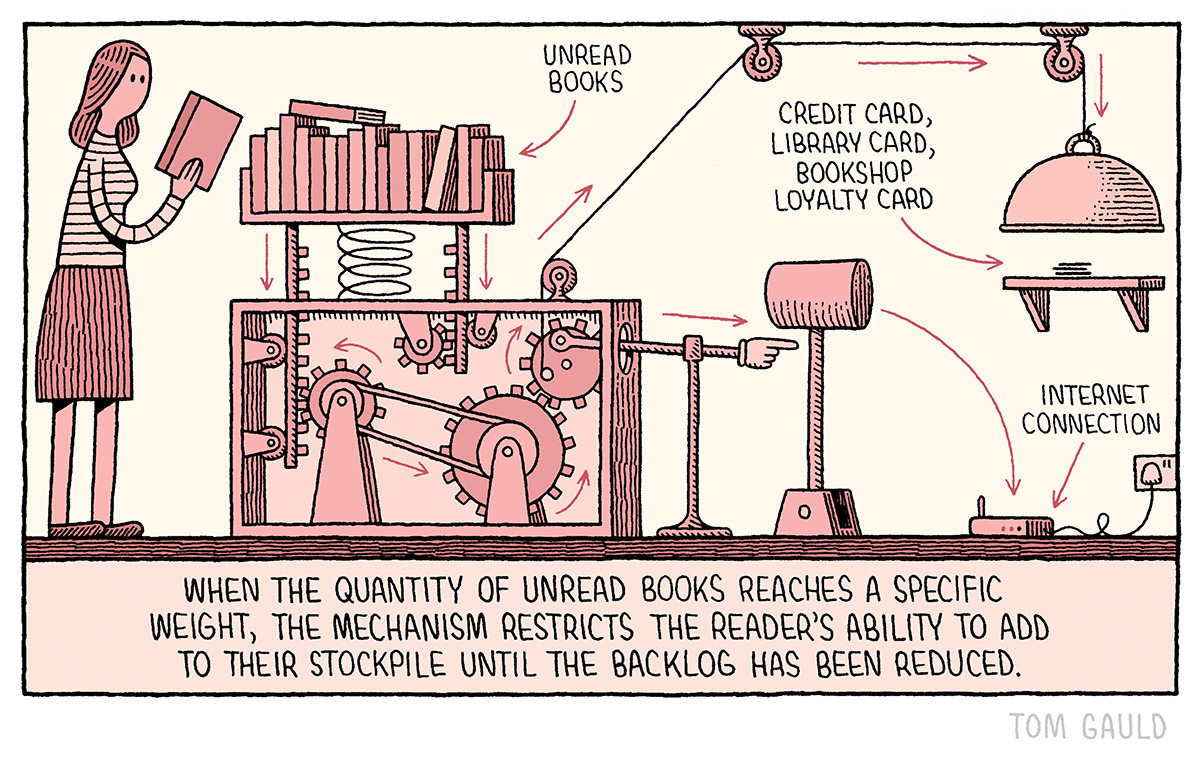
TSUNDOKU: And our favorite, a Japanese word describes piling up books to save for later … even if you’ll never actually read them.

Posted in Books | Tagged , , , | Leave a comment

There is only one way to read

There is only one way to read, which is to browse in libraries and bookshops, picking up books that attract you, reading only those, dropping them when they bore you, skipping the parts that drag — and never, never reading anything because you feel you ought, or because it is part of a trend or a movement. Remember that the book which bores you when you are twenty or thirty will open doors for you when you are forty or fifty — and vice versa. Don’t read a book out of its right time for you.


Posted in Uncategorized | Tagged , , | Leave a comment