I have known the inexorable sadness of pencils,
Neat in their boxes, dolor of pad and paper weight,
All the misery of manilla folders and mucilage,
Desolation in immaculate public places,
Lonely reception room, lavatory, switchboard,
The unalterable pathos of basin and pitcher,
Ritual of multigraph, paper-clip, comma,
Endless duplication of lives and objects.
And I have seen dust from the walls of institutions,
Finer than flour, alive, more dangerous than silica,
Sift, almost invisible, through long afternoons of tedium,
Dropping a fine film on nails and delicate eyebrows,
Glazing the pale hair, the duplicate grey standard faces.
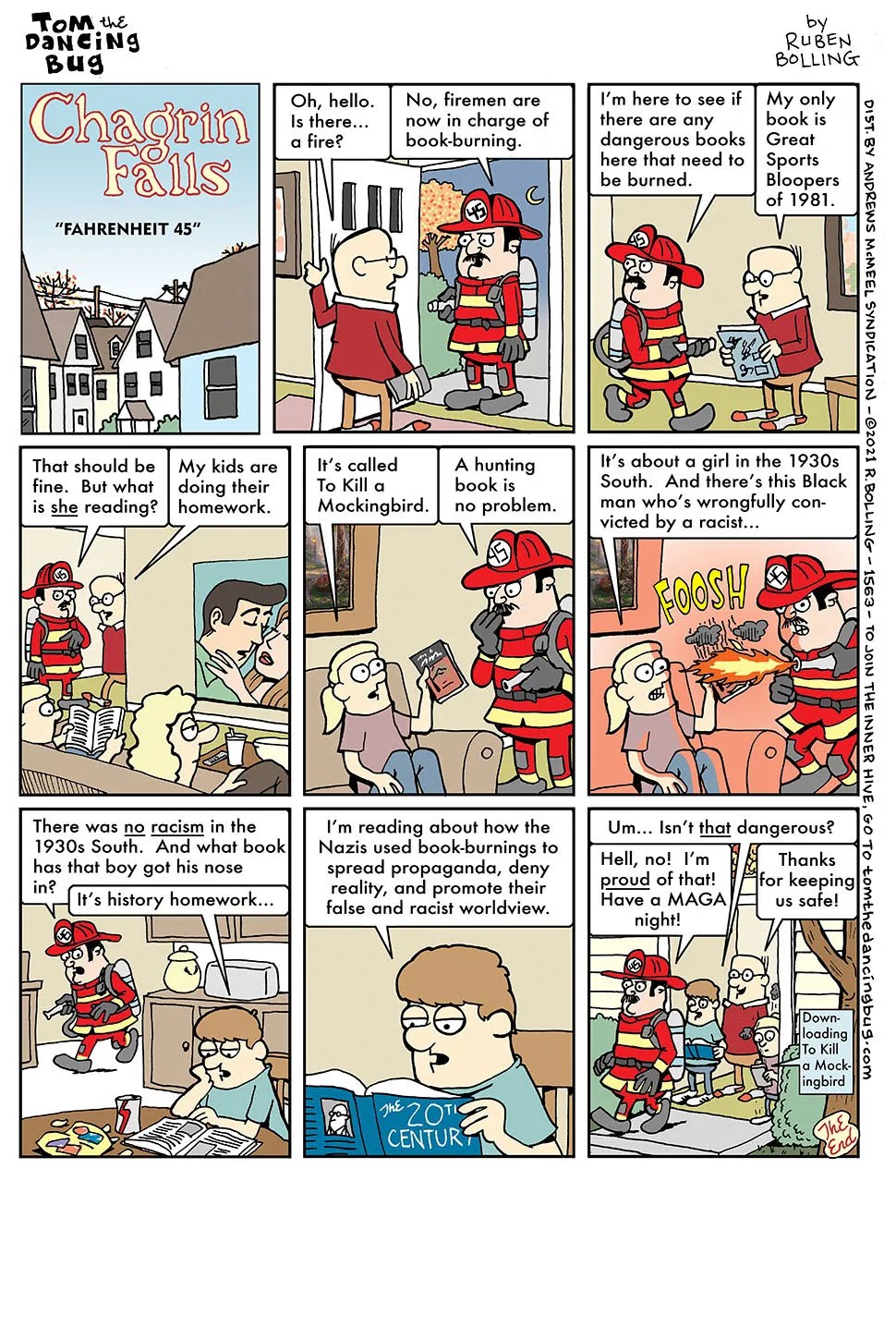
As I have mentioned more than a few times over the years, I was a voracious reader of Ray Bradbury’s novels and short stories as a kid. So, I was excited to see that the American Writers Museum in Chicago is highlighting Ray Bradbury, perhaps best known as the author of Fahrenheit 451 and The Martian Chronicles, online and in-person, now through spring 2022. Check out the excellent introductory three-minute trailer for the exhibition featuring fellow sci-fi and fantasy authors John Scalzi, Rachel Bloom, and Maurice Broaddus below.
NB: If subscribe to TPTP through email, some videos are not showing up in the feed. You can access them by clicking on the blog’s short link at the bottom of your email.
I don’t remember which book that I read first, Of Mice and Men or The Grapes of Wrath, but both had a lasting effect on me and made me a John Steinbeck fan. Over the years, I think that I’ve read every novel and short story that the Nobel Prize-winning author wrote. So, I was quite surprised to read a story this week about the discovery of an unpublished horror novel by Steinbeck.
The book has been “hidden” at the University of Texas in Austin’s Harry Ransom Center, which specialized in archiving literary ephemera, especially from Nobel laureates. According to the Guardian, the book is “Set in a fictional Californian coastal town, Murder at Full Moon tells the story of a community gripped by fear after a series of gruesome murders takes place under a full moon… Investigators fear that a supernatural monster has emerged from the nearby marshes. Its characters include a cub reporter, a mysterious man who runs a local gun club and an eccentric amateur sleuth who sets out to solve the crime using techniques based on his obsession with pulp detective fiction.”
The Steinbeck estate has emphatically stated its lack of interest in its posthumous publication. Personally, I think that millions of readers who were introduced to Steinbeck through his powerful stories and moving characters in high school English classes would jump at the chance to read the horror story. Maybe Hollywood will option the book for a film ? How about a 40s style black and white thriller with 21st century special effects ?
Rooting through my image files I came across this little series of paintings by British artist and illustrator Jonathan Wolstenholme. He is widely known for his amazingly detailed works deriving from a love of old books and of the paraphernalia associated with a bygone age whose hallmarks were finely skilled labor and exquisite craftsmanship in the production of all manner of objects.
A map indicating the state of the union may
Yield the statues, static & statutes of grave
White men while a map indicating disrepair may
Yield colorful groundbreakers uprooting graves.
A map indicating the state of your affairs may
Include only the business of your accountant
If you are able to steer clear of laissez-faire—may-
Be let’s not take that road down the mountain.
A map indicating states of arousal may
Also be a map few people find useful
Though the people who feel this way may
Also be people in a state of denial.
A map indicating a state of inertia may
Be indistinguishable from a map
Indicating a state of flux. The route may
Lead you in circles around the map.
A map indicating a state-of-the-art May-
Bach may feature what could be mistaken
For peace signs or tiny wheels making
Their way across a larger map that may
Indicate a state of grace under fire or may
Indicate a state of emergency exit, a route
Which may divide at forks in the road or may
Multiply at crossroads leading you out
Into a light so bright & constant you may
Have to wear a cap & shades indoors
Like brothers who know as much about May-
Bachs as Bach pursuing cultural studies or
The mother tongue of New York, they may
Wear peace signs on their shoulders
Traveling states of aggression that may
Actually be states of preservation or
Distress. A map indicating a state of war may
Actually be a map indicating a state
Of weariness. Let your eyes fall where they may
On the map indicating your state.You may wander the states of wonder indicated
By the many unmarked areas along the map.
Almost anything you see is a map in some way.
Let your eyes fall where they may on the maps
Terrance Hayes’s most recent publications include American Sonnets for My Past And Future Assassin (Penguin 2018) and To Float In The Space Between: Drawings and Essays in Conversation with Etheridge Knight (Wave, 2018). To Float In The Space Between was winner of the Poetry Foundation’s 2019 Pegasus Award for Poetry Criticism and a finalist for the 2018 National Book Critics Circle Award in Criticism. American Sonnets for My Past And Future Assassin won the Hurston/Wright 2019 Award for Poetry and was a finalist the 2018 National Book Critics Circle Award in Poetry, the 2018 National Book Award in Poetry, the 2018 TS Eliot Prize for Poetry, and the 2018 Kingsley Tufts Poetry Award. Hayes is a Professor of English at New York University.
Last week, Viking announced that this year—which happens to be the 60th anniversary of the publication of John le Carré’s first novel, Call for the Dead—they will publish the late writer’s twenty-sixth, and likely last, novel, Silverview.
Silverview will be released on October 12, 2021, during the week that would have been le Carré’s 90th birthday. It is reportedly the only complete novel that was still unpublished when the iconic author died last December.
The Viking describes the novel, which is set in contemporary Britain, as “a brilliantly conceived novel about the tension between personal and political loyalty. It interrogates the concept of moral goodness in the face of public duty.
Brian Tart, John le Carré’s publisher and editor at Viking Penguin, said, “Silverview is a brilliant novel and thrilling reminder of the genius of John le Carré. His inimitable voice is on every page, and I am so pleased that readers everywhere will be able to hear it once again.”
This life-long fan sees the publication as a gift from the master of espionage fiction. I’m looking forward to the read.
By now nearly every human being on the planet has seen one version or another of the iconic painting above. What do most of us really know about this sublime work of art ? When woodcut artist Katsushika Hokusai made his famous print The Great Wave off Kanagawa in 1830 — part of the series Thirty-six Views of Mount Fuji — he was 70 years old and had lived his entire life in a Japan closed off from the rest of the world. In the 19th century, however, “the rest of the world was becoming industrialized,” James Payne explains below in his Great Art Explained video, “and the Japanese were concerned about foreign invasions.” The Great Wave shows “an image of Japan fearful that the sea — which has protected its peaceful isolation for so long — would become its downfall.”
I was saddened to read that mystery writer and editor Marvin Kaye died on May 13, 2021 at the age of 83. Edward Gorey created wonderful wraparound dust jacket cover designs for eight of the numerous anthologies Kaye produced.