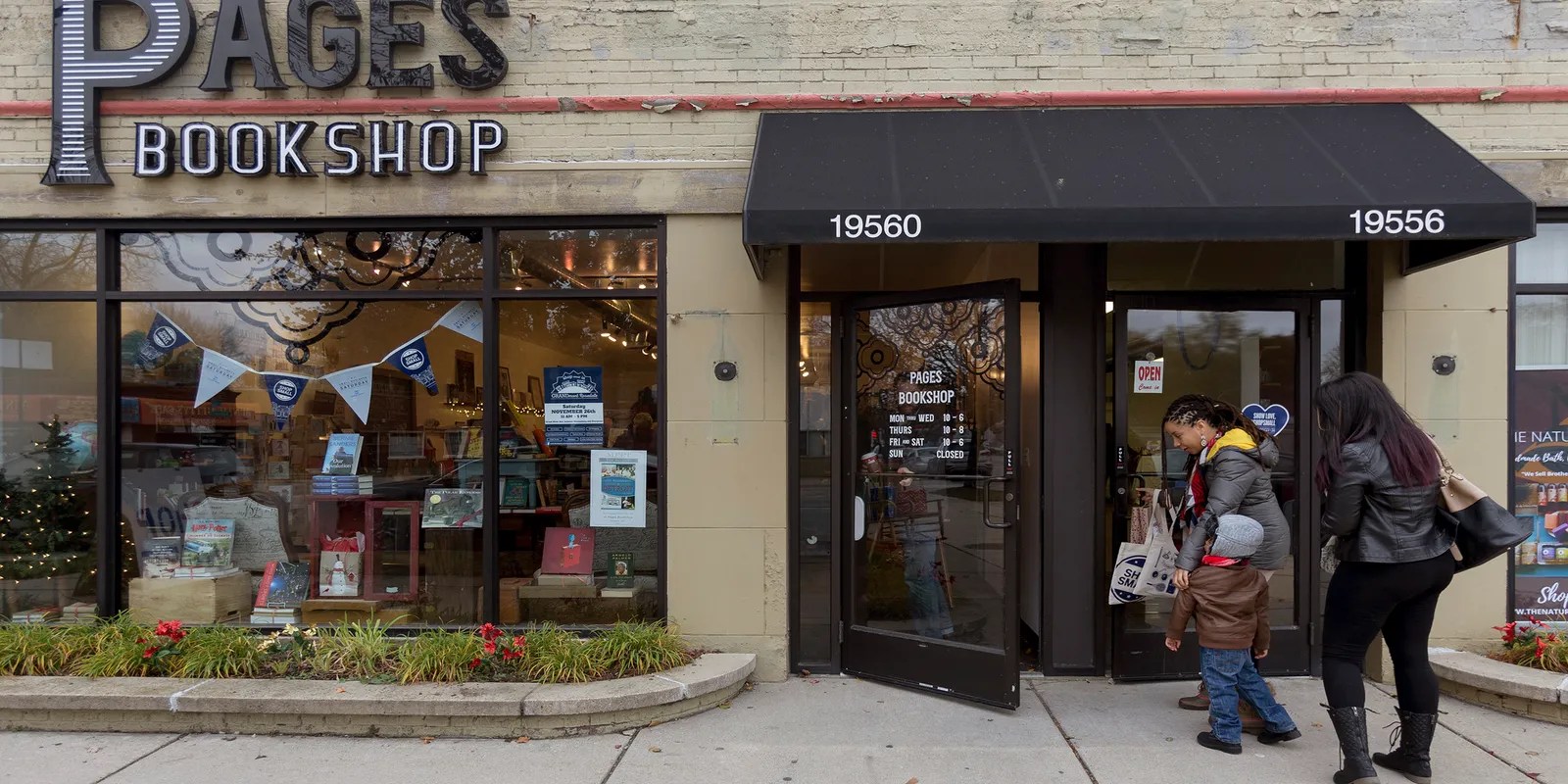
Community Spirit

A big shout out to TBTP follower Linda T. who took time out from packing for a 14 hour flight to let me know about this heartwarming story. On April 13, a 300-strong volunteer book brigade helped Serendipity Books, Chelsea, Mich., move 9,100 books and hundreds of boxes in just under two hours.

Owner Michelle Tuplin told the Sun Times News: “I know the Chelsea community is strong, and Serendipity Books enjoys a central space in that community but to see what that means in action, to see people come together, to hear the laughter and the singing and the new conversations, to see friendships springing up as people chatted about the books they passed, it was a sight to behold for sure. Home is where we make it and Chelsea is our home.”


Posted in Books, Bookstore Tourism, USA | Tagged , | 3 Comments

Little Free Penguins

The UK’s largest book publisher has announced plans to install dozens of mini-libraries across the country as part of its 90th birthday celebrations.

The project from Penguin Books will see 90 ‘Little Book Stops’ installed across the UK, with online nominations now open to the public. The publisher teams up with US-based Little Free Library, which has installed more than 200,000 book exchange boxes around the world since 2009.

The 90 Little Book Stops will feature a bespoke Penguin design and be installed with an initial curation of children’s and adult books, specially selected to celebrate 90 years of Penguin publishing. A local steward will be appointed to maintain each Little Book Stop, which run on a ‘give a book, take a book’ concept and promote community-led book sharing.

The organisers are now seeking suggestions from the public as to where the Little Book Stops should be located. Individuals and organisations who would like one in their area, are encouraged to apply, and a wide range of locations, including unique and unusual options, will be considered.

Applicants will have to answer four key questions:

  1. Why is book access important at this location?
  2. How do you expect a Little Book Stop will change this community?
  3. How will you plan to look after the Little Book Stop as a steward?
  4. Does this Little Book Stop aim to celebrate a local individual or organisation that champions reading?

Applications are open until the 1st May and will be reviewed by a panel featuring staff from both Penguin and Little Free Library. Judges will be asked to look for applications that demonstrate the positive impact a Little Book Stop could have on the local community and why spreading the joy of reading is important to the person applying. The panel are also looking for a diversity of locations across England, Northern Ireland, Scotland and Wales.

Last year, Penguin donated book vending machines to schools, including Linlithgow Academy, as part of the publisher’s Lit in Colour campaign.

Rebecca Sinclair, Chief Brand Officer at Penguin, said:

“Widening access to books is at the heart of Penguin’s origin story with the launch of the first ten Penguin paperbacks and shapes our mission today.  Books and reading are a wonderful way to build connections and create communities and we hope that our 90 Little Book Stops will enable that in the locations lucky enough to have one.  We’re excited to work with a community of stewards to connect books with readers and to champion the ongoing power of reading.”

Greig Metzger, Executive Director at Little Free Library said: “We are honoured to help celebrate Penguin’s 90th anniversary with the installation of 90 Little Book Stop boxes across the UK. We believe everyone has the right to read, and we hope these book-sharing boxes will build community, inspire readers, and expand book access where it is needed most. We look forward to welcoming these new locations to the global Little Free Library network.”

Those interested in nominating their local area for a Little Book Stop can find out more and apply via this link: https://www.penguin.co.uk/discover/campaigns/90-little-book-stops

via The Herald


Posted in Books, Europe | Tagged , | Leave a comment

More Indie Bookstore Celebrations

Canadian independent booksellers are celebrating Independent Bookstore Day, a tradition that began in 2018 with the first Canadian Independent Bookstore Day that has aligned with the U.S. version since then. CIBD developed from Authors for Indies Day, which began in 2015.

More than 300 Canadian bookstores are participating this year and will offer a variety of celebratory activities that are similar to what’s being offered in the U.S., including customer giveaways, discounts, exclusive products, author events, and more.

Exclusive giveaways from publishers include “shop local” sticker sheets from Penguin Random House Canada, bookish zines from Biblioasis, World of Munsch sticker sheets from Scholastic Canada, Murdle: By the Book mystery activity booklets from Macmillan Publishers & Raincoast Books, CIBD chocolate bars from HarperCollins Canada, activity books, bookmarks, postcards, and more. (A few of the exclusives are offered by U.S. bookstores, too.)

This year’s celebration again features the Contest for Book Lovers, under which people who purchase books at a Canadian Independent Booksellers Association store on April 26 can enter a drawing; prizes include four C$200 (about US$140) gift cards and a grand prize C$1,000 (US$700) gift card to a bookstore of the winner’s choice. Each book purchased is worth one entry, and books written or illustrated by Canadians are worth double.

Canadian authors are as excited by and supportive of Canadian Independent Bookstore Day as booksellers and publishers, especially at a time when Canada’s neighbor to the south isn’t acting very neighborly. The Canadian Independent Booksellers Association highlighted “Authors Love Indies,” featuring Canadian authors expressing their appreciation for independent bookstores.

For example, Louise Penny wrote, “Canadian indies made my career. Without the support of independent bookshops, including Brome Lake Books in my own village, there’s no way there would be 18 Gamache books. That’s why it was the first thing I created in Three Pines. Myrna’s Bookshop. Beyond that, as a reader, it’s where I choose to spend time. Is there anything better than wandering the shelves of a Canadian independent bookstore?”

 Bookstore Day idea is growing beyond North America in a huge way. Booksellers from around the world have organized the Global Book Crawl, which will take place for the first time April 21-27 and include hundreds of stores on six continents. Organizers included Jessica Stockton Bagnulo, owner of Greenlight Bookstore and Yours Truly, Brooklyn.

Each city or region designs its own crawl. The countries with the most participating bookstores are Australia, Ireland, Switzerland, and the U.S. The areas in the United States that are part of Global Book Crawl include Atlanta, Ga., Brooklyn, N.Y., Cape Cod, Chequamegon Bay in Wisconsin, Louisville, Ky., Oklahoma City, Okla., Puget Sound in Washington, Queens, N.Y., San Gabriel Valley in California, and Washington, D.C.

Posted in Books, Bookstore Tourism, Canada, Europe, Tourism | Tagged , , , , | Leave a comment

Celebrate Indie Bookstores

Nearly 1,500 bookstores across the U.S., the most ever, will participate in the 12th annual Independent Bookstore Day, which takes place Saturday, April 26. The stores will celebrate with a variety of creative, welcoming events, merchandise, food & drink, merriment, and more, all reenforcing connections between the stores and their communities.

As American Booksellers Association CEO Allison Hill puts it, “Independent Bookstore Day is one of my favorite days of the year. The collaboration between independent bookstores, the spirit of community with their customers, the support for small businesses, the celebration of books and authors and illustrators–these are the things I love about our industry year round but it’s nice to have a day to celebrate all that the indies represent in the world.”

Courtney Wallace, ABA’s marketing manager and Independent Bookstore Day program director, added, “Independent bookstores continue to elevate their creativity and community engagement, making this twelfth year of Independent Bookstore Day our biggest celebration yet. With many stores expanding their festivities beyond a single day, it’s clear that indie bookstores are vital hubs that bring people together and shape the heart of their communities.”

map that shows participating bookstores and includes information about bookstore passport programs will appear soon on IndieBound.org.

Posted in Books, Bookstore Tourism, USA | Tagged , | Leave a comment

O Canada


It seems like an opportune moment to feature some classic Canadian travel posters. Stylish posters along with tourism  brochures were produced by Canadian Pacific for its network of railways, steamships, airlines, and hotels. They were generally well designed—and frequently quite fetching. This should come as no surprise considering the caliber of artists the company employed, although not all of CP’s artists were necessarily widely acclaimed. The company also hired artists who worked in near anonymity at the time, and about whom even less is known today.

Posted in Art, Canada, Tourism, Travel Writing, Uncategorized | Tagged , , | Leave a comment

Found in translation

I am usually ambivalent about literary prizes, although like a good hypocrite I mine the lists for reading suggestions. Somehow I missed the announcement for this year’s International Booker Prize and was surprised to discover that I had read three of the six nominees.


Launched in 2005, the International Booker Prize was originally given to an author for their life’s work, but since 2016 has been awarded to a single book translated into English and published in Britain or Ireland. It comes with prize money of £50,000, about $64,000, which the winning author and translator share equally.

The six books include Solvej Balle’s “On the Calculation of Volume: 1” about a bookseller who relives the same day over and over again. “Under the Eye of the Big Bird,” by Hiromi Kawakami, translated from Japanese by Asa Yoneda: a series of interconnected stories set in a dystopian future, in which the only remaining humans are produced in factories. Vincenzo Latronico’s “Perfection,” translated from Italian by Sophie Hughes, about an expatriate couple living in a hip Berlin neighborhood and struggling to engage with life outside their bubble.

Also the three that I haven’t read: “Small Boat” by Vincent Delecroix, translated from French by Helen Stevenson: a fictionalized retelling of the 2021 sinking of a migrant boat that capsized on the journey from France to Britain, leading to 27 deaths. “Heart Lamp” by Banu Mushtaq, translated from Kannada, a language spoken in southern India, by Deepa Bhasthi: a collection of short stories about Muslim women in India and dealing with family and community tensions. And, “A Leopard-Skin Hat” by Anne Serre, translated from French by Mark Hutchinson: a novel about the relationship between an unnamed narrator and an anguished friend.

The judges will announce a winner on May 20 during a ceremony at Tate Modern in London.

Posted in Books, Writing | Tagged , | Leave a comment

Tout le monde aime la Tour Eiffel

I’m always chuffed to run across a copy book that I sold many years ago in a random blog post. in this case, the book in question is Les Tours Eiffel de Robert Delaunay : poèmes inédits / [Guillaume] Apollinaire. It was originally printed in an edition of 1,150 in Brussels in 1974. 

This work features artwork created by Robert Delaunay (1885-1941), along with previously unpublished poems by renowned and influential poets of the early 20th century. It includes a preface by Jean Cassou (1897-1986), the first director of the National Museum of Modern Art in Paris, who was also a French art critic and poet.

Some of the poets in this collection are notable for their ties to surrealism. French writers and poets André Breton (1896-1966) and Philippe Soupault (1897-1990) co-founded the Surrealist movement, aiming to explore the unconscious mind and challenge the conventional boundaries of art and literature. Guillaume Apollinaire (1880-1918) is regarded as one of the leading poets of the 20th century and is credited with coining the terms “Surrealism,” “Cubism,” and “Orphism,” showcasing the intersection of visual art and poetry in contemporary movements. Louis Aragon (1897-1982), a French novelist, editor, and poet, was one of France’s prominent voices in the Surrealist movement and was deeply involved in both literature and political activism, often reflecting these themes in his works.

Other notable poets included in this collection are Jean Arp, known for his contributions to both Dada and Surrealism; Blaise Cendrars, whose adventurous spirit and modernist style reshaped poetry; Tristan Tzara, a founder of Dada who sought to disrupt traditional artistic norms; Joseph Delteil, whose work often focused on the themes of nature and humanity; and René Crevel, whose works often depicted existential themes.

Robert Delaunay (1885-1941) was a French artist who co-founded the Orphism art movement, which emphasized the use of color and light to evoke emotion and create a sense of movement. Guillaume Apollinaire noted the musical quality in Delaunay’s work, coining “Orphic Cubism” or “Orphism.” This name draws inspiration from the Greek god Orpheus, renowned for his ability to captivate animals with enchanting music played on the lyre. Delaunay saw the Eiffel as a symbol of modernity and masculinity. He was among the first artists to focus his work on this iconic landmark, portraying it numerous times in his work, including his famous series of paintings that capture its dynamic forms and colors.

via


Posted in Architecture, Art, Books, Europe, Tourism, Travel Writing, Writing | Tagged , , , | 1 Comment

New York’s Secret Gem

Today marks the official re-opening of one of New York City’s finest art museums after a nearly five year closure for renovation. While the Frick Collection may not be a secret to the city’s art lovers, most visitors to NYC don’t seem to know that it exists.

Once residence to the robber baron Henry Clay Frick (1849-1919), the museum has been undergoing a $220 million renovation and expansion, inside and out. Frick assembled the core collection over a brief few decades, and gifted it to the public. It also celebrates, like many art museums, the complicated power of private wealth. (Frick’s benevolent populism had serious limits; he is notorious in the annals of American labor as an adamant anti-unionist.)

The Frick is an impressive “house” museum, which is much more accessible than the grand Met. In 1935, when the house opened as a museum, it officially transitioned to a monument, one that has been added to more than once over the years.

The renovation, designed by Selldorf Architects with Beyer Blinder Belle Architects and Planners, which includes a two-level reception hall, a coat check, and cafe, and Special Exhibition galleries, where a three-picture blockbuster titled “Vermeer’s Love Letters” will debut in June.


Personally, I always go to the Frick for the Vermeers. Frick’s interest in Vermeer was also unusual for a time when the Golden Age Dutch painter was by no means the trophy artist he is now. Frick collected three pictures by him. The two smaller ones hang in a narrow corridor near the skylit Garden Court (added in the 1930s by the architect John Russell Pope). The largest one, the velvety pollen-gold “Mistress and Maid” (1666-67), is in the West Gallery and was the very last painting that Frick bought.

When asked for advice from New York tourists, I encourage the art lovers to make time for the Frick collection. Now with the newly completed renovations, I think that it should be on everyone’s list.


Posted in Architecture, Art, Europe, History, Museums, Tourism, USA | Tagged , | Leave a comment

OK Go Budapest

I have to admit that I think the LA-based band OK Go’s music is just okay. However, they consistently created clever, quirky music videos that are irresistible. Their newest release was filmed in Budapest’s iconic Keleti Station and is a knockout.

Do yourself a favor and what the video below and then watch the amazing video on how the brilliant film was created. it’s well worth the time and loads of fun.

Now, how the sausage was made.


Posted in Architecture, Art, Europe, Film, Music, Photography, Tech | Tagged , , , , | Leave a comment

Reading is a means of listening

Reading is not as passive as hearing or viewing. It’s an act: you do it. You read at your pace, your own speed, not the ceaseless, incoherent, gabbling, shouting rush of the media. You take in what you can and want to take in, not what they shove at you fast and hard and loud in order to overwhelm and control you. Reading a story, you may be told something, but you’re not being sold anything. And though you’re usually alone when you read, you are in communion with another mind. You aren’t being brainwashed or co-opted or used; you’ve joined in an act of the imagination.

I know no reason why our media could not create a similar community of the imagination, as theater has often done in societies of the past, but they’re mostly not doing it. They are so controlled by advertising and profiteering that the best people who work in them, the real artists, if they resist the pressure to sell out, get drowned out by the endless rush for novelty, by the greed of the entrepreneurs.

Much of literature remains free of such co-optation, in part because a lot of books were written by dead people, who by definition are not greedy. And many living poets and novelists, though their publishers may be crawling abjectly after bestsellers, continue to be motivated less by the desire for gain than by the wish to do what they’d probably do for nothing if they could afford it, that is, practice their art—make something well, get something right. Literature remains comparatively, and amazingly, honest and reliable.

Books may not be “books,” of course, they may not be ink on wood pulp but a flicker of electronics in the palm of a hand. Incoherent and commercialised and worm-eaten with porn and hype and blather as it is, electronic publication offers those who read a strong new means of active community. The technology is not what matters. Words are what matter. The sharing of words. The activation of imagination through the reading of words.

The reason literacy is important is that literature is the operating instructions. The best manual we have. The most useful guide to the country we’re visiting, life.


Posted in Books, USA, Writing | Tagged , | 1 Comment