Every fan of Mummy films knows that the ancient Egyptians were obsessed with death. The tombs in the Valley of the Kings are covered with elaborate paintings and hieroglyphic writings about dying and the afterlife. But what is not well known is that ancient Egypt was the first civilization to picture and write about a moral connection between human behavior and a person’s existence after death.
The British Museum’s current exhibition, Journey through the Afterlife (running to March 6, 2011), and its excellent catalog edited by the exhibition’s curator John H. Taylor, explores this groundbreaking idea, by elegantly and imaginatively displaying some of the museum’s fragile collection of manuscripts and other objects, such as coffins and jewelry, relating to the ancient Egyptian Book of the Dead.
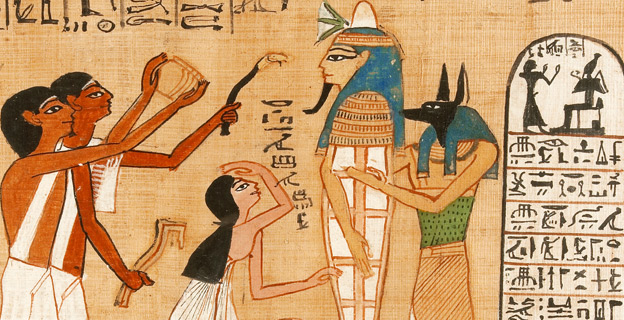
Inscribed on stone sarcophagi, wooden coffins and stone amulets, but mainly drawn on long papyrus scrolls placed close to a mummified corpse, the Book of the Dead was a collection of up to about two hundred spells intended to reanimate and protect the corpse of an Egyptian—most of whom were dead by the age of thirty-five—in the afterlife. Neither the number of spells nor their precise order and content was fixed, so there can be no single, authoritative Book of Dead; nor does it have an easily followed narrative, although the exhibition does its best to provide one. The book appeared before the beginning of the New Kingdom around 1550 BC and was commonly used until the Greco-Roman era in Egypt. It was rediscovered in the 1820s as a funerary ritual by Jean-François Champollion, the French scholar who deciphered the hieroglyphs.
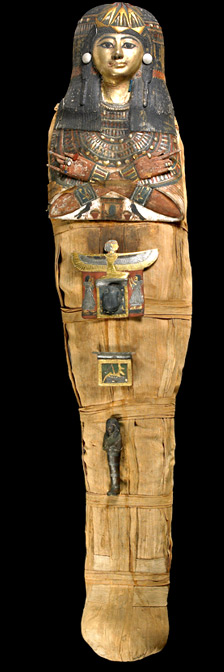 Death is always a fascinating subject for artists, and the Book of the Dead revels in it. The ravishingly colored vignettes of life among the deities, animals, chimeras, kings, scribes and wealthy elite of Egypt more than three thousand years ago, have a disconcerting power, despite the extremely bizarre universe of belief described in their accompanying hieroglyphic, hieratic and demotic texts.
The dominant idea is always that the ba (soul) of the deceased should be able to fly during the daylight hours from its mummy and continue to enjoy earthly pleasures beside the fertile River Nile, returning to its mummy at nightfall—like the endless cycling through the sky of the sun god Ra. According to spell 1, “Here begin the spells of coming forth by day, the praises and recitations for going to and fro in the realm of the dead”. Indeed, the ancient Egyptians called the composition the “book of coming forth by day”; its modern name, Book of the Dead, was coined only in the 1840s, probably from the term used by Egyptian workers on excavations when they discovered such manuscripts.
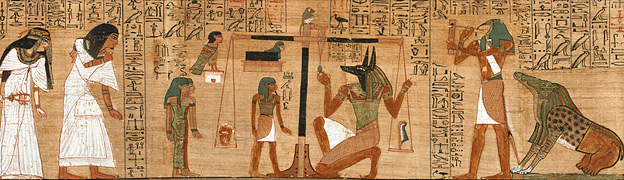
The best-known vignette in the book, rightly given pride of place near the end of the exhibition, is the judgment of the deceased before he or she is permitted to enter the afterlife. In the papyrus of Ani, a scribe who probably died around 1275 BC during the reign of Ramesses II, Ani and his wife bow respectfully towards the gods, as Ani’s heart is weighed in the balance scales by the jackal-headed Anubis against the feather of Maat (truth), greedily watched by the Devourer, a monstrous combination of crocodile, lion and hippopotamus. The text in front of Ani is spell 30B, his speech to his heart, telling it not to testify against him. “With their usual pragmatism, the Egyptians devised ways to escape punishment by the gods, but the fact that they felt a need to do so is revealing of a new stage in human psychology, a new notion of just behaviour”, notes the director of the British Museum, Neil MacGregor. Even the most convinced atheist, seeing this compelling vignette and understanding its accompanying text, will surely pause for thought.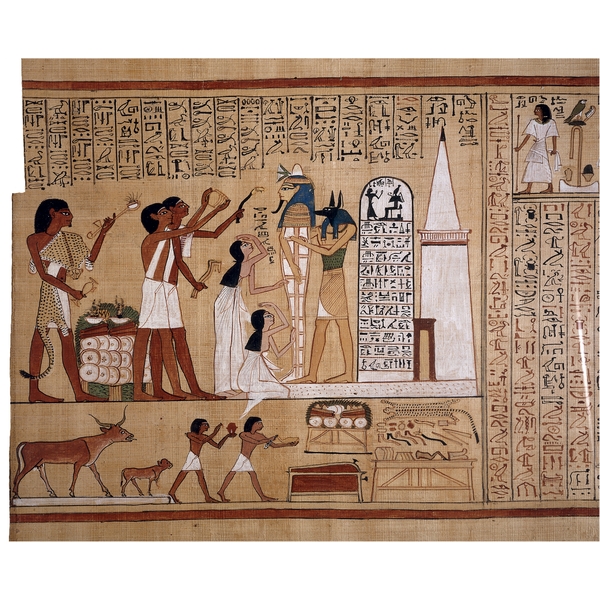



































 Travel Between The Pages
