It is true that I can no longer remember very well
the time when we first began to know each other.
However, I do remember very well
the time we first met. You walked in sunlight,
holding a daisy. You said, “Children make unreliable witnesses.”
Now, so long after that time,
I keep the spirit of it throbbing still.
The ideas are still the same, and they expand
to fill vast, antique cubes.
My daughter was reading one just the other day.
She said, “How like the pellucid statues, Daddy. Or like a…
an engine”
In this house of blues the cold creeps stealthily upon us.
I do not do what I fantasize doing.
With time the blue congeals into roomlike purple
that takes the shape of alcoves, landings…
Everything is like something else.
I should have waited before I learned this.
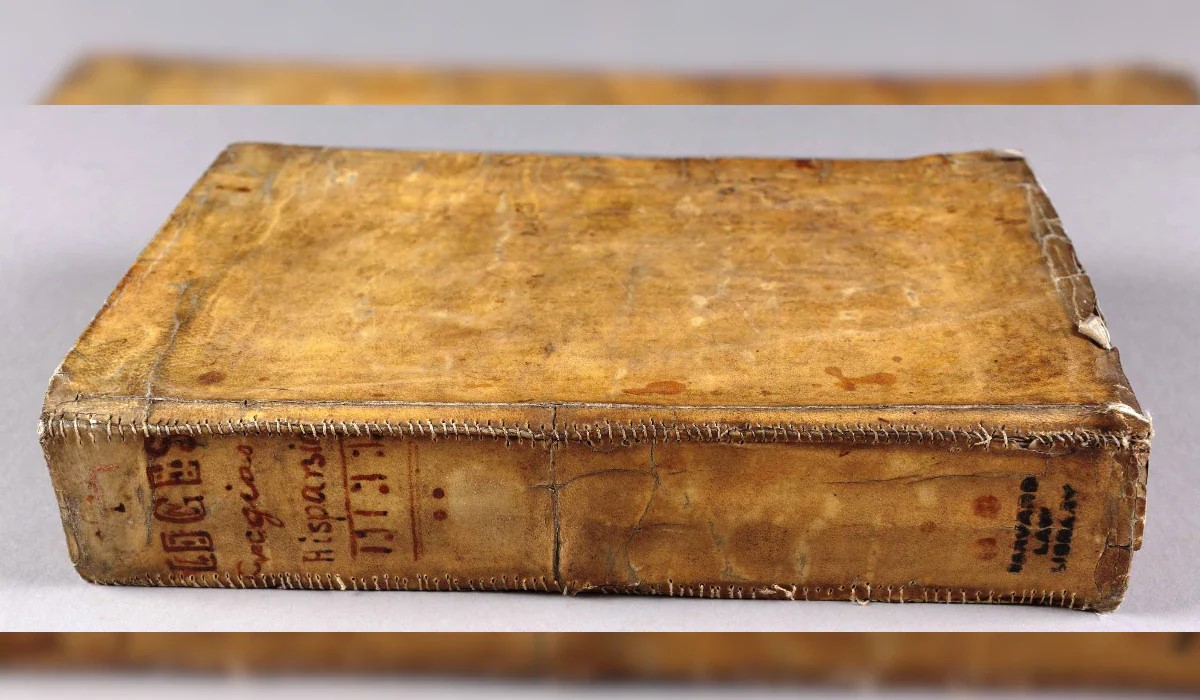
Harvard University Library has reported that it has removed a volume bound in human skin from its collection. A copy of the 19th-century book Des Destinées de l’Ame — or Destinies of the Soul, a meditation on life after death — was found in 2014 to be bound in the skin of a deceased woman. The book apparently was in the library for 90 years without being questioned.
The University said it had removed the book and noted “past failures in its stewardship of the book that further objectified and compromised the dignity of the human being whose remains were used for its binding”. Harvard also reported that it was consulting with French authorities “to determine a final respectful disposition of these human remains”.
Previously, Harvard seemed to relish the notoriety garnered by the wide interest in the morbid story of the book, calling the 2014 discovery “good news for fans of anthropodermic bibliopegy, bibliomaniacs and cannibals alike”.
The university said at the time that Ludovic Bouland, the first owner of the book written by French author Arsene Houssaye, had taken skin from the body of a mentally ill woman, who died of a heart attack, at a hospital where he worked. Dr Bouland was said to have told Mr Houssaye in a note: “A book about the human soul deserved to have a human covering.”
Anthropodermic bibliopegy, the practice of binding books in human skin, was once a relatively common practice.
The Codex Gigas (or Devil’s Bible) is a large 13th-century manuscript from Bohemia, one of the historical Czech lands. Renowned for its size and its striking full-page rendition of the devil (found on page 577), it contains a number of parts: the Old and New Testaments, two works of Josephus Flavius, Isidore of Seville’s Etymologies, the standard textbook for teaching medicine in the Middle Ages known as Ars medicinae (The art of medicine), the 12th-century Chronica Boëmorum (Chronicle of the Bohemians) of Cosmas of Prague, and a calendar. Of special interest are the sections that testify to the Bohemian origin of the manuscript and its eventful history. At the end of the 16th century, the Codex was incorporated into the collections of Habsburg ruler Rudolph II. During the Swedish siege of Prague at the end of the Thirty Years’ War (1648), the manuscript was taken as war booty and transferred to Stockholm.
The video below offers an over-the-top description of the creation and history of the Devil’s Bible, but it’s quite amusing and entertaining.
Who could have imagined that an award winning children’s book titled Ban This Book would actually be banned and in the state of Florida of all places.
The Indian River County School Board voted to remove “Ban This Book” by Alan Gratz from its shelves in a meeting last month, overruling its own district book-review committee’s decision to keep it. The children’s novel follows a fictional fourth grader who creates a secret banned books locker library after her school board pulled a multitude of titles off the shelves. Indian River County School Board members said they disliked how it referenced other books that had been removed from schools and accused it of “teaching rebellion of school board authority,” as described in the formal motion to oust it.
From the author’s website:
It all started the day Amy Anne Ollinger tried to check out her favorite book in the whole world, From the Mixed-Up Files of Mrs. Basil E. Frankweiler, from the school library. That’s when Mrs. Jones, the librarian, told her the bad news: her favorite book was banned! All because a classmate’s mom thought the book wasn’t appropriate for kids to read.
Amy Anne decides to fight back by starting a secret banned book library out of her locker. But soon things get out of hand, and Amy Anne finds herself on the front line of an unexpected battle over book banning, censorship, and who has the right to decide what she and her fellow students can read. In the end, her only recourse might be to try to beat the book banners at their own game. Because after all, once you ban one book, you can ban them all…
Traditional rooftops slope like the backs of resting camels.
Forests play fortresses;
secrets held in whistling pine needles.
Serene valleys echo
a painter’s lost blues and greens.
Mountains order the sky, no less,
wearing casts of gray ruggedness.
Although I am a frequent critic of AI projects, like all good hypocrites, I’m also fascinated by the subject. The poem above was generated by an experimental program based on the photo above of Bergun, Switzerland, and a brief prompt from me.
The Data Poets: is an intriguing project by Gaston Welisch. The website offers users the opportunity to upload an image of a place that’s important to them, along with some text prompts about where it is and why it’s special to them; the site will then generated a brief poem to accompany the image. This is all done by AI (image recognition and then LLM-ing the verse).
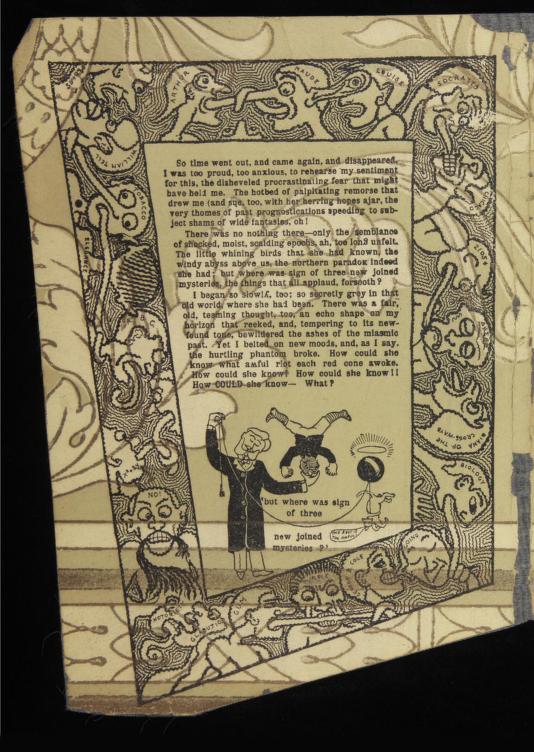
In October 1895, a surprising announcement appeared in The Lark, a popular literary magazine then based in San Francisco. It called for submissions for the first-ever edition of Le Petit Journal des Refusées (The Little Journal of Rejects), which advertised itself as “the smallest and most extraordinary magazine in existence”. The ad claimed to offer rates of $10 per page of poetry and $5 per page of prose (around $400 and $200 in today’s money), “one hundred free copies of the number in which [the contributor’s] article appears”, and included the commitment that “No manuscripts will be refused”. There was, however, one caveat to acceptance: The manuscript had to have been rejected from a “leading magazine”, and be accompanied by the rejection slip to prove it.
The announcement was intended as a humorous prank aimed at satirizing the many self-important literary journals that had been launched in the late-19th century. The ad was created by The Lark’s editor-in-chief, Gelett Burgess, who was an important literary figure in America at the time.
Surprisingly, the joke turned into reality and Le Petit Journal des Refusées actually launched a year later, and its first, and only, issue was published. The opportunity to skewer the pretentious literary journals was too good to pass up. The result was a sixteen-page chapbook, printed using woodcuts on wallpaper.
The little zine opens with an introductory note from the editor, a fictional “James Marrion”. What follows is a collection of poetry and prose works that have been “ruthlessly rejected by less large-hearted and appreciative editors but which now witness the light of day . . . for the first and last time.” The published works were likely also penned by Burgess, but all bear the names of unknown women writers. The pieces in Le Petit Journal des Refusées were representative of the literary styles in vogue at the time: a Symbolist prose piece, an experimentally typeset poem, a short story written in dialect.
What began as a little joke may have turned into the first American parody zine. I imagine that any editor or publisher who attempted this today would probably end up with a string of lawsuits.
Forgive the pun, but in this case life is truly stranger than the fictional book above. A fascinating handwritten manuscript of the French novel L’Étranger translated as The Outsider/The Stranger by Albert Camus has sold for €500,000 ($544,000) at auction in Paris.
There is little doubt that Camus himself faked the 104-page draft sold by French auction house Tajan in 1944, backdating it to April 1940 two years before it was first published. According to Tajan: “As the war dragged on and he sought a solution to his financial difficulties, Camus took advantage of the intellectual craze for L’Étranger, his first novel published in France, to compose this bibliophilic work – in 1944, according to [his wife] Francine Camus. In these years of struggle, the young author needed money and remained combative: he understood the interest of responding to the admiration of bibliophiles for his work, and perceived the market value of his manuscript. ”
It seems that Camus hand copied out his own book in black pen using two separate nibs before signing and dating it, adding a range of marginalia including unpublished remarks, erasures, additions, doodles including several suns and guillotines, and a sprinkling of arrows. Tajan suggest that the slight browning on one page is a deliberate cigarette mark, and various other light water stains could well be intentional. It’s not known to whom Camus entrusted the work.
It has previously been sold at auction in 1958 and 1991. The identity of the buyer has not been revealed.
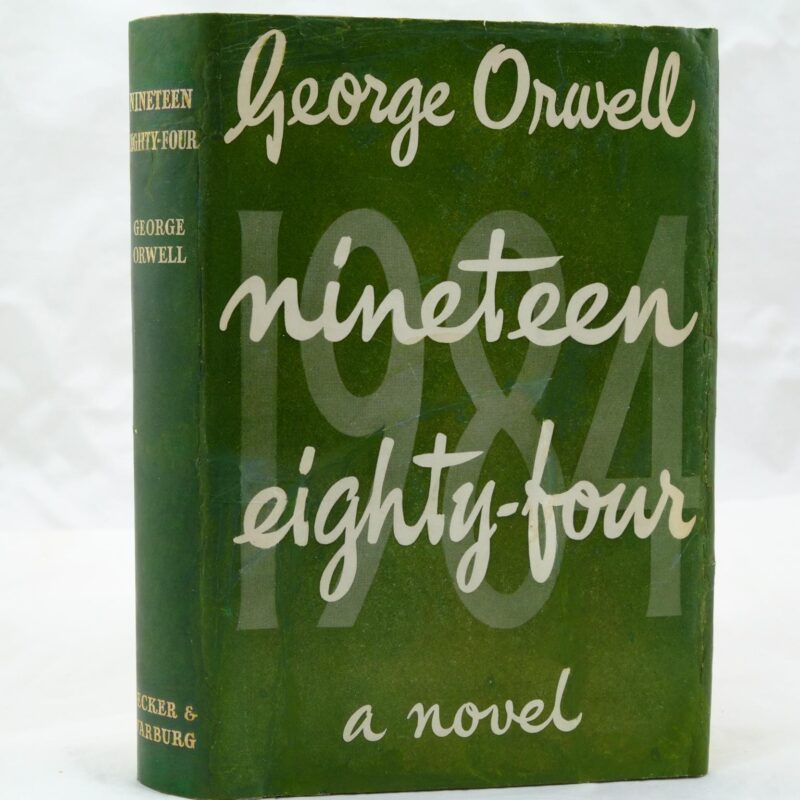
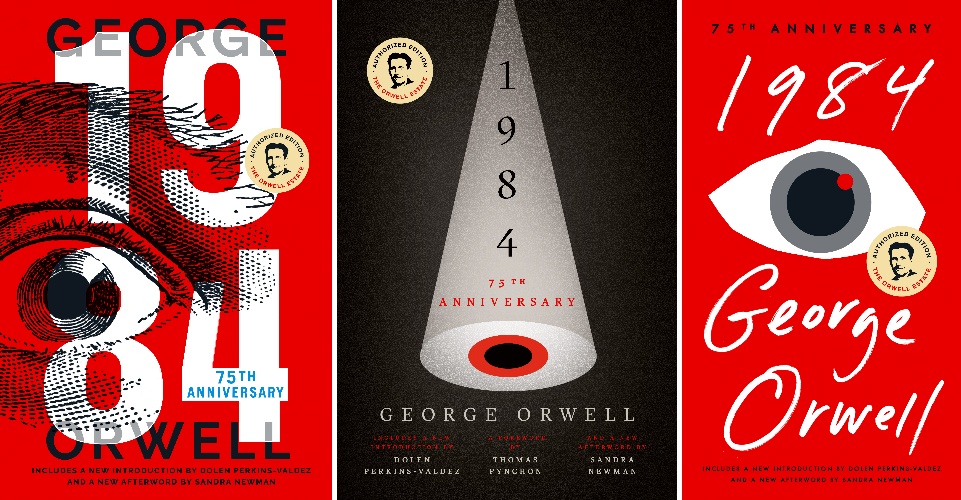
George Orwell’s seminal novel turns seventy-five this week. In Nineteen Eighty-Four, Orwell posed a frightening question: could people be conditioned to actually believe (rather than just pretend to believe) the lies they are told ?
Here we are 75 years later in a digital era where we are drowning in the information technologies that already do much to control our thoughts and beliefs. While simultaneously there is a terrifying resurgence of authoritarianism. The novel’s brilliant response to the threat of propaganda overload is as topical as it has ever been.
Nineteen Eighty-Four remains timeless in its message of the power of language to shape our world. George Orwell’s iconic book seems more than ever to be chilling prophecy. His dystopian vision of a government that will do anything to control the narrative is timelier than we could have imagined.
I am not embarrassed at all to admit that I have spent an inordinate amount of time thinking about things in the Lord of the Rings universe such as : who is in charge of trash collection; and what are the tax rates; and who collects the taxes and decides how the revenue is spent. Well, I recently stumbled on an enlightening article online at Goldwag’s Journal on Civilizationtitled “The Moral Economy of the Shire.” It’s a surprisingly good read even if you are not a LOTR fanatic.
Like many a curious adolescent, my introduction to the writing of Vladimir Nabokov was by way of his controversial novel Lolita . Much later, I got around to reading some of his other less salacious works such as Transparent Things and Ada or Ardor. By far my favorite (other than Lolita) has always been Pale Fire, but to be honest, I found it to be somewhat confusing. The excellent article at UnHerd by the novelist Mary Gaitskill titled “Don’t be terrified of Pale Fire Nabokov’s masterpiece has a complex but huge heart” helps to unravel the intricate plotting of the book.
Who could possibly resist an article titled “What Frida Kahlo Kept in Her Bathroom” ?After artist Frida Kahlo’s death in 1954, her husband, painter Diego Rivera, blocked off two bathrooms in their home, La Casa Azul, on the condition that they not be opened until at least 15 years after his death.
In 2005, La Casa Azul, now part of Museo Frida Kahlo, invited fellow legendary Mexican artist Graciela Iturbide to photograph the space and the belongings inside.
I am not an artist, but I live with one, so I am constantly exposed to art supplies and materials of all sorts. The marvelous video below from Business Insider’s series Still Standing, is an endearing look at La Maison du Pastel, a 300-year-old Parisian company that makes pastels for artists by hand. Back in its golden age, the company supplied the likes of Monet & Degas but fell into neglect near the end of the 20th century. The newest generation of ownership has restored the company and they now offer over 1,900 different pastel colors.
What could possibly be more fun than a Dutch bicycle orchestra riding on a summer’s day in the Netherlands.
Regular visitors to Travel Between The Pages will be well aware of my proclivity for all things Sci-Fi. My interests in the genre are wide-ranging and include everything from classic space operas to Black Mirroresque streamers. So, I was chuffed when I stumbled upon the online mini-anthology A Thousand Suns.
Described as “a mind-bending sci-fi anthology series that explores visions of humanity’s past, present and future.” The trailer says, “In the vastness of time, many stories weave into one under the light of the thousand suns.”
The series comes from filmmaker who goes by the name Macgregor, and it’s produced by a company called Blackmilk Studio. Macgregor gathered a team of team of filmmakers together to make “films that serve as a gateway to our hopes, dreams… and nightmares.”
There are a total of six anthology episodes released and the titles include Episode 1 – Ice; Episode 2 – Red; Episode 3 – Exodus; Episode 4 – Deal; Episode 5 – Bug; and Episode 6 – Tomorrow.








 Travel Between The Pages