Today’s guest post is by travel writer Richard Clark:
A Journey to Atlantis
If you have the time while staying on Crete, the capital, Heraklion is the ideal place to board a boat for Santorini, and believe me it is worth the journey if only for a day trip. It is magical.
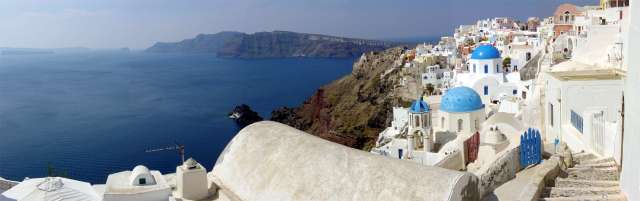
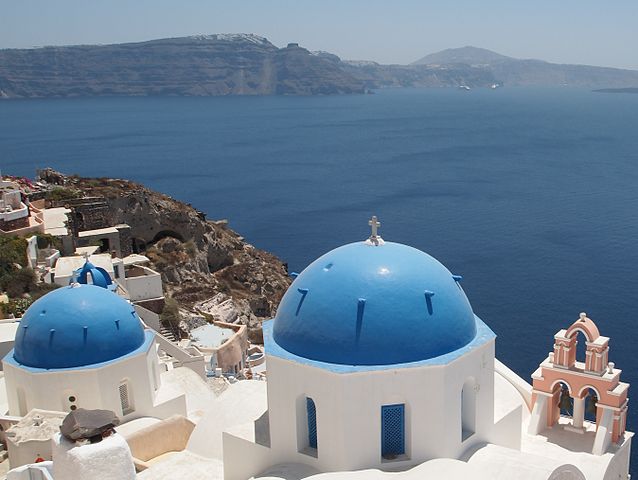
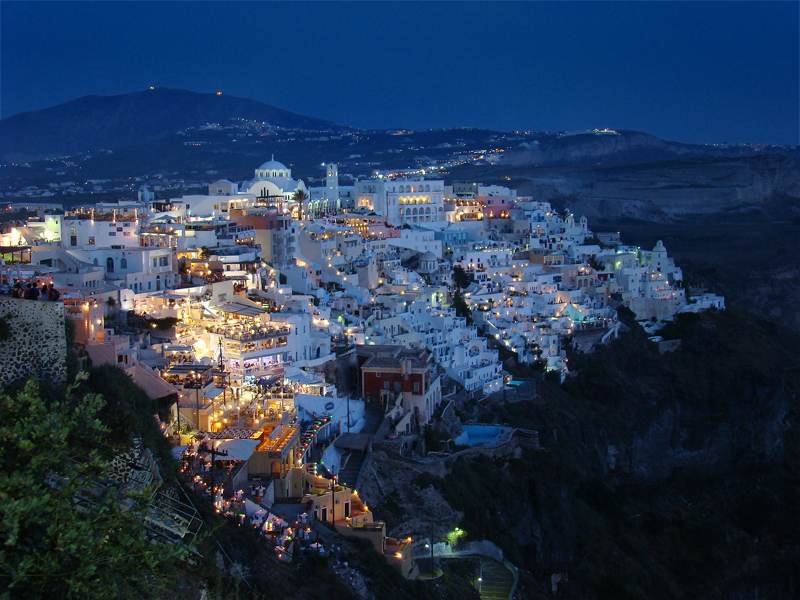
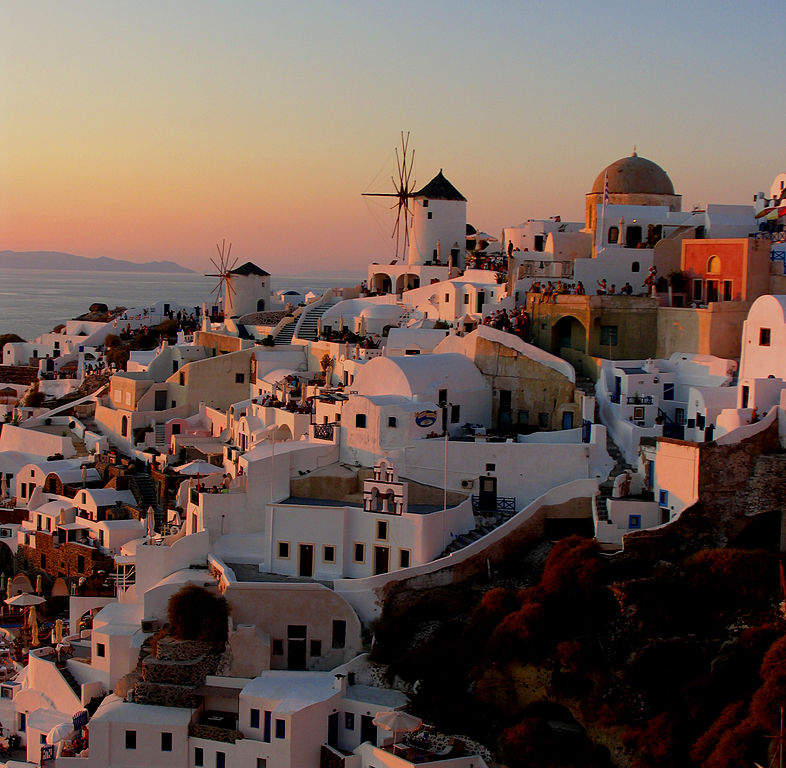
Shimmering white, perched atop sheer cliffs overlooking a cerulean sea, the villages of Santorini, or Thera as it is classically known, sum up so many people’s visions of a Greek island. Cats bask in the sun under blue shuttered windows as multi-colored flowers cascade from terracotta urns. Even the capital, Fira, the hub of the island’s commercial and tourist trade, manages to retain this picture-postcard charm.
Not much more than 60 miles north of Crete, the first time I took the journey it took four hours. Nowadays it can be done considerably quicker by hydrofoil, but I still prefer the conventional ship. The slower approach to this spectacular island allows more time for the appreciation of its unique views, which are the dramatic result of a history of volcanic activity.
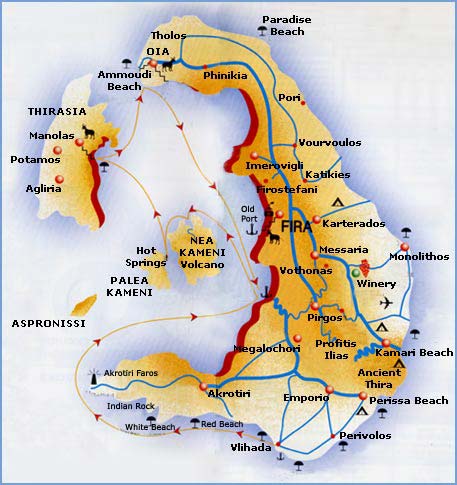
The main crescent-shaped island and its five smaller acolytes are all that remain of a once much larger land mass, which was destroyed by a massive volcanic eruption in the second millennium BC. This explosion blew a hole in the island that now constitutes the Santorini lagoon. What once was dry land now lies submerged 1300 feet underwater.
The consequences of this volcanic event, one of the largest eruptions in recorded history, were monumental. The lagoon covers about 50 square miles and butts up against sheer cliffs that rise up out of the water to a height of 1000 feet. The seismic activity that created this dramatic geological feature also completely destroyed the Bronze Age Minoan civilization that had prevailed there.
For me, contemplating the magnitude of such an event as your ship sails across the deep, calm waters of the caldera is one of the great pleasures of taking this journey. As the ferry coasts towards its mooring on the very edge of the crater’s rim, the cliffs thrust skywards to form the current island, where the small villages of white houses glimmer in the sun as they cling precariously to the summit.

As on other islands, competition to sell rooms was fierce. Walking down the gangplank we were met by hoards of islanders hustling to sell us accommodation. Having only come for a day trip we pushed our way through the scrum and made for the awaiting bus. Cases and crates, rucksacks and boxes were being stowed in the luggage compartment or on the roof, tied down tight in preparation for the winding ascent up the precipitous side of the caldera to the island’s capital.
Huffing and puffing, the bus took off in a cloud of dust and exhaust fumes. The ascent is not for the faint-hearted. The road when I first visited was not bordered by crash barriers and, on each hairpin bend, the bus would alarmingly hang its front end out over the sheer drop to the sea below.
Smoking and with music blaring from the speakers, the driver would wrestle the wheel around the sharp bends, sometimes taking a hand away to cross himself three times whenever passing one of a number of none-too-reassuring roadside shrines.

As the coach neared the top of the cliffs, for the braver of the passengers who looked out and down over the lagoon, the view was breathtaking. Our ship below tied up to its pier and, further out to sea, small fishing caiques plied their trade across the lagoon, leaving a web of wake trails breaking the glassy surface. The occasional pleasure boat was taking visitors to the other inhabited island in the archipelago, Therasia.
From here it is easy to see why Santorini is thought by many to be the inspiration for Plato’s lost island of Atlantis. Although this might be the fanciful romanticizing of a myth, such opinions have been given some credence by frescoes depicting the island’s shape prior to the eruption having been found by archaeologists beneath the volcanic ash.
The wall paintings are considered to have more than a passing resemblance to the Atlantis written about by Plato in his Timaeus and Critias dialogues. These tell the story of a mighty, all-conquering state that spread its influence throughout North Africa and what is now Europe, before catastrophically sinking into the sea.
Such dreadful devastation has created this spectacular landscape, which is now the destination for so many visitors. Its beaches reveal this turbulent geomorphological past, consisting of black, red and white sand depending on which geological layer has been exposed by the erosive action of the sea.

As recently as 1956, the island suffered a sizeable earthquake and volcanic eruption that did significant damage to many buildings and resulted in the desertion of several of its villages. Despite this, a permanent population of about 15,000 people remains on this flawed paradise, making a living out of tourism, wine production, fishing and market gardening.

The climate is especially arid and water is in short supply. A desalination plant supplies water for washing and watering crops, but it is not suitable for human consumption. However, looking out across the bay, it is easy to see why people stay, risking all to remain on this island heaven.
Richard Clark is a writer and journalist, and is the author of two books about Greece. Both are available in paperback or in eBook format from Amazon and other major retailers.
The Greek Islands – A Notebook, http://tinyurl.com/cv3j4jm
Crete – A Notebook http://tinyurl.com/6vbdn3a





















 Travel Between The Pages