This guest post on Crete is from writer and journalist Richard Clark, who is the author of two books on Greece.
Samaria – The Longest Gorge
The early start had taken its toll and I was fighting with my eyes as we approached the foothills of the White Mountains in the west of Crete. I had walked the Samaria Gorge before, but the experience had been somewhat spoiled by my own bad planning. First I had gone on an organized trip, second it was the height of summer, neither of these factors proved an ideal way to experience walking what is claimed to be the longest gorge in Europe.
The walk in itself is not too taxing if you are reasonably fit but, as I discovered, a 10-mile downhill trek in 35 degrees heat is uncomfortable, and when surrounded by hundreds of other walkers it is difficult to ponder on this towering natural phenomenon.
This time I had experience on my side and was determined to enter the National Park the moment it opened at 7.00am. It was the end of September, when the sun, although still hot in the middle of the day, would be more forgiving.
My taxi had arrived to pick me up from my pension in Chania at 5.45am to ensure I was in good time to be ahead of the coach tours. I needn’t have worried, my driver put me in no danger of being late – that is if I was to make it at all. He swung the silver Mercedes enthusiastically around the hairpin bends in the dark as we threaded our way up into the White Mountains.
No longer able to doze, I was torn between staring out into the void of the sheer drops just inches from the car’s screeching wheels and closing my eyes in terror at my proximity to an early grave. And there were grounds for my nervousness, as born testament to by the increasing number of roadside shrines which appeared, caught in our headlights, as the going got steeper. At each little chapel erected in memory of previous motorists who had succumbed to the precipitous nature of our route, my driver would take one hand off the wheel and cross himself.
Now wide awake and in excellent time to start my walk, my taxi driver probably mistook my effusive thanks for gratitude rather than relief when we arrived at the head of the gorge at Xyloskalo. His haste to get me to my destination at least allowed me time to appreciate the most radiant sunrise which began to fill in the colors of the trees and rocks and played a breathtaking accompaniment to the silence which restored my composure and whetted my appetite for the walk ahead.
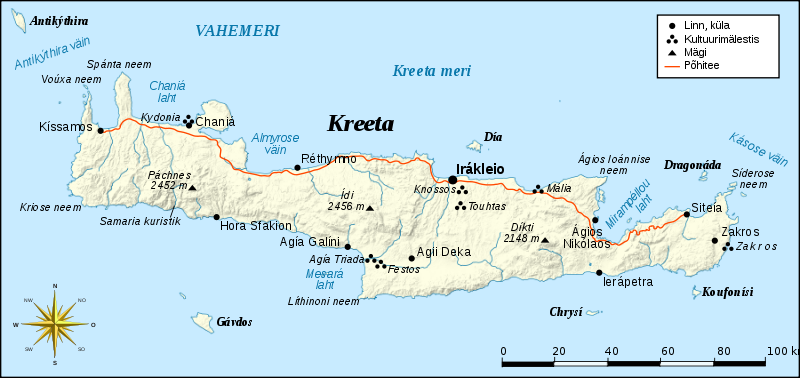
Right on 7 o’clock I paid my entrance to the park and set off along the path which almost immediately turned into a steep drop down steps into a valley densely forested with pines and cypresses trees. This is the start of a spectacular descent of some 4000 feet from the Omalos Plateau to sea level at the small village of Agia Roumeli on the south west coast.
Along with Knossos this is widely regarded as a must-see by many visitors to the island, and in the peace and quiet of this early morning in late September it was living up to its reputation. The gorge has been carved out of this spectacular limestone and granite landscape by a river that runs between the White Mountains and Mount Volakias.
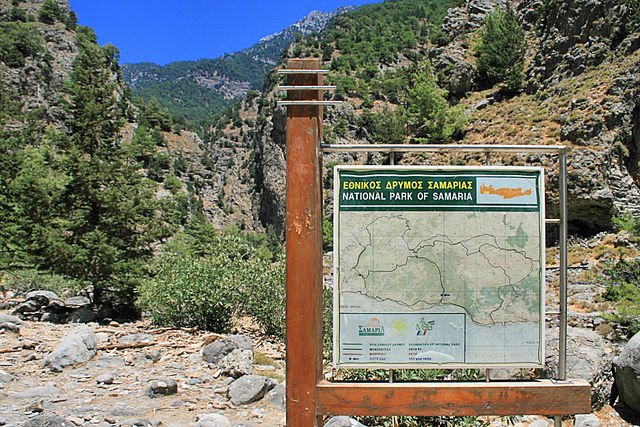
Over thousands of years the chemical reaction between the water and the rock has created this wonder of nature in the shadow of the spectacular White Mountains, or Lefka Ori. The range is so named because its color never changes. The mountains are snow covered in the winter months and when the warmer weather comes they glow white as the sun reflects off the limestone.
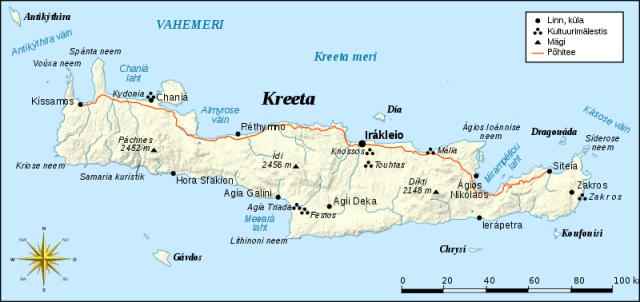
The mountain range is massive, and the largest on the island, covering more than 300 sq miles. It is the most remote area on Crete and is home to the renowned Sfakiots, named after Sfakia, the capital of the region, a small port on the south coast.
Sfakia is famous for being at the heart of the evacuation of Allied troops from the island during the Battle of Crete in the Second World War. For the Sfakiots, living has been tough and this toughness is reflected in their temperament. Throughout Cretan history they have been at the center of the fight against oppression.
The Sfakiot qualities are typified by the man known as Yannis Daskalogiannis, after whom Chania’s international airport is named. His real name was Yannis Vlachos. The son of a wealthy merchant in the 18th Century, he was educated abroad and nicknamed Daskalogiannis, meaning John the Teacher because of his wisdom. He became a rich ship owner and chairman of the council of Sfakia.
In 1770, after being promised support by the Russians, he led a force that rose up against the ruling Turks and had many successes in liberating parts of the region. But, with the Russians reneging on their promise, he was eventually overwhelmed by the sheer numbers of Turkish troops and surrendered at Frangokastello Castle near the region’s capital of Horia Sfakion. Yannis was taken to Heraklion where he was skinned alive in public in front of the harbor fort.
The highest peak in the White Mountain range is Mount Pachnes, at 8045 feet it is just 12 feet shorter than Mount Psiloritis, the tallest mountain on Crete. I have not been to the summit but am told that there is an ever-growing pile of rocks there, deposited by proud locals in an attempt to make their mountain stand taller than its rival to the east.
The Samaria National Park was set up in 1962 to provide a protected haven for the significant numbers of species of plants and animals indigenous to the area. In the same year the last villagers of Samaria left their homes to accommodate the park that bears its name and which, in turn, was named after the small, white 14th-century church of Saint Mary or Ossia Maria.
There was still a chill in the air as I got into my stride, the smells of wild marjoram, pine and eucalyptus infused the atmosphere as I criss-crossed over the small burbling stream that runs through the gorge. It seems hard to believe that this benign trickle could have been partly responsible for creating such an imposing formation. But throughout the winter months, swollen with rainfall and melt waters from the snows on the mountain peaks it shows its true colors, and during this period the park is closed to visitors as the massive flow of water makes walking too dangerous.
Well before 9 o’clock I must have descended about half the height of the gorge as I passed the small stone church of Agios Nikolaos standing in solitary splendor beside the trickling river. Another hour and I was approaching the abandoned village of Samaria.
Here is a good stopping point to sit for a time and take on some food and water. This is supposed to be a favored haunt of the kri-kri or indigenous Cretan ibex, which is an endangered species and a major factor in the establishment of the National Park as a wildlife reserve.
On that occasion I was unlucky. I had seen some of these rare beasts higher up the Gorge on my previous visit when the park was heaving with people. But now, all alone, these allegedly timid creatures were nowhere to be seen. I don’t know what that says about me!
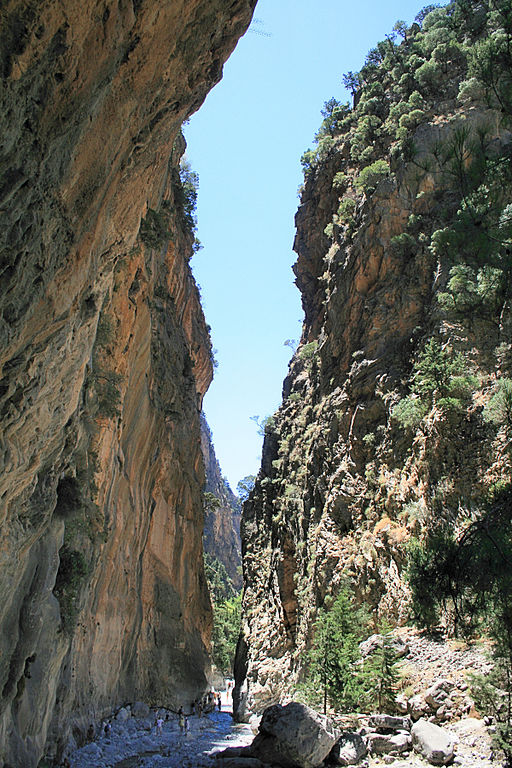
Despite the seeming attraction of the crowds for the kri-kri, I was still determined to stay one-step ahead of the guided tours. After a snack of bread, olives and feta from my backpack, I set off again downhill for the second half of the trek towards the coast. This is the most spectacular part of the walk as the gorge narrows, closing in on me and emphasizing the sheer nature of the vertical rock faces on both sides, stretching upwards and at times obliterating the sun.
I was approaching the famous sideroportes, or iron gates, where I felt I could almost touch both sides of the canyon at once. I reached out to try, and fell short by some six feet, looking upwards the rock faces towered above me for 1000 feet at least.
This was breathtaking. I stood in awe, breathing in the splendor; alone, a tiny dot at the bottom of this natural canyon.
From here the path flattens out as I followed the river out of the park along the course of its final few miles to the Libyan Sea. An elderly goatherd in traditional Sfakiot dress stopped to watch me, chin resting on his crook as his herd tinkled their way across the rocky lowland between the end of the Gorge and the sea. He nodded enigmatically at my greeting of kalimera.
It was the middle of the day and the sun was beating off the large rocks that gradate to stones before forming a pebble beach as my journey matched that of the river and reached the sea at Agia Roumeli. A regular boat service runs to Sfakia from here, there is no way out by road.
From Sfakia there are frequent bus services traveling back up into the mountains on one of the most dizzyingly dramatic routes in the country, which makes its way north across the 40 miles back to Chania. It is worth preserving enough energy to remain awake and, for those who travel well, try to get a window seat on the bus.
Richard Clark is a writer and journalist, and is the author of two books about Greece. Both are available in paperback or in eBook format from Amazon and other major retailers.
The Greek Islands – A Notebook, http://tinyurl.com/cv3j4jm
Crete – A Notebook http://tinyurl.com/6vbdn3a












 Travel Between The Pages