The fight against Fascism is never ending

His Millennium trilogy was a worldwide hit. But to the Swedish author, it was only ever a sideshow to his true life’s work: fighting fascism, racism and rightwing extremism. Today marks the 20th anniversary of the untimely death of Stieg Larrson.

It is a relatively well-known fact that the author of the bestselling and most widely known Nordic noir crime series of all time never got to witness his own success. Swedish novelist Stieg Larsson died of a sudden heart attack 20 years ago this week, aged only 50, before the publication of The Girl With the Dragon Tattoo and the Millennium trilogy that followed.

What is less well known is that on the day of his death ( November  9, 2004), Larsson was due to give a lecture on the Nazis’ November pogrom at the headquarters of the Workers’ Educational Association in Stockholm. Kristallnacht, “the night of broken glass”, was an important date in Larsson’s calendar, which he commemorated every year. To him, it epitomised the abyss of far-right extremism he spent his life fighting.

Larsson’s life as an antifascist activist has been increasingly overlooked in the wake of his books’ phenomenal global success. One of Sweden’s most lucrative literary exports, the Millennium series has sold more than 100m copies across its various titles, according to publisher Norstedts. The novels have since been adapted into a number of Swedish TV films, a Hollywood blockbuster starring Daniel Craig, and expanded into two further trilogies by two other authors.

“And yet, the trilogy is only one episode in Stieg’s journey through the world, and it certainly isn’t his life’s work”, his life partner, Eva Gabrielsson, wrote back in 2011 in her memoir. Gabrielsson refers to the “Stieg of the ‘Millennium industry’” as being created after his death. The Larsson she knew was an unwavering antifascist – a deeply rooted conviction that shines through passage after passage of his page-turning crime thrillers.

Two decades on, the novels read like a gloomy premonition of Sweden’s political landscape to come, with the far-right Sweden Democrats a de facto part of the governing coalition since 2022. Larsson exposed the undemocratic underbelly of a country usually associated with Scandinavian exceptionalism rather than murderous Nazis. It was a side of Swedish society he knew all too well as a journalist.

In The Girl With the Dragon Tattoo, a suspenseful whodunnit set on a fictional Swedish island inhabited by a wealthy industrialist family, Nazi pasts are never far beneath the surface of the plot. The Vanger brothers – Richard, Harald and Greger – were all members of the extreme right organisation New Sweden, with Harald becoming a “key contributor to the hibernating Swedish fascist movement”. The investigative journalist Mikael Blomkvist later finds photos of Greger with Sven Olov Lindholm, a Swedish Nazi leader in the 1940s. And the fascist ideology of Richard – grandfather of the missing Harriet and her vicious brother Martin – led him to the Finnish trenches in the second world war.

In the sequel, The Girl Who Played With Fire, we find the biker gang Svavelsjö MC (whose logo features a Celtic cross, a symbol common among white supremacy groups) at the centre of a sex trafficking ring. The gang is well connected with the organised extreme right: its number two, Sonny Nieminen, has had dealings with neo-Nazi groups such as the Aryan Brotherhood and the Nordic Resistance Movement while in prison. Lisbeth Salander’s nemesis and, as it turns out, brother – a giant brute who feels no pain called Ronald Niedermann – was part of a skinhead gang in the 1980s in Hamburg, we are told; it’s a nod to a nascent far-right subculture in Germany responsible for arson attacks and murders.

And in Larsson’s final novel, The Girl Who Kicked the Hornets’ Nest, Blomkvist and Salander expose a shadowy clique within Swedish intelligence called “the Section”, comprised of members of the extreme right Democratic Alliance. “Within the Section this was no obstacle,” we learn. “The Section had in fact been instrumental in the very formation of the group.”

While the Millennium trilogy touches on many themes, especially violence against women (the original Swedish title Larsson insisted on for the first novel translates as “Men who hate women”), Larsson condemned the Swedish far right’s influence at all levels of society.

These convictions were rooted in his biography. His grandfather, with whom he grew up with in the icy north of Sweden, was an anti-Nazi communist imprisoned in an internment camp during the second world war. The grandfather would recount the horrors of the November pogrom, leaving a lasting impression on the young Larsson, himself a committed activist, first in the anti-Vietnam war movement, then in Maoist and Trotskyist circles. But it was Larsson’s commitment against the far right that would shape his politics for the bulk of his life.

In 1979, Larsson joined the Swedish news agency Tidningarnas Telegrambyrå, where he spent the next 20 years of his modest career as a low-level journalist. But as rightwing extremists began robbing banks, stealing weapons and murdering people in Sweden in the mid-1980s, Larsson became the agency’s go-to expert.

From 1983, he began writing for the British antifascist magazine Searchlight as a Stockholm correspondent. In 1991 he co-authored a Swedish-language book on rightwing extremism. And over the years he penned numerous reports and articles on contemporary antisemitism and the far right for organisations and institutes in Israel, Belgium and France.

A pivotal moment came in 1995. Larsson co-founded the Expo Foundation, which publishes a quarterly magazine on racism, antisemitism and the far right to this day. By 1999, it had become his day job. It was a calling that came at great personal cost, landing him on neo-Nazi hitlists. He received bullets by post. Colleagues were targeted through shootings or car bombs. According to Gabrielsson, it was for security reasons that they did not marry, leaving her without inheritance rights under Swedish law.

“Stieg was a nerd at heart, but there was a certain machismo to covering the far right in the 90s,” says Daniel Poohl, head of the Expo Foundation since 2005. “It was men researching dangerous other men and sometimes that meant having a baseball bat to protect yourself. Because that’s what you do when you feel that you’re on your own.”

Poohl is sitting in the first floor office of Expo in a nondescript block in a residential neighbourhood in Stockholm. Framed covers of the compact, stylish magazine, which today has 7,000 subscribers, adorn the wall behind him. In the next room, the 14 staff members are busy planning the coming issue, page drafts of which are plastered on the wall.

It’s hard not to think of Larsson’s fictional investigative publication Millennium, with which there are plenty of parallels in the novels. “A lot of people have said to me that Millennium is basically Expo,” says Poohl. “But it’s not. Millennium was the ultimate dream magazine. Stieg was a bad businessman, so it would never work in real life.”

The success of the novels, which Larsson wrote in his spare time, has partly helped the foundation, however. A representative of Larsson’s estate said that the holding company that controls it has donated a total of over 40 million Swedish kronor (£2.9 million) over the years, which “have clearly been crucial for Expo’s activities.” .

Poohl from Expo confirmed that the foundation received one off payments, as well as an additional yearly support from the Larssons for a period and a cut of the fourth novel in the series, The Girl in the Spider’s Web, published in 2015 and authored by David Lagercrantz.

“People sometimes think we received a lot of money through the books, but it’s less than they think,” he says. “We’re thankful for the financial support that we have received during the years. But the royalty agreement has since ended.” Poohl adds: “The sad part is that Stieg didn’t get to use his fame to further his political work.” Joakim Larsson, his brother, declined an interview request due to health reasons. Gabrielsson, now 70, didn’t respond to multiple interview requests.

With the electoral success of the far-right Sweden Democrats, a party rooted in Swedish nazism, Larsson’s political nightmare has in many ways come true. “He tried to show that they weren’t simply a gang of madmen plotting to infiltrate Swedish society … but a real political movement that had to be combated through political means,” wrote Gabrielsson back in 2011. The “Millennium millions”, as a Swedish documentary has called the fortune made through the trilogy, would have undeniably been a big boost to his other life’s work.

via Guardian


Posted in Books, Europe | Tagged , , | Leave a comment

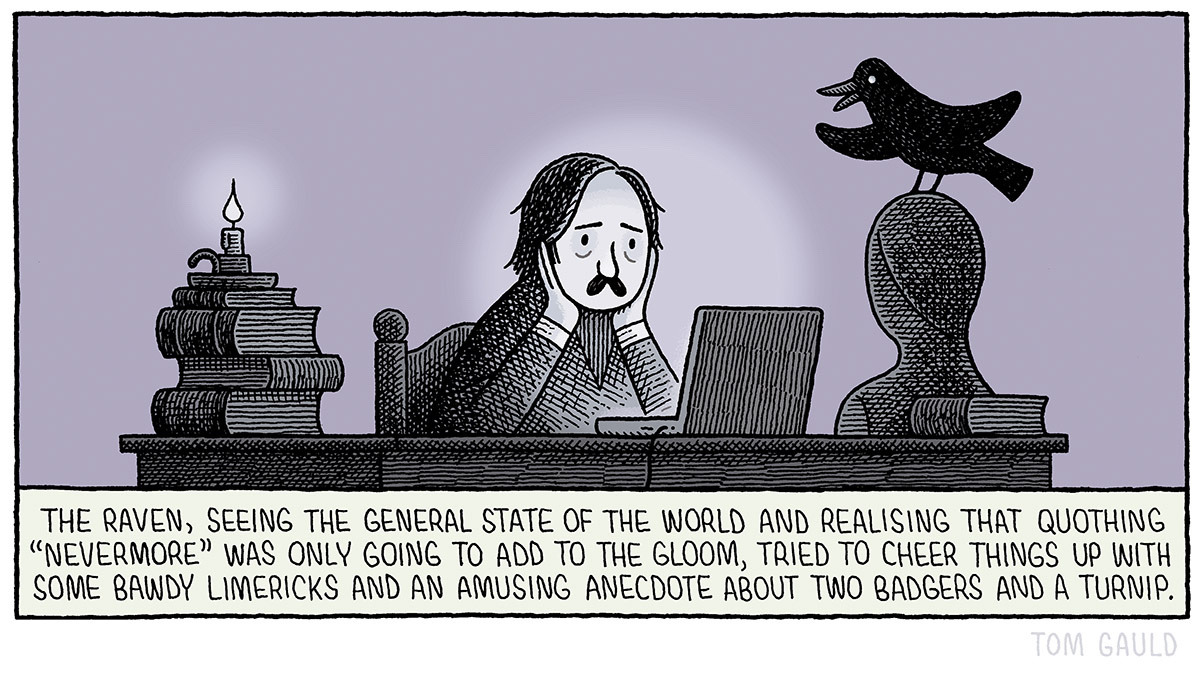
The Unfortunate Narrator


Posted in Art, Books, Writing | Tagged , | Leave a comment

Forget Dystopia

Thinking about all of the dystopian speculative fiction that I’ve been binging on in recent years, I am reminded of the great Ray Bradbury’s imagining of a more positive future for humanity. The 1984 short story The Toynbee Convector tells the tale of the world’s first time traveler, who returned with fabulous stories of a future so wonderful that it inspired humanity to build it. But an investigative reporter uncovers the shocking truth 100 years later: the traveler had fabricated the entire journey to divert the bleak path he saw mankind on. Yet the sheer power of that fabricated vision—a world flourishing in harmony with nature—was enough to make it real.

The narrative follows a reporter named Roger Shumway who has been given the opportunity to interview 130 year old Craig Bennett Stiles, a time traveler who had visited the distant future and returned full of hope.

A century has passed since his trip and the interview will almost certainly be his last chance to tell the world more about what his journey was like and why he was so excited about what he saw in humanity’s future.

You can read it here at short story  on this Google doc. or watch the dramatization from The Ray Bradbury Theater television series below.


Posted in Books, Theater, USA, Writing | Tagged , , | 1 Comment

After London, or Wild England

During the Pandemic, I oddly began reading dystopian and post-apocalyptic fiction. I recently ran across Richard Jefferies’ 1885 novel After London which likely is one of the first post-apocalypse English language novels. The tale is set in a future England after an unspecified catastrophe has destroyed civilization, cut off communication with the continent, and set the surviving human population back to a quasi-medieval existence among the overgrown ruins of the “ancients.” The nature of the disaster is never explained, but it must have been significant — the interior of the island is now filled with an immense freshwater lake, and London is now choked under poisonous fumes.

The first section, called “The Relapse Into Barbarism,” reads like a nonfiction natural history, describing in detail how nature reclaims the ruins in the decades after the conflagration. The longer second section, “Wild England,” recounts the adventures of the young nobleman Felix Aquila as he leaves the stultifying court life in which he has been raised and rows out onto the lake in a homemade canoe.


The full text is available at Project Gutenberg and on Google Books, and there’s a free audio version at Librivox. (see below)


Posted in Books, Europe, Writing | Tagged , , , | 1 Comment

Banned In the USA

Banned In The USA isn’t a classic Springsteen tune, but instead it’s the newly released report from PEN America  documenting  public school book bans for the full 2023-2024 school year. The report records 10,046 instances of books banned nationwide, a dramatic 200 percent rise over the previous school year. Since 2021, PEN America has counted close to 16,000 instances of book bans in U.S. public schools.

According to Banned in the USA: Beyond the Shelves43% of book ban cases, or 4,295 bans, were books completely prohibited from access – neither pending a review nor available with newly imposed restrictions. Books completely removed from access were 16 percentage points higher this year (43%) compared to prior years (27%).

As has been true since this censorship crisis started in 2021, individuals and groups espousing extreme conservative viewpoints predominantly targeted titles with themes of race, sexuality, and gender identity. The report also found that books are increasingly being censored that depict topics young people confront in the real world, including experiences with substance abuse, suicide, depression and mental health concerns, and sexual violence.

An updated Index of School Book Bans showed 4,231 unique titles were banned during the 2023-2024 school year, impacting 2,662 authors, 195 illustrators, and 31 translators, a total of 2,877 creative individuals. Over the last three years, 6,143 titles and 4,563 creatives have been affected by book bans.

Nineteen Minutes by bestselling author Jodi Picoultwas the most commonly banned book during the last school year. It is among 19 titles banned in 50 or more school districts. The next most frequently banned titles were: Looking for Alaska by John GreenThe Perks of Being a Wallflower by Stephen Chbosky; Sold by Patricia McCormick, and Thirteen Reasons Why by Jay Asher. And, 74 titles by Stephen King were banned.

Disproportionate to publishing rates, titles about LGBTQ+ people and characters, people and characters of color, and books with sex-related content were overwhelmingly affected. Analyzing book titles banned in two or more districts, or 1,091 unique titles, PEN America found that 57% of these include sex or sex-related topics and content, 44% included characters or people of color, and 39% included LGBTQ+ characters or people.

via pen.org

Posted in Books, Freedom of Speech, USA, Writing | Tagged , , | 2 Comments

As the human village prepares for its fate

Tom Clark


Posted in Books, USA | Tagged | Leave a comment

It’s a small world

The older that I get, the more often I stumble on snippets of information online that immediately triggers personal memory links to my own experience. In this category, I recently saw a reference to the innovative science-fiction short La Jetée by the underappreciated French cinema director and writer Chris Marker. My “link” to Marker isn’t his brilliant film work, but a little known travel guidebook series called Petite Planète .

The Petite Planète collection consists of a series of little travel guides by the French publishing house Edition du Seuil where he conceived and designed a series of travel guides called Petite Planète. He considered each volume “not a guidebook, not a history book, not a propaganda brochure, not  traveler’s impressions, but instead equivalent to the conversation we would like to have with someone intelligent and well versed in the country that interests us. Chris Marker was hired as the editor and often  photographer, designer and writer of the series, establishing an unorthodox approach to travel literature, both editorially and visually. The narratives were full of commentary and critique and the visuals surprising or unsettling, avoiding the glossy clichés of typical guidebooks. The covers in particular had a deliberately cinematic approach, each with a face of a woman, often staring at the viewer (or looking off) in a powerful, knowing way.

Over the years, I’ve only owned a few books from the series. Too often when I found copies for sales in European book markets, they were in poor condition from heavy use.

“Apart from the ambition to provide something different from run-of-the-mill guidebooks, histories, or travelers’ tales,” writes Catherine Lupton in Chris Marker: Memories of the Future, “the most innovative aspect of the Petite Planète guides was their lavish use of illustrations, which were displayed not merely as support to the text but in dynamic layouts that established an unprecedented visual and cognitive relay between text and images.” Though Marker contributed some of his own photographs (as did his French New Wave colleague Agnès Varda), his chief creative contribution came in blending these and a variety of “engravings, miniatures, popular graphic illustrations, picture postcards, maps, cartoons, postage stamps, posters, and advertisements” into “a heady and heterogenous mix of high cultural and mass-market scenes,” all arranged with the words in “a manner that engages knowingly and playfully with the parameters of the book.”


Posted in Africa, Books, Europe, Film, Middle East, movies, Photography, South America, Tourism, Travel Writing | Tagged , , , | Leave a comment

IDK but you may be interested too

Best of lists are always subjective but can be helpful if you’re planning a trip. Here’s one from a newspaper that has gotten some bad press of late. A list of the 20 best art museums in America, including the Wadsworth AtheneumMoMAMFA Bostonthe Art Institute of Chicago, and the top dog, the Metropolitan Museum of Art.

Google Translate has become a powerful tool for breaking down language barriers. It helps millions of people communicate across different languages every day. As of October 2024, Google Translate supports 244 languages for text translation.

This wide range of languages covers many regions and dialects around the world. Google recently added 110 new languages to its translation service. These additions include Cantonese, NKo, and Tamazight. The new languages represent over 614 million speakers globally.

Google Translate offers various ways to use its service. People can access it through a website, mobile apps for Android and iOS, and an API for developers. The API allows creation of browser extensions and software that use Google’s translation technology.”

You can read the rest of this helpful article on Google Translate right here, I use it every day.


A Dog Has Died

By Pablo Neruda

My dog has died.

I buried him in the garden

next to a rusted old machine.

Some day I’ll join him right there,

but now he’s gone with his shaggy coat,

his bad manners and his cold nose,

and I, the materialist, who never believed

in any promised heaven in the sky

for any human being,

I believe in a heaven I’ll never enter.

Yes, I believe in a heaven for all dogdom

where my dog waits for my arrival

waving his fan-like tail in friendship.

Ai, I’ll not speak of sadness here on earth,

of having lost a companion

who was never servile.

His friendship for me, like that of a porcupine

withholding its authority,

was the friendship of a star, aloof,

with no more intimacy than was called for,

with no exaggerations:

he never climbed all over my clothes

filling me full of his hair or his mange,

he never rubbed up against my knee

like other dogs obsessed with sex.

No, my dog used to gaze at me,

paying me the attention I need,

the attention required

to make a vain person like me understand

that, being a dog, he was wasting time,

but, with those eyes so much purer than mine,

he’d keep on gazing at me

with a look that reserved for me alone

all his sweet and shaggy life,

always near me, never troubling me,

and asking nothing.

Ai, how many times have I envied his tail

as we walked together

on the shores of the sea

in the lonely winter of Isla Negra

where the wintering birds filled the sky

and my hairy dog was jumping about

full of the voltage of the sea’s movement:

my wandering dog, sniffing away

with his golden tail held high,

face to face with the ocean’s spray.

Joyful, joyful, joyful,

as only dogs know how to be happy

with only the autonomy

of their shameless spirit.

There are no good-byes

for my dog who has died,

and we don’t now and

never did lie to each other.

“Frankenstein”

by

John Gardner


(August 26th, 17—)

The myth is unchained: it staggers north,
insane. A ghost of lightning glows
in its eyes; its slow hands close in wrath
like child’s hands seizing flowers.

I hunt it, cavernous with hate—
my brain’s projection: speculum
of my dim soul, life-eating heart—
to tear it limb from limb

and lash it again to the bloodstained table
at Ingolstadt, beyond dark hallways,
sealed against night, where the busy smell of
death consumes like flies.

I made it giant. All its parts
of blood, bone, flesh must stand more plain
than life. Teased frail organic bits,
the mechanic dust of pain,

and so at last set loose my image,
mysterious as before, a monster
tottering now toward love, now rage.
He watched me like a stranger.

Make no mistake: I was not afraid,
not overawed, though I watched him kill
and stood like stone. I understood
his mind by a spinal chill.

But he bawled the woes of rejected things.
I could not say for a fact he lied
though I’d fathomed the darkest pits of his brains
and carved each scar on his hide.

And so he taught me nothing. He was.
Usurped my name, split off—raves home-
ward now by his own inscrutable laws
to his own disintegration,

staggering north. Outside my power,
beyond my understanding. And I,
who made him, cringe at my blood’s words:
None more strange than I

This may be a real alternative to Goodreads, Storygraph and Hardcover, BookWyrm is a decentralised, open-source social platform for tracking reading, sharing book reviews, and discussing literature, built on the ActivityPub protocol. Users can create personal bookshelves, follow other readers, and participate in a federated network of book lovers.


Posted in Books, Museums, South America, Tech, Tourism | Tagged , , | Leave a comment

There would be a parade

If Adam Picked the Apple

There would be a parade,

a celebration,

a holiday to commemorate

the day he sought enlightenment.

We would not speak of

temptation by the devil, rather,

we would laud Adam’s curiosity,

his desire for adventure

and knowing.

We would feast

on apple-inspired fare:

tortes, chutneys, pancakes, pies.

There would be plays and songs

reenacting his courage.

But it was Eve who grew bored,

weary of her captivity in Eden.

And a woman’s desire

for freedom is rarely a cause

for celebration.

From Danielle Coffyn, a poem called If Adam Picked the Apple.


Posted in Art, Books | Tagged , | 2 Comments

Happy Halloween

A few years ago, I spent a very happy Halloween in Taupo, New Zealand. The charming lakeside town is sadly overlooked by many foreign visitors to the country. Along with stunning natural beauty, the community is surprisingly welcoming to tourists. But what amazed me the most on that visit was the town’s embrace of an American-style Halloween complete with costumed kiddies and trick or treating.

Almost half a century ago, during my first sojourn outside of North America that coincided with Halloween, I found myself in another beautiful lakeside town. That October I was in magical Luzern, Switzerland. However, way back then, none of the locals seemed to know, or care about Halloween and I had to put together a very impromptu holiday themed party.

Anyway, for better or worse, the entire world seems to have embraced Halloween. So have a happy one how ever you celebrate.

Maybe try out this morbid little diversion by playing  seventeenth century death roulette, which delivers the player to their grim fate. Given the state of medical science, the causes listed are vague at times and ring more like curses than disease but provides an engrossing glimpse at historical demographics and record-keeping. Spin at your own peril and probably it is best to remain ignorant of what such terminal ailments like the riſing of the lights (lung disease, using the term for the organ as an ingredient), strangury (the inability to empty one’s bladder despite the urgent need to do so), surfeit (over indulgence), kingſevil (scrofula, an infection of the lymph nodes supposedly cured by the touch of the sovereign), etc. as those were that compiled these list.


Posted in Art, Europe, Tourism, USA | Tagged , | 1 Comment