
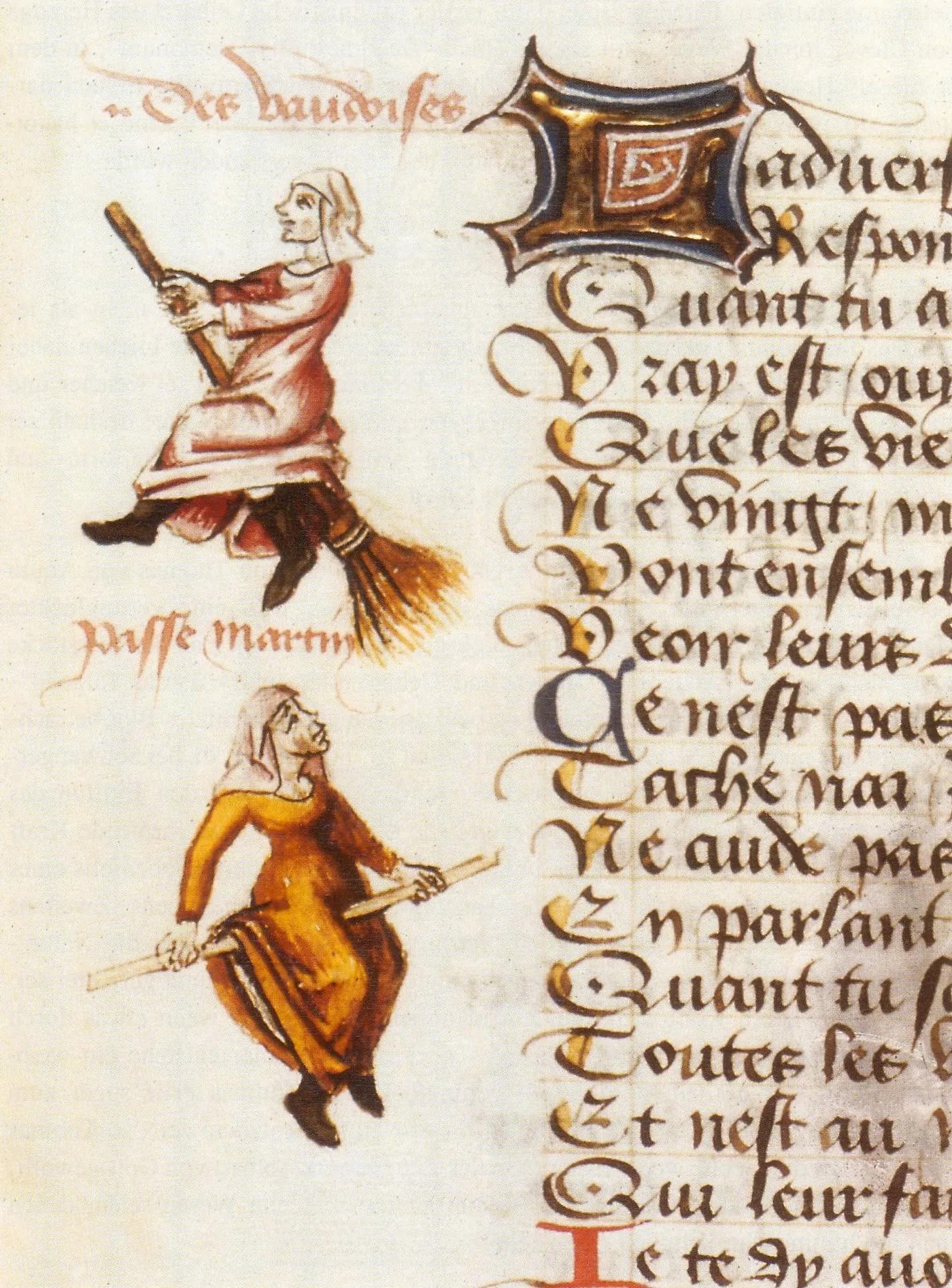
While I was watching the new Marvel spin-off TV series “Agatha All Along”, which revolves around a coven of witches, I wondered when witches were first depicted flying on broomsticks. Thanks to the net the answer involved the image pictured above, Witches illustrated in Martin Le Franc’s ‘Le Champion des Dames’ (1451) (via Bibliothèque nationale de France (BNF)/Wikimedia).
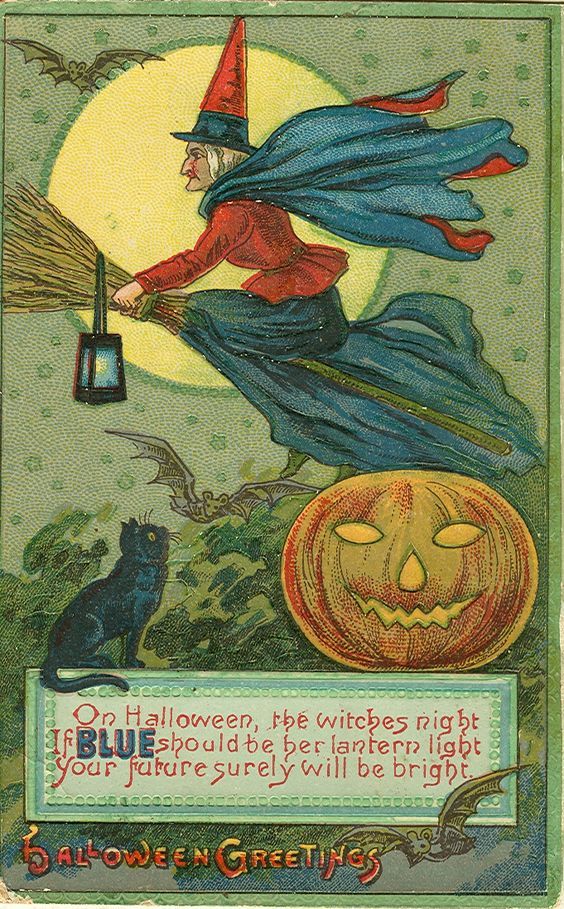
The visual of the witch on a broomstick is so ubiquitous as to be benign. Before the Wicked Witch of the West or Harry Potter took flight on the spindly cleaning tool, the image first appeared in the 15th century. Two women in marginal illustrations of the 1451 edition of French poet Martin Le Franc’s Le Champion des Dames (The Defender of Ladies), a manuscript now in the Bibliothèque nationale de France (BNF), are soaring, one on a stick, the other on a broom.
According to Witchcraft in Europe, 400-1700: A Documentary History, edited by University of Pennsylvania history professors Alan Charles Kors and Edward Peters, Le Champion des Dames has “the first such illustration in the pictorial history of witchcraft.” Le Franc’s long poem about virtuous women is interrupted by a discussion of witchcraft, and the covered heads of the two women marks them as Waldensians. This Christian movement emerged in the 12th-century. With its tenet that any member could be a priest, even a woman, and perform sacraments and preach, the bloody ire of the Catholic Church soon followed. That these heretics would also meddle with the supernatural was not a leap, but why the broomstick?
Dylan Thuras at Atlas Obscura wrote that the “broom was a symbol of female domesticity, yet the broom was also phallic, so riding on one was a symbol of female sexuality, thus femininity and domesticity gone wild.” The two women in Le Champion des Dames importantly don’t appear deformed or grotesque, they are ordinary; their corruption cannot be visually perceived. And pagan rituals before the 15th century had involved phallic forms, so the shape of the broomstick between a woman’s legs had both a sexual and spiritually deviant meaning to the Church.
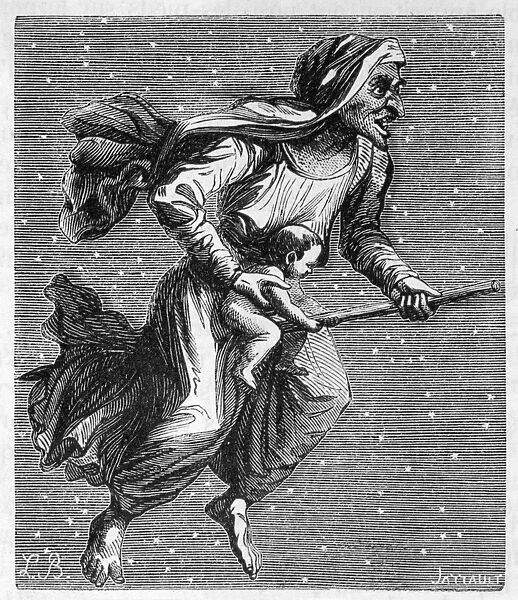
Yet it was racier than that. Richard Cavendish’s 1970 An Illustrated Encyclopedia of the Supernatural cites a man, Guillaume Edelin, who confessed to flying on a broom in 1453 as the first known reference to the act. Just a few years later, in 1456, emerged the mention of “flying ointment.” Either given by the devil or crafted by a witch, the potion allowed a human to take flight, likely for a trip to the Witches’ Sabbath.
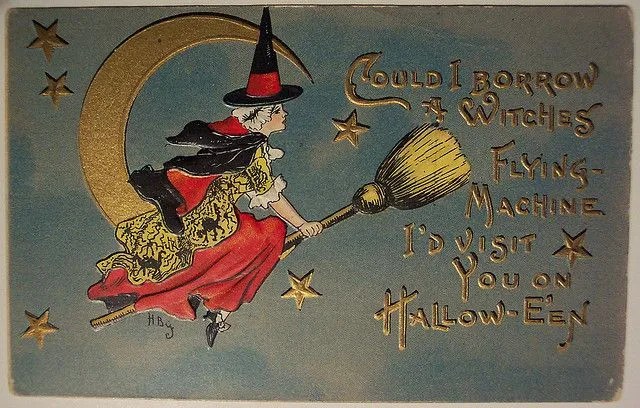
But the image of the witch on the broomstick combined anxieties on women’s sexuality, drug use, and religious freedom into one enduring myth.
via Hyperallergic


 Travel Between The Pages
