

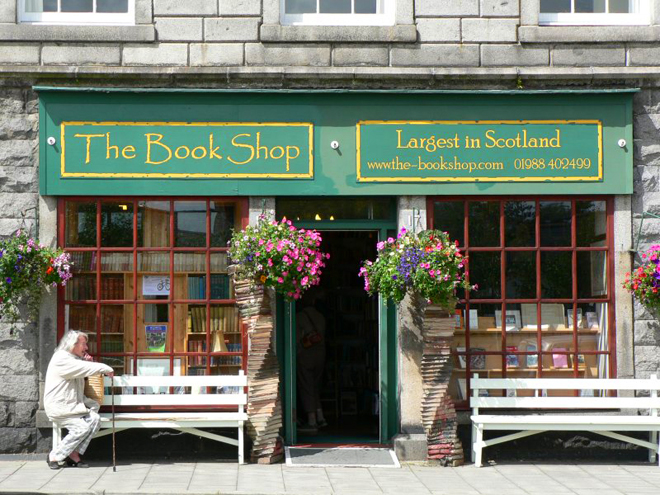
On Saturday, TBTP featured bookseller Shaun Bythell’s tech help tips for coping with a malfunctioning Kindle. It seems that the proprietor of Scotland’s largest secondhand bookstore is also an author. His book, The Diary of a Bookseller, has been available in the U.K. for a few months, but the U.S. edition won’t be released until September 4, 2018. It promises to be an interesting read for booklovers and booksellers alike. Here’s a sample of the forthcoming colonial edition:
Thursday, 13 February
Online orders: 4
Books found: 4
Eliot left for London at 2 p.m.
A young woman and her mother spent most of the afternoon in the shop. The mother seemed well prepared for the temperature, but the daughter appeared to be oblivious to the near-freezing conditions. She chatted breezily away as she was paying, and told me that her name was Lauren McQuistin, and she was training to be an opera singer. She seemed vaguely familiar; must have been in before. She bought an impressive pile of fairly highbrow material and suggested that I read Any Human Heart. Possibly the most recommended book I have been advised to read is William Boyd’s Any Human Heart. I tend to avoid anything that is recommended to me, preferring naively to imagine that I will dig my own literary goldmine, but so compelling was her enthusiasm that after supper I lit the wood-burning stove and began to read it. By bedtime I was completely hooked.
Till total £13
2 customers
Friday, 14 February
Online orders: 4
Books found: 4
If anyone can be said to be a Wigtown institution, it is Vincent. He has been here as long as anyone can remember, although he spent his childhood on the Clyde. He is universally liked, and is interesting and mischievous. There is a rumour that he was educated at Cambridge, but as far as I am aware, nobody has been able to substantiate this. He must be in his eighties, but he still works long hours — longer than any of his mechanics. Vincent’s garage was once a Renault dealership, from which he sold new cars. Indeed, the old showroom is still there, with all the faded and cracked Renault branding on it, but now, instead of shiny new cars, his fleet consists of vehicles that, to put it politely, have seen better days. Once, when a botanist friend was visiting, we went there to fill the van with diesel. My friend leapt excitedly out of the van and headed towards one of Vincent’s fleet, which had been parked outside the showroom with four flat tyres since I have been back in Wigtown. He pointed at a fern that was growing inside the wheel arch and identified it as something quite rare.
After lunch I drove to a farm near Stranraer to give a probate valuation on some books. I was met by a damp, taciturn farmer in a tweed cap who instructed me to follow him on his quad bike, complete with a miserable collie perched precariously on the back, barking at the van all the way. We soon arrived at a desolate-looking farmhouse in the hollow of a muddy hillside, made all the more awful by the incessant, horizontal rain.
Inside, he explained that the house had belonged to his uncle and aunt. She had died five years previously and the uncle two years ago. It was clear that nothing had been touched since then, or in fact probably in the five years since his aunt had died. A lonely looking cat lay on a blanket on a radiator by the window and stared out across the flooded fields. The farmer went up every day to empty the litter tray and feed it. Everything was covered in dust and cat hair. There were about two thousand books, crammed into every nook and cranny, including a pile on every step of the stairs. The aunt was the reader. L. M. Montgomery, Star Trek, Agatha Christie, Folio Society and a lot of children’s books, including many complete runs. Most were paperbacks and not in particularly good condition, thanks in part to the cat. I valued the lot at £300, and he asked if I would consider buying them once he had discussed it with his family. I told him that I would, but that a lot of it was rubbish. He replied that if he decided to sell them to me, it would be conditional on the entire lot being taken away.
When I returned to the shop at 3 p.m., I was immediately accosted by a customer who marched up to the counter without the slightest of pleasantries and barked, ‘Gold markings.’ I sighed inside and explained where the jewellery section was.
Till total £307.50
4 customers
Saturday, 15 February
Online orders: 6
Books found: 6
Yet another miserable day, which did not improve at 9.10 a.m., when the telephone rang: ‘It’s a bloody disgrace. I don’t know how you have the nerve to call yourself a bookseller, sending out this sort of rubbish,’ etc. He continued in this vein for several minutes. On further questioning, it transpired that he had ordered a book from a shop with a similar name (not unusual, as Tom Jones so wisely said), and he was not happy with the condition it was in. When it became clear that he’d telephoned the wrong bookshop and that the whole affair was nothing to do with us, he told me that he would be ‘taking the matter further,’ then hung up.
A woman wearing what appeared to be a sleeping bag with a hole cut in the top for her head and the bottom for her feet complained about the icy temperature in the shop. The shop is old, cold and rambling. It is a large, granite-fronted building on the broad main street of Wigtown. In the early nineteenth century it was the home of a man called George McHaffie. He was the town’s provost, and he rebuilt the property in the Georgian style, which it retains to this day. The entire ground floor is now devoted to books, and at the last count there were about 100,000 of them. In the past fifteen years we have replaced every shelf and done considerable work, both structural and cosmetic. Customers often refer to it as ‘an Aladdin’s cave’ or ‘a ‘labyrinth.’ I removed the internal doors in the shop to encourage customers to explore more, but this, and the fact that it is a huge, old house with inadequate heating, often lead to unflattering comments about the temperature from customers.
Till total £336.01
8 customers







 Travel Between The Pages