Winston Churchill is considered by many historians to be among the finest orators and writers of the twentieth century. His speeches galvanized Great Britain at its darkest hour during World War II, and his letters to President Franklin D. Roosevelt were instrumental in building support for the war effort from the United States, the country of Churchill’s mother’s birth. Awarded the Nobel Prize for Literature in 1953 for his contribution to the written and spoken word, Churchill became an icon of the post-war age, an internationally recognized leader admired throughout the free world.
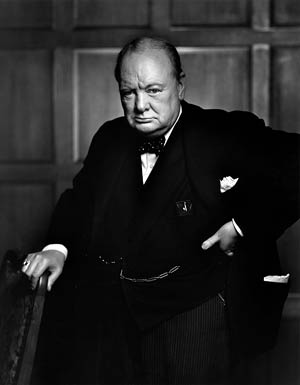
Churchill: The Power of Words, on view from June 8 through September 23, 2012 at The Morgan Library & Museum, brings to life the man behind the words through some sixty-five documents, artifacts, and recordings, ranging from edited typescripts of his speeches to his Nobel Medal and Citation to excerpts from his broadcasts made during the London blitz. Items in the exhibition are on loan from the Churchill Archives Centre at Churchill College, University of Cambridge, as well as from Churchill’s house at Chartwell in Kent, which is administered by Britain’s National Trust. The exhibition is designed with a contemporary audience in mind, and includes a compelling audio-visual space where visitors may listen to Churchill’s major speeches, as well as an interactive timeline with touch screens that explores the context of Churchill’s broadcasts and writings with related images.

Yalta summit in February 1945 with (from left to right) Winston Churchill, Franklin Roosevelt and Joseph Stalin. Also present are USSR Foreign Minister Vyacheslav Molotov (far left); Admiral of the Fleet Sir Andrew Cunningham, RN, Marshal of the RAF Sir Charles Portal, RAF, (both standing behind Churchill); Field Marshal Alan Brooke and Fleet Admiral William D. Leahy, USN, (standing behind Roosevelt). Note ornate carpets under the chairs. (Photo credit: Wikipedia)
“Few modern statesmen have approached Sir Winston Churchill’s skill with the written and spoken word,” said William M. Griswold, director of The Morgan Library & Museum. “He made his name as a writer, he funded his political career with his pen, and he carefully crafted his words to serve as tools for international diplomacy and as patriotic symbols for a nation at war. This exhibition shows why words matter, and how they can make a difference for the better, and it is therefore particularly appropriate that the Morgan, with its extraordinary literary collections, should host this exhibition.” Allen Packwood, director of the Churchill Archives Centre, said: “The incredible collections of The Morgan Library & Museum represent the literary, artistic and cultural tradition that informed the writings of Winston Churchill, and the world he fought to preserve. There can be no better venue for this exhibition. The Power of Words “In the dark days and darker nights when Britain stood alone—and most men save Englishmen despaired of England’s life—he mobilized the English language and sent it into battle.” —John F. Kennedy, April 9, 1963
The physical and intellectual heart of the exhibition is Churchill’s own voice, as recorded in some of the broadcasts that were received in the United States, and as set out on the page in his own annotated speaking notes. The exhibition highlights a number of the speeches that he made between October 1938, when Hitler began to dismember Czechoslovakia, and December 1941, when Pearl Harbor brought the United States fully into World War II. Churchill’s broadcast to the United States on October 16, 1938 was made from the political wilderness, as he no longer held high political office in Britain, but is a powerful articulation of the need for the United States to become more engaged in Europe and to play a role in containing Hitler. It is also a clear statement of the power of words and ideas: “They [the dictators] are afraid of words and thoughts: words spoken abroad, thoughts stirring at home—all the more powerful because forbidden—terrify them. A little mouse of thought appears in the room, and even the mightiest potentates are thrown into panic.” Churchill became Prime Minister on May 10, 1940, the very day that Hitler launched his blitzkrieg offensive against France and the Low Countries. Within weeks, France had fallen, and Britain was facing the possibility of invasion. Churchill’s speeches during the aerial Battle of Britain and the German bombing campaign known as the ‘blitz,’ were composed and delivered at a time of extreme national emergency. Yet Churchill’s words were carefully chosen to deliver several messages simultaneously: maintaining British morale, while also sending a message of hope to occupied Europe, a message of defiance to the enemy, and an appeal for help to President Roosevelt and the people of the United States. Churchill’s speech of September 11, 1940, is a dramatic example, and reaches across the years to another, more recent September 11. His response to the blitz bombing of London, which had begun two days earlier, was to invoke British history in order to send a personal message of defiance to Hitler, stating, “It ranks with the days when the Spanish Armada was approaching the Channel” and, “He [Hitler] hopes by killing large numbers of civilians, and women and children, that he will terrorize and cow the people of this mighty Imperial city, and make them a burden and anxiety to the Government, and thus distract our attention unduly from the ferocious onslaught he is preparing. Little does he know the spirit of the British Nation.” The documents on view provide a unique insight into the development of these great speeches, from the first heavily annotated typescripts to the final speaking notes, set out in a blank verse format that enabled Churchill to achieve the memorable rhythm, emphasis, and phrasing of his speeches and broadcasts. Churchill’s typed speeches served as a prompt-copy for his performance, and in these documents one can see vividly his mind at work. The Making of the Man How did Churchill’s power with words develop? His school records show that he was far from a model pupil. But the early death of his father, and the sudden need to make a name and an income, led him to pick up his pen while serving as an officer in the British army.
The exhibition features some of Churchill’s early letters and writings. In 1897 he managed to get himself attached to the Malakand Field Force fighting against the Pathan people in what is now Afghanistan. A letter to his mother, written after his return, reveals his yearning for a mention in military dispatches: “I am more ambitious for a reputation for personal courage than of anything else in the world. A young man should worship a young man’s ideals.” One of the few handwritten pages that survive from Churchill’s draft of his first book, The Malakand Field Force, is on view. Written one hundred and fifteen years ago, and published in 1898, his remarks about the challenges of fighting in the hills of Afghanistan resonate to this day. Progressing through the exhibition, the visitor is able to see Churchill’s writing grow in breadth and confidence. Churchill not only made history, he wrote history, and in 1953 he was rewarded with the Nobel Prize in Literature. The Nobel Medal and Citation, on loan from the National Trust, Chartwell, are a fitting centerpiece to the exhibition and serve as definitive recognition that this man of action was also always a man of words. The Man behind the Myth Churchill’s public writings and speeches are powerfully juxtaposed with some of his personal and official correspondence. While resolute in public, his telegram to Roosevelt’s key adviser Harry Hopkins, written in August 1941, sees him voicing his fears over lack of greater American involvement in the war: “…there has been a wave of depression through Cabinet and other informed circles here about President’s many assurances about no commitments and no closer to war etc.” Churchill’s immediate response to Pearl Harbor was to fire off a telegram to Irish Prime Minister Eamon de Valera, offering, “Now is your chance. Now or Never. ‘A Nation once again’.” By opening up the Churchill dispatch box we gain some insights into the personalities behind the politics; Roosevelt’s telegram to Churchill on D-Day, or King George VI’s handwritten message to Churchill about Roosevelt’s death, serve to remind us that these were real people wrestling with enormous, unprecedented challenges. On a lighter note, Churchill’s letter to the Duke of Devonshire upon receiving the gift of a living lion in 1943, reveals his mischievous side, showing that, even at times of great stress, words and wit could be used to enliven events. A New York Homecoming Half American by birth—his mother, Jennie Jerome, who became Lady Randolph Churchill, was born in Brooklyn, New York—Churchill became an Honorary United States Citizen just before his death. He was a lifelong observer of American affairs, and New York was both the first (1895) and last (1961) American city he visited. Churchill’s first experience of Manhattan came in November 1895, just short of his twenty-first birthday, and en route to observe military action in Cuba. He was well looked after by his mother’s friends and relatives and in a letter, featured in the exhibition, wrote: “What an extraordinary people the Americans are! Their hospitality is a revelation to me and they make you feel at home and at ease in a way that I have never before experienced. On the other hand their press and their currency impress me very unfavourably.” While New York was often a place to relax, there were incidents. In December 1931 he made the very British mistake of looking the wrong way while crossing Fifth Avenue and was hit by an automobile. The collision occurred at Fifth Avenue and 76th Street, at a time when traffic was still two-way on Fifth. For Churchill the accident meant a hospital stay, a lecture tour postponed, and a long recovery. Yet he turned it to his advantage, writing some newspaper articles on what it was like to be run down, and securing a doctor’s prescription, on view in the exhibition, for alcohol—for medicinal purposes—at the height of prohibition! In March 1946, Churchill came to New York fresh from having delivered his famous “Iron Curtain” speech at Fulton, Missouri. It is now largely forgotten just how controversial that speech was, criticizing the Soviet Union, with whom the United States and Britain were still allied, so soon after the end of the Second World War. Churchill was forced to defend his remarks in the address he gave at the Waldorf Astoria, and found himself on the receiving end of both a ticker tape parade and some protest demonstrations. Ultimately, however, Churchill was deeply revered in New York and in the United States, and remains so to this day. He was only the second person to be accorded Honorary US Citizenship (ironically, the first was Lafayette, for fighting the British). The exhibition features the grant of Citizenship, signed by President Kennedy in April 1963, and the accompanying passport, which Churchill was not able to use before his death in January 1965.
Churchill: The Power of Words includes the following primary components: • A display of approximately sixty-five key documents and artifacts, with particular focus on his own writings and the ways in which he used the power of words in his political, literary, and personal life to underpin his career, to engage with the United States, and to mobilize international opinion against fascism in the 1930s and 1940s, and communism in the 1940s and 1950s. • An audio-visual space at the center of the gallery, allowing visitors to listen to a number of Churchill’s famous broadcasts, drawn from the important period of 1938-46, and to hear audio tie-ins to some of the original speech drafts and notes on display. The sound will be complemented by images from the period, and with the text of notable passages flashed onto the screens to reinforce the audio message. • An interactive timeline, which will run on two touch screens, and feature all the documents appearing in the gallery reproduced in full, along with related images and extra contextual information. This element of the exhibition will allow visitors to explore the show’s written content in a much deeper and more detailed manner.
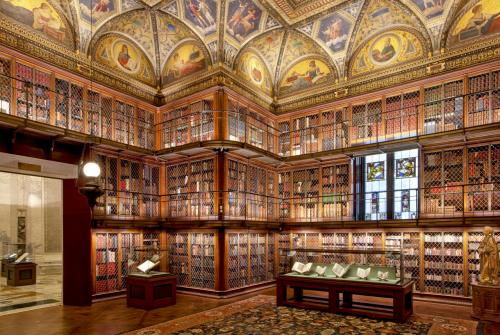
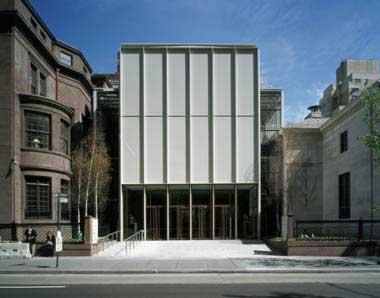
The Morgan Library & Museum The Morgan Library & Museum began as the private library of financier Pierpont Morgan, one of the preeminent collectors and cultural benefactors in the United States. Today, more than a century after its founding in 1906, the Morgan serves as a museum, independent research library, musical venue, architectural landmark, and historic site. In October 2010, the Morgan completed the first-ever restoration of its original McKim building, Pierpont Morgan’s private library, and the core of the institution. In tandem with the 2006 expansion project by architect Renzo Piano, the Morgan now provides visitors unprecedented access to its world-renowned collections of drawings, literary and historical manuscripts, musical scores, medieval and Renaissance manuscripts, printed books, and ancient Near Eastern seals and tablets. General Information The Morgan Library & Museum 225 Madison Avenue, at 36th Street, New York, NY 10016-3405 212.685.0008 www.themorgan.org Just a short walk from Grand Central and Penn Station Hours Tuesday-Thursday, 10:30 a.m. to 5 p.m.; extended Friday hours, 10:30 a.m. to 9 p.m.; Saturday, 10 a.m. to 6 p.m.; Sunday, 11 a.m. to 6 p.m.; closed Mondays, Thanksgiving Day, Christmas Day, and New Year’s Day. The Morgan closes at 4 p.m. on Christmas Eve and New Year’s Eve. Admission $15 for adults; $10 for students, seniors (65 and over), and children (under 16); free to Members and children 12 and under accompanied by an adult. Admission is free on Fridays from 7 to 9 p.m.
Related articles
- Winston Churchill Library To Be Created In D.C. (baltimore.cbslocal.com)
- A Point of View: Churchill and the birth of the special relationship (bbc.co.uk)
- Plans for Winston Churchill centre in Israel spark controversy (telegraph.co.uk)








 Travel Between The Pages