Bye-Bye Banned Books Week (til next year)

Posted in Books, Freedom of Speech, Libraries, USA | Leave a comment

Remembering the Bookseller, Not the Books

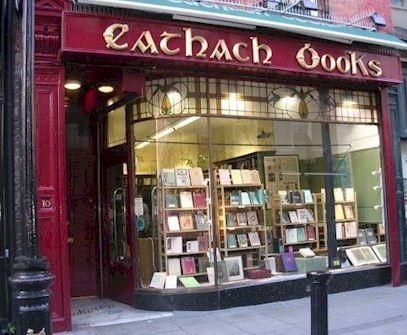
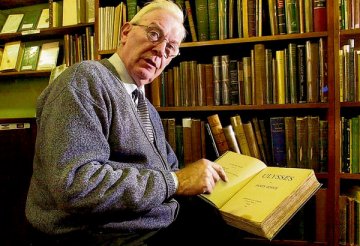
I was saddened to hear this week of the passing of Dublin’s most genial bookseller, Mr.Enda Cunningham of Cathach Books on Duke Street. It’s been about four years since I last visited the bookshop, and I can’t recall the last titles that I purchased there, but I do fondly remember “talking” Irish travel books with Mr. Cunningham and his generous recommendations of other shops to visit in town. Here’s a heartwarming remembrance of Mr. Cunningham by Kevin Cullen of The Irish Times.

ENDA CUNNINGHAM was the Don Quixote of Duke Street. The deep-pocket multinationals and chain stores were his windmills, and he didn’t tilt at them as much as he defied them.

His iconic shop, Cathach Books, with its blood-red frame and inviting plate glass window, is one of the last independent bookshops in Dublin.It has stood in the same spot at 10 Duke Street for 22 years. The first Dublin incarnation of Cathach was in Market Arcade for nine years before that.

Cunningham was working as a schoolteacher in his native Carrick in Donegal when he opened the first Cathach Books more than 40 years ago.He named it after the ancient manuscript of psalms. A battle over the ownership of the original manuscript, amounting to the first copyright dispute, led to a war. Cunningham reasoned that fighting over words was a most appropriate theme for an Irish bookshop.

He moved the business to Dublin 31 years ago, and when Cathach Books moved to Duke Street, it was just a short stroll from what’s left of the original Cathach manuscript at the Royal Irish Academy on Dawson Street.

When Cunningham first opened in Dublin, he was more of an idealist than a businessman. One of his first customers was a man who claimed his wife had bought him a book at Cathach that he already had. Cunningham had given the man a refund and the man was well down Grafton Street before Cunningham checked his files and realised that besides lying about his wife buying the book in the first place the man had nicked the book on the way out the door.

Cunningham’s business acumen grew through the years. Cathach specialises in rare books, first and second editions, and there is an impressive map collection downstairs. He came to regard his job as that of a gold prospector, sifting through silt for valuable nuggets. It was important not to rely on only first impressions. He had to dramatically increase the price of a 1922 facsimile of The Book of Kells when he noticed it had been inscribed by James Joyce to one of Nora Barnacle’s uncles.

The writing was never on the walls at Cathach, but the writers were.Stenciled caricatures of Heaney, Swift, Goldsmith, Wilde, Shaw, Joyce, Yeats and O’Casey look down upon the browsers with stern approval.

Like the late, lamented Parsons of Baggot Street Bridge, Cathach is one of those bookshops where it is not uncommon to find yourself leafing through a book while standing next to its author. Anne Enright and John Banville are frequent visitors, as is Joe O’Connor. Brendan Kennelly, the poet, appreciated the shop’s impressive number of works in Irish, as does Brian Lenihan, the Minister of Finance. Whenever he was in Dublin, Brian Friel would drop in to chat with his old friend Enda Cunningham.

Cunningham was more than a kind, genial bookseller. He was a publisher and a man devoted to preserving history, literary and otherwise. He founded Four Masters Press which, among other things, published John O’Donovan’s Ordnance Survey Letters, a treasure trove of information about how and why people named places throughout Ireland before the Famine.

He didn’t do it for the money. For love of history, Cunningham would empty his own pockets. He commissioned a pair of plaques in Cornish, New Hampshire – one of the Dublin-born sculptor Augustus Saint-Gaudens, the other of the Carrick-born Mary Cunningham – to commemorate an obscure moment in American history. Mary Cunningham, his father’s cousin, had left Donegal for America and by chance became the model for Miss Liberty when Saint-Gaudens redesigned American coins at the behest of President Teddy Roosevelt in the early 20th century.

Growing up in Donegal’s Gaeltacht, Enda Cunningham retained a deep, spiritual love of the language, which was in evidence throughout his shop, no more prominently than on his business card, which listed his name as Eanna Mac Cuinneagain. The anglicised version was in parentheses.

In recent years, Cunningham fretted over the prospects of keeping an independent shop alive in a market where the rents are high and the chain stores hover like vultures. He turned over the day-to-day running of the shop to two of his five children, David and Aisling. Together, they created something of a hybrid, relying on both the Internet, for an increasing international clientele, and the constant walk-ins of tourists, academics, artists and punters.

Two years ago, Enda Cunningham was diagnosed with cancer. He appeared to have beaten it but it returned this year with a vengeance. He fought it with everything he had. He died, aged 82, in his home in Castleknock on September 15th, surrounded by his family. Two days later, he was buried in his native Carrick, in a grave he went to knowing that Cathach, the bookshop, has the convention-defying staying power of Cathach, the manuscript. A third generation of the family, brother and sister David and Shauna O’Brien, has started working at the shop .
Posted in Books, Europe | Tagged , | Leave a comment

Why Not Moby-Dick ?

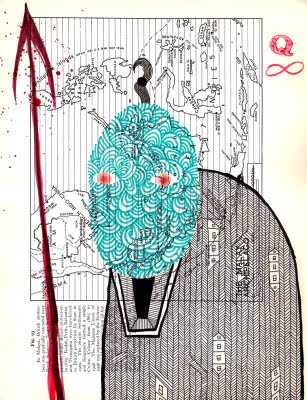
Inspired by Zak Smith’s Gravity’s Rainbow project and the Blood Meridian project, artist/illustrator/librarian Matt Kish has created the Every Page of Moby-Dick blog, where he posts one drawing per day illustrating each of the 540 pages of the Signet Classic edition of Moby-Dick.

Begining in August 2009, Kish is now up to page 391. After completing the Melville project, Kish plans on undertaking a similar blog on Joseph Conrad’s Heart of Darkness. The original paintings from the current project can be viewed and purchased on Kish’s website spudd64.

If you still can’t get enough of Melville’s masterpiece, visit the amazing Power Moby-Dick website, which offers a terrific fully annotated version of the novel.

Posted in Art, Books, History, USA, Writing | Tagged , | 5 Comments

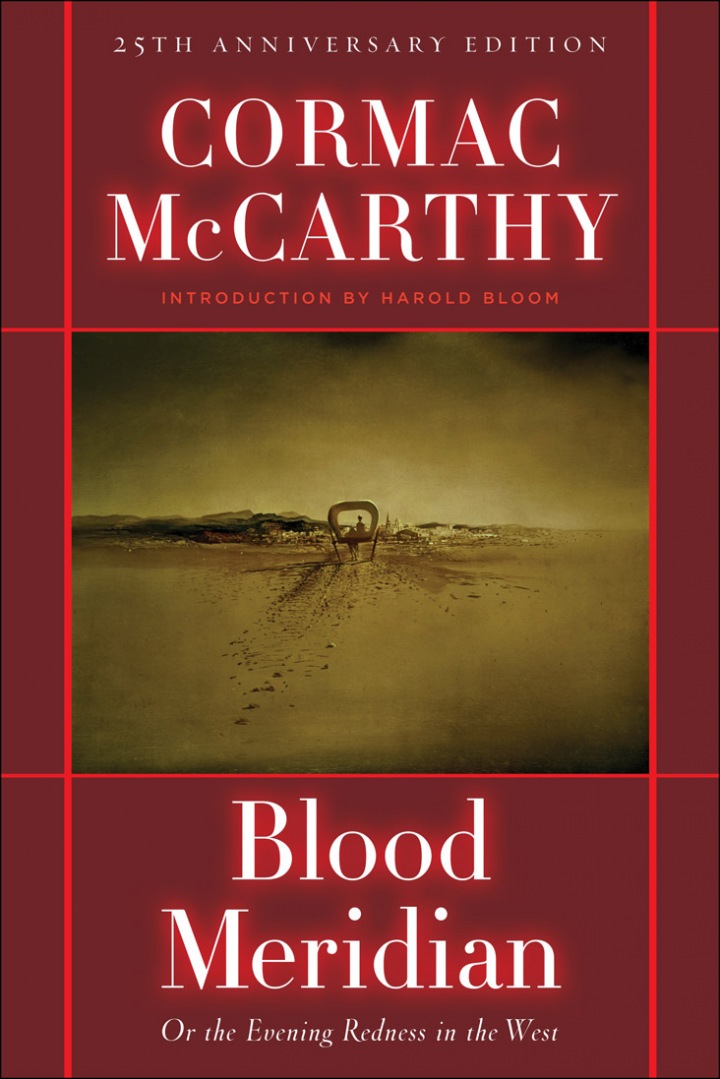
Blood Meridian at 25

This week, Random House is commemorating the 25th anniversary of Cormac McCarthy’s blood-soaked, horror-story of a Western, Blood Meridian, by releasing a special hardcover Modern Library edition of the novel.

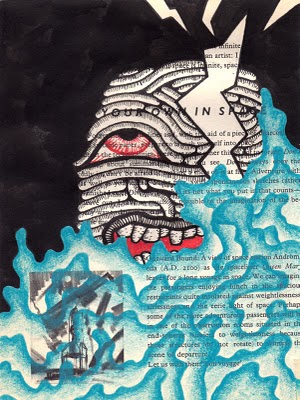
McCarthy fans will also want to check-out an amazing ongoing project, Six Versions of Blood Meridian, where six artists—John Mejias, Sean McCarthy, Zak Smith, Matt Wiegle, Craig Taylor and Shawn Chang—illustrate every page of the novel.

Zak Smith’s earlier project, Illustrations for every page of Gravity’s Rainbow, is just as impressive.

Posted in Art, Books, USA, Writing | Leave a comment

Great First Lines From Banned Books

If you really want to hear about it, the first thing you’ll probably want to know where I was born… J.D.Salinger Catcher in the Rye

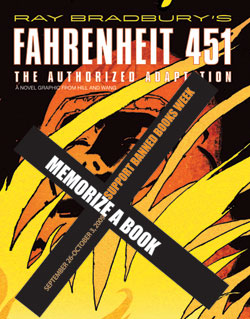
It was a pleasure to burn. Ray Bradbury, Fahrenheit 451

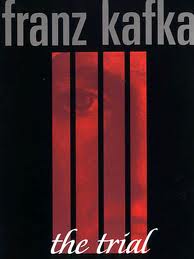
Someone must have slandered Josef K., for one morning, without having done anything wrong, he was arrested. Franz Kafka, The Trial


Lolita, light of my life, fire of my loins. Vladimir Nabokov, Lolita

You don’t know about me without you have read a book by the name of The Adventures of Tom Sawyer, but that ain’t no matter. Mark Twain, Adventures of Huckleberry Finn

It was a bright cold day in April, and the clocks were striking thirteen. George Orwell, 1984


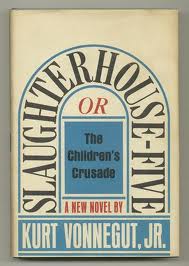
All this happened, more or less. Kurt Vonnegut, Slaughterhouse-Five


It was a queer, sultry summer, the summer they electrocuted the Rosenbergs, and I didn’t know what I was doing in New York. Sylvia Plath, The Bell Jar


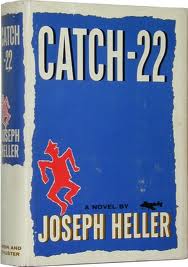
It was love at first sight. Joseph Heller, Catch-22


Stately, plump Buck Mulligan came from the stairhead, bearing a bowl of lather on which a mirror and razor lay crossed. James Joyce, Ulysses


Posted in Books, Freedom of Speech, Writing | Tagged , | 1 Comment

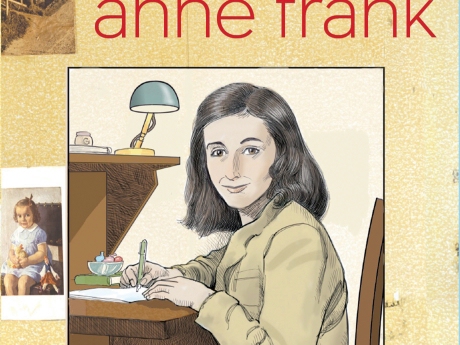
Anne Frank, A Graphic Biography

Many thanks to Nina Dijkstra for this timely post during Banned Books Week:

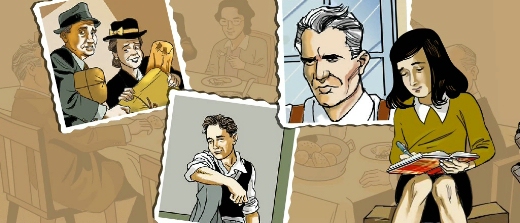
Following the publication of Anne Frank – the graphic biography in the Netherlands at the beginning of July, publications in other countries will follow this autumn. The biography will appear in the USA this week, in France in mid-October and in Germany in early November. Publications in Italy, Spain, Britain, Australia and Israel will follow in 2011. The biography covers the complete life story of Anne Frank in words and images, and makes connections between her life and important historical events. The graphic biography is in book format, and is aimed at a wide audience from 14 years old to adults.  

An animated trailer and a video interview with the authors can be seen on the Anne Frank channel on YouTube.

The Anne Frank House’s mission is to make the life story of Anne Frank accessible to as large an audience as possible. A graphic biography is an effective form to reach both young people and adults. Following positive experiences with two earlier educational graphic novels with drawings by Eric Heuvel – ‘A Family Secret’ and ‘The Search’ – the Anne Frank House decided to also depict the life of Anne Frank in this innovative and accessible manner and has now authorised a graphic narrative of the life of Anne Frank. 

The story of Anne Frank and the Second World War 

The biography starts with the life of Anne Frank’s parents – Otto and Edith – and the first years of the sisters Anne and Margot in Frankfurt. The biography ends with the return of Otto Frank – who was the only one of the eight people in hiding in the secret annexe to survive the Holocaust – and the publication of Anne’s diary and the opening of the Anne Frank House. Anne Frank’s life story is told in parallel with important historical events surrounding the Holocaust and the Second World War.

International partnerships 

In the USA there is a long tradition of graphic books on serious subjects, known as graphic non-fiction, and the genre is also becoming more popular in the Netherlands. Together with publisher Hill & Wang, the Anne Frank House approached a renowned creative team – writer Sid Jacobson and artist Ernie Colón – to develop the biography. With The 9/11 Report and several other works, Jacobson and Colón have shown that they can make complex information accessible with creativity, rich imagery and integrity. Sid Jacobson and Ernie Colón have worked on the biography of Anne Frank with great dedication, assisted by experts from the Anne Frank House. “This is a crown on our careers”, say the authors.

International publications 

The biography is being published in a number of countries. L Publishers (an imprint of Luitingh Publishers) will publish the biography in the Netherlands, Hill & Wang in the United States, Canada and other English-speaking countries, Les Editions Belin in France, Carlsen Verlag in Germany, Rizzoli/Lizard in Italy, Norma in Spain, MacMillan in Great Britain and Australia, and Kinneret and Yad Vashem in Israel.

Posted in Books, Europe, Freedom of Speech, History, Museums, Writing | Tagged , , | Leave a comment

Campaign For Real Books

Many thanks to contributor Evan Smythe for this post:

Over the past year, the media has reported  over-the-top claims for e-book readers sales and the  escalating sales of e-books. Clearly, e-books have a place in the book reading world but they will not replace printed books. If people want printed books they will survive anyway but what we don’t want is hype for a product that may not survive the test of time. Did the IBM PC make for a paperless office as once claimed? No. Did television kill the cinema? No.  Then there was the craze for CB radios which was the ‘must have’ gadget at the time.  So are we now witnessing a similar craze with e-books but on a much greater scale?
  Publishing e-books suit publishers for they remove so many business and financial risks from the act of publishing compared to producing a printed book: how many to print, storage and logistic costs, warehousing and distribution are just some of the factors. If publishers and the media have their way, our trade may not have the volume of titles to sell. Quite rightly, traditionalists, bibliophiles, booksellers and book dealers, who value the printed book have expressed concern that the media is doing its best to devalue the printed word. We all know the advantages of a printed book but does the public?
  Today, an embryonic idea for promoting the printed book has been launched – CAMBO, the Campaign for Real Books. The brainchild of  UK journalist Jeremy Carson who regularly writes in book trade magazines under the pen name of betweenthelines.
  His idea is certainly worth a moment or two of your time – read what he is proposing for sooner or later if the printed book is to survive in style some action along these lines will be vital to support the printed word. We need to let publishers know that there are people who still like to read the printed word and for whom the e-reader is less than ideal. You may not agree with all the reasons put forward for CAMBO, but you will surely agree that a focal point to promote the printed book is in all our interests.
  Although this is a UK based initiative, it is clear the concept could spread to other countries. So, wake-up  North America.

Posted in Books, Bookstore Tourism, Canada, Europe, Freedom of Speech, Libraries, USA, Writing | 2 Comments

Museum of Innocence

Turkey’s most celebrated living novelist, Orhan Pamuk, is turning his fictional Museum of Innocence into a real tourist attraction in Istambul. The winner of the 2006 Nobel Prize for Literature is transforming an old building in central istambul into a real-life incarnation of the shrine to lost love that his character Kemal Basmaki created in the novel  The Museum of Innocence.

The idiocyncratic institution, which is due to open in early 2011, will house 83 exhibits relating to the 83 chapters of the book. Supported by the Istambul 2010 European Capital of Culture project, this unique museum will also be an exclusive attraction with a strict limit on the number of visitors admitted each day.

Posted in Books, Museums, Tourism, Writing | Tagged , | 1 Comment

Covering Lolita

Many thanks to author and jounalist Dieter Zimmer for this post:

Vladimir Nabokov’s modern classic, Lolita, has been banned many time since its first publication in the U.S. . Author Dieter Zimmer has put together an impressive collection of 150 book covers and media images from 33 countries.

Posted in Books, Europe, Freedom of Speech, History, USA, Writing | Tagged , , , | Leave a comment

BANNED ! … Books Week

September 25−October 2, 2010

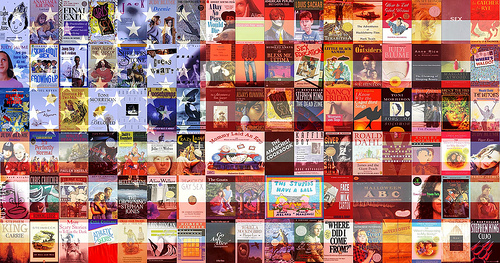
Banned Books Week (BBW) is an annual event celebrating the freedom to read and the importance of the First Amendment.  Held during the last week of September, Banned Books Week highlights the benefits of free and open access to information while drawing attention to the harms of censorship by spotlighting actual or attempted bannings of books across the United States.

Intellectual freedom—the freedom to access information and express ideas, even if the information and ideas might be considered unorthodox or unpopular—provides the foundation for Banned Books Week.  BBW stresses the importance of ensuring the availability of unorthodox or unpopular viewpoints for all who wish to read and access them.

  Imagine how many more books might be challenged—and possibly banned or restricted—if librarians, teachers, and booksellers across the country did not use Banned Books Week each year to teach the importance of our First Amendment rights and the power of literature, and to draw attention to the danger that exists when restraints are imposed on the availability of information in a free society.

For more information and to take action contact the National Coalition Against Censorship .
Posted in Books, Freedom of Speech, History, Libraries, USA, Writing | Tagged , | 3 Comments