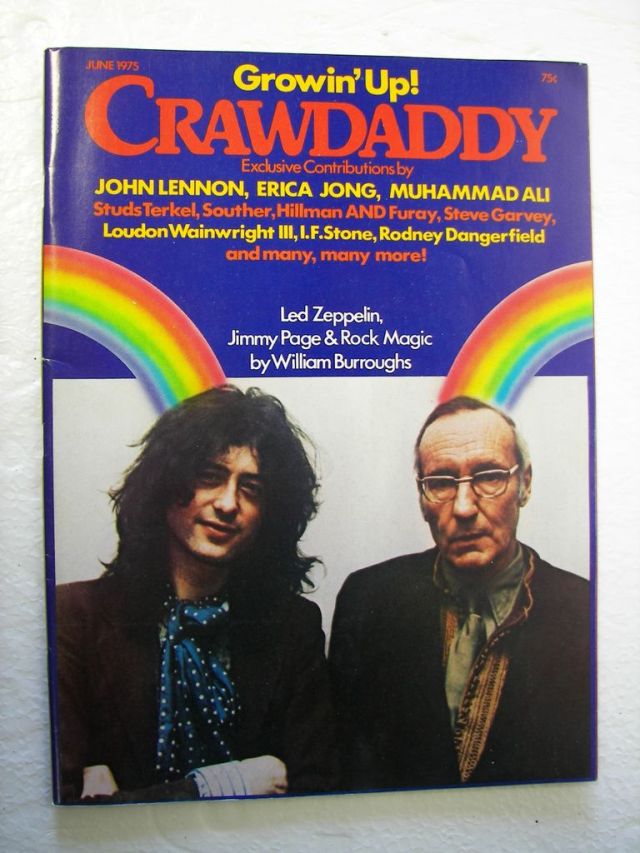
With William Burroughs in the literary news again these days, a mind-bending article from the June 1975 issue of Crawdaddy magazine has surfaced:
When I was first asked to write an article on the Led Zeppelin group, to be based on attending a concert and talking with Jimmy Page, I was not sure I could do it, not being sufficiently knowledgeable about music to attempt anything in the way of musical criticism or even evaluation. I decided simply to attend the concert and talk with Jimmy Page and let the article develop. If you consider any set of data without a preconceived viewpoint, then a viewpoint will emerge from the data.
My first impression was of the audience. As we streamed through one security line after another–a river of youth looking curiously like a single organism: one well-behaved clean-looking middle-class kid. The security guards seemed to be cool and well-trained, ushering gate-crashers out with a minimum of fuss. We were channeled smoothly into our seats in the thirteenth row. Over a relaxed dinner before the concert, a Crawdaddy companion had said he had a feeling that something bad could happen at this concert. I pointed out that it always can when you get that many people together–like bullfights where you buy a straw hat at the door to protect you from bottles and other missiles. I was displacing possible danger to a Mexican border town where the matador barely escaped with his life and several spectators were killed. It’s known as “clearing the path.”
So there we sat, I decline earplugs; I am used to loud drum and horn music from Morocco, and it always has, if skillfully performed, an exhilarating and energizing effect on me. As the performance got underway I experienced this musical exhilaration, which was all the more pleasant for being easily controlled, and I knew then that nothing bad was going to happen. This was a safe and friendly area–but at the same time highly charged. There was a palpable interchange of energy between the performers and the audience which was never frantic or jagged. The special effects were handled well and not overdone.
A few special effects are much better than too many. I can see the laser beams cutting dry ice smoke, which drew an appreciative cheer from the audience. Jimmy Page’s number with the broken guitar strings came across with a real impact, as did John Bonham’s drum solo and the lyrics delivered with unfailing vitality by Robert Plant. The performers were doing their best, and it was very good. The last number, “Stairway to Heaven”, where the audience lit matches and there was a scattering of sparklers here and there, found the audience well-behaved and joyous, creating the atmosphere of a high school Christmas play. All in all a good show; neither low nor insipid. Leaving the concert hall was like getting off a jet plane.
I summarized my impressions after the concert in a few notes to serve as a basis for my talk with Jimmy Page. “The essential ingredient for any successful rock group is energy–the ability to give out energy, to receive energy from the audience and to give it back to the audience. A rock concert is in fact a rite involving the evocation and transmutation of energy. Rock stars may be compared to priests, a theme that was treated in Peter Watkins’ film ‘Privilege’. In that film a rock star was manipulated by reactionary forces to set up a state religion; this scenario seems unlikely, I think a rock group singing political slogans would leave its audience at the door.
“The Led Zeppelin show depends heavily on volume, repetition and drums. It bears some resemblance to the trance music found in Morocco, which is magical in origin and purpose–that is, concerned with the evocation and control of spiritual forces. In Morocco, musicians are also magicians. Gnaoua music is used to drive out evil spirits. The music of Joujouka evokes the God Pan, Pan God of Panic, representing the real magical forces that sweep away the spurious. It is to be remembered that the origin of all the arts–music, painting and writing–is magical and evocative; and that magic is always used to obtain some definite result. In the Led Zeppelin concert, the result aimed at would seem to be the creation of energy in the performers and in the audience. For such magic to succeed, it must tap the sources of magical energy, and this can be dangerous.”
THE INTERVIEW
I felt that these considerations could form the basis of my talk with Jimmy Page, which I hoped would not take the form of an interview. There is something just basically WRONG about the whole interview format. Someone sticks a mike in your face and says, “Mr. Page, would you care to talk about your interest in occult practices? Would you describe yourself as a believer in this sort of thing?” Even an intelligent mike-in-the-face question tends to evoke a guarded mike-in-the-face answer. As soon as Jimmy Page walked into my loft downtown, I saw that it wasn’t going to be that way.
We started talking over a cup of tea and found we have friends in common: the real estate agent who negotiated Jimmy Page’s purchase of the Aleister Crowley house on Loch Ness; John Michel, the flying saucer and pyramid expert; Donald Camel, who worked on ‘Performance’; Kenneth Anger, and the Jaggers, Mick and Chris. The subject of magic came up in connection with Aleister Crowley and Kenneth Anger’s film ‘Lucifer Rising’, for which Jimmy Page did the sound track.
Since the word “magic” tends to cause confused thinking, I would like to say exactly what I mean by “magic” and the magical interpretation of so-called reality. The underlying assumption of magic is the assertion of ‘will’ as the primary moving force in this universe–the deep conviction that nothing happens unless somebody or some being wills it to happen. To me this has always seemed self-evident. A chair does not move unless someone moves it. Neither does your physical body, which is composed of much the same materials, move unless you will it to move. Walking across the rooom is a magical operation. From the viewpoint of magic, no death, no illness, no misfortune, accident, war or riot is accidental. There are no accidents in the world of magic. And will is another word for animate energy. Rock stars are juggling fissionable material that could blow up at any time… “The soccer scores are coming in from the Capital…one must pretend an interest,” drawled the dandified Commandante, safe in the pages of my book; and as another rock star said to me, “YOU sit on your ass writing–I could be torn to pieces by my fans, like Orpheus.”
I found Jimmy Page equally aware of the risks involved in handling the fissionable material of the mass unconcious. I took on a valence I learned years ago from two ‘Life-Time’ reporters–one keeps telling you these horrific stories: “Now old Burns was dragged out of the truck and skinned alive by the mob, and when we got there with the cameras the bloody thing was still squirming there like a worm…” while the other half of the team is snapping pictures CLICK CLICK CLICK to record your reactions–so over dinner at Mexican Gardens I told Jimmy the story of the big soccer riot in Lima, Peru in 1964.
We are ushered into the arena as VIPs, in the style made famous by ‘Triumph of the Will’. Martial music–long vistas–the statuesque police with their dogs on leads–the crowd surging in a sultry menacing electricity palpable in the air–grey clouds over Lima–people glance up uneasily… the last time it rained in Lima was the year of the great earthquake, when whole towns were swallowed by landslides. A cop is beating and kicking someone as he shoves him back towards the exit. Oh lucky man. The dogs growl ominously. The game is tense. Tied until the end of the last quarter, and then the stunning decision: a goal that would have won the game for Peru is disqualified by the Uruguayan referee. A howl of rage from the crowd, and then a huge black known as La Bomba, who has started three previous soccer riots and already has twenty-three notches on his bomb, vaults down into the arena. A wave of fans follows The Bomb–the Uruguayan referee scrambles off with the agility of a rat or an evil spirit–the police release tear gas and unleash their snarling dogs, hysterical with fear and rage and maddened by the tear gas. And then a sound like falling mountains, as a few drops of rain begin to fall.
“Yes, I’ve thought about that. We all have. The important thing is maintain a balance. The kids come to get far out with the music. It’s our job to see they have a good time and no trouble.”
And remember the rock group called Storm? Playing a dance hall in Switzerland…fire…exits locked…thirty-seven people dead including all the performers. Now any performer who has never thought about fire and panic just doesn’t think. The best way to keep something bad from happening is to see it ahead of time, and you can’t see it if you refuse to face the possibility. The bad vibes in that dance hall must have been really heavy. If the performers had been sensitive and alert, they would have checked to be sure the exits were unlocked.
Previously, over two fingers of whiskey in my Franklin Street digs, I had told Page about Major Bruce MacMannaway, a healer and psychic who lives in Scotland. The Major discovered his healing abilities in World War II when his regiment was cut off without medical supplies and the Major started laying on hands…”Well Major, I think it’s a load of bollocks but I’ll try anything.” And it turns out the Major is a walking hypo. His psychic abilities were so highly regarded by the Admiralty that he was called in to locate sunken submarines, and he never once missed.
I attended a group meditation seminar with the Major. It turned out to be the Indian rope trick. Before the session the Major told us something of the potential power in group meditation. He had seen it lift a six-hundred-pound church organ five feet in the air. I had no reason to doubt this, since he was obviously incapable of falsification. In the session, after some preliminary excercises, the Major asked us to see a column of light in the center of the room and then took us up through the light to a plateau where we met nice friendly people: the stairway to heaven in fact. I mean we were really THERE.
I turned to Jimmy Page: “Of course we are dealing here with meditation– the deliberate induction of a trance state in a few people under the hands of an old master. This would seem on the surface to have a little in common with a rock concert, but the underlying force is the same: human energy and its potential concentration.” I pointed out that the moment when the stairway to heaven becomes something actually POSSIBLE for the audience, would also be the moment of greatest danger. Jimmy expressed himself as well aware of the power in mass concentration, aware of the dangers involved, and of the skill and balance needed to avoid them…rather like driving a load of nitroglycerine.
“There IS a responsibility to the audience,” he said. “We don’t want anything bad to happen to these kids–we don’t want to release anything we can’t handle.” We talked about magic and Aleister Crowley. Jimmy said that Crowley has been maligned as a black magician, whereas magic is neither white nor black, good nor bad–it is simply alive with what it is: the real thing, what people really feel and want and are. I pointed out that this “either/or” straitjacket had been imposed by Christianity when all magic became black magic; that scientists took over from the Church, and Western man has been stifled in a non-magical universe known as “the way things are.” Rock music can be seen as one attempt to break out of this dead soulless universe and reassert the universe of magic.
Jimmy told me that Aleister Crowley’s house has very good vibes for anyone who is relaxed and receptive. At one time the house had also been the scene of a vast chicken swindle indirectly involving George Sanders, the movie actor, who was able to clear himself of any criminal charges, Sanders committed suicide in Barcelona, and we both remembered his farewell note to the world: “I leave you to this sweet cesspool.”
I told Jimmy he was lucky too have that house with a monster in the front yard. What about the Loch Ness monster? Jimmy Page thinks it exists. I wondered if it could find enough to eat, and thought this unlikely–it’s not the improbability but the upkeep on monsters that worries me. Did Aleister Crowley have opinions on the subject? He apparently had not expressed himself.
We talked about trance music. He had heard the Brian Jones record from recordings made at Joujouka. We discussed the possibility of synthesizing rock music with some of the older forms of trance music that have been developed over centuries to produce powerful, sometimes hypnotic effects on the audience. Such a synthesis would enable the older forms to escape from the mould of folk lore and provide new techniques to rock groups.
We talked about the special effects used in the concert. “Sure,” he said, “lights, lasers, dry ice are fine–but you have to keep some balance. The show must carry itself and not rely too heavily on special effects, however spectacular,” I brought up the subject of infra-sound, that is, sound pitched below 16 Hertz, the level of human hearing; as ultra-sound is above the level. Professer Gavreau of France developed infra-sound as a military weapon. A powerful infra-sound installation can, he claims, kill everyone in a five-mile radius, knock down walls and break windows. Infra-sound kills by setting up vibrations within the body so that, as Gavreau puts it, “You can feel all the organs in your body rubbing together.” The plans for this device can be obtained from the French Patent Office, and infra-sound generators constructed from inexpensive materials. Needless to say, one is not concerned with military applications however unlimited, but with more interesting and useful possibilities, reaching much further that five miles.
Infra-sound sets up vibrations in the body and nervous system. Need these vibrations necessarily be harmful or unpleasant? All music played at any volume sets up vibrations in the body and nervous system of the listener. That’s why people listen to it. Caruso as you wil remember could break a champagne glass across the room. Especially interesting is the possibility of rhythmic pulses of infra-sound; that is, MUSIC IN INFRA-SOUND. You can’t hear it, but you can feel it.
Jimmy was interested, and I gave him a copy of a newspaper article on infra-sound. It seems that the most deadly range is around 7 Hertz, and when this is turned on even at a low volume, anyone within range is affected. They feel anxious, ill, depressed, and finally exclaim with one voice, “I feel TERRIBLE!”…last thing you want at a rock concert. However, around the borders of infra-sound perhaps a safe range can be found. Buddhist mantras act by setting up vibrations in the body. Could this be done in a much more powerful yet safe manner by the use of infra-sound rhythms which could of course could be combined with audible music? Perhaps infra-sound could add a new dimension to rock music.
Could something be developed comparable to the sonar communication of dolphins, conveying an immediate sonar experience that requires no symbolic translation? I mentioned to Jimmy that I had talked with Dr. Truby, who worked with John Lilly recording dolphins. Dr. Truby is a specialist in inter-species communication, working on a grant from the government–so that when all our kids are born Venusians we will understand then when they start to talk. I suggested to him that ALL communication, as we know it, is actually inter-species communication, and that it is kept that way by the nature of verbal and symbolic communication, which must be indirect.
Do dolphins have a language? What is a language? I define a language as a communication system in which data are represented by verbal or written symbols–symbols that ARE NOT THE OBJECTS to which they refer. The word “chair” is not the object itself, the chair. So any such system of communication is always second-hand and symbolic, whereas we CAN conceive of a form of communication that would be immediate and direct, undercutting the need for symbols. And music certainly comes closer to such direct communication than language.
Could musical communication be rendered more precise with infra-sound, thus bringing the whole of music a second radical step forward? The first step was made when music came out of the dance halls, roadhouses, and night clubs, into Madison Square Garden and Shea Stadium. Rock music appeals to a mass audience, instead of being the province of a relatively few aficionados. Can rock music make another step forward, or is it a self-limiting form, confirmed by the demands of a mass audience? How much that is radically new can a mass audience safely absorb? We came back to the question of balance. How much new material will be accepted by a mass audience? Can rock music go forward without leaving its fans behind?
We talked about Wilhelm Reich’s orgone accumulator, and I showed him plans for making this device, which were passed along to me by Reich’s daughter. Basically the device is very simple, consisting of iron or steel wool on the inside and organic material on the outside. I think this was highly important discovery. Recently a scientist with the National Aeronautics and Space Administration announced an “electrical cell” theory of cancer that is almost identical to Reich’s cancer theory put forth 25 years ago. He does not acknowledge any indebtedness to Reich. I showed Jimmy the orgone box I have here, and we agreed that orgone accumulators in pyramid form and/or using magnetized iron could be much more powerful.
We talked about the film ‘Performance’ and the use of cut-up techniques in this film. Now the cut-up method was applied to writing by Brion Gysin in 1959; he said that writing was fifty years behind painting, and applied the montage method to writing. Actually, montage is much closer to the facts of perception thatn representational painting. If for example you walked through Times Square, and then put on canvas what you had seen, the result would be a montage…half a person cut in two by a car, reflections from shop windows, fragments of street signs. Antony Balch and I collaborated on a film called ‘Cut-Ups’, in which the film was cut into segments and rearranged at random. Nicholas Roeg and Donald Camel saw a screening of the film not long before they made ‘Performance’.
Musical cut-ups have been used by Earl Browne and other modern composers. What distinguishes a cut-up from, say, an edited medley, is that the cut-up is at some point random. For example, if you made a medley by taking thirty seconds from a number of scores and assembling these arbitrary units–that would be a cut-up. Cut-ups often result in more succinct meanings, rather than nonsense. Here for example is a phrase taken from a cut-up of this article: “I can see the laser gate crashers with an appreciative cheer from the 13th row.” (Actually a gate crasher was extricated by security from the row in front of us; an incident I had forgoten until I
saw this cut-up.)
Over dinner at the Mexican Gardens, I was suprised to hear that Jimmy Page had never heard of Petrillo, who started the first musicians’ union and perhaps did more than any other one man to improve the financial positioin of musicians by protecting copyrights. One wonders whether rock music could have gotten off the ground without Petrillo and the Union, which put musicians in the big money bracket, thereby attracting managers, publicity, and the mass audience.
Music, like all the arts, is magical and ceremonial in origin. Can rock music return to these ceremonial roots and take its fans with it? Can rock music use older forms like Moroccan trance music? There is at present a wide interest among young people in the occult and all means of expanding consciousness. Can rock music appeal directly to this interest? In short, there are a number of disparate tendencies waiting to be synthesized. Can rock music serve as a vehicle for this synthesis?
The broken guitar strings, John Bonham’s drum solo, vitality by Robert Plant–when you get that many people to get it, very good. Buy a straw hat at the door–the audience all light matches. Cool well-trained laser beams channelled the audience smoothly. A scattering of sparklers. Danger to a Mexican border town. We start talking over a cup of the mass unconscious–cut to a soccer riot photo in Lima. The Uruguayan referee as another rock star. Sound like falling mountains of the risks involved. It’s our job to see trouble and plateau the center of the room–remember the stairway to Switzerland? Fire really there. You can’t see it if you refuse–underlying force the same. I mean we were playing a dance hall in heaven at the moment when the stairway actually possible for the audience was unlocked.
WORD FOR WORD
WILLIAM BURROUGHS: I really, really enjoyed the concert. I think it has quite a lot, really, in common with Moroccan trance music.
JIMMY PAGE: Yes, yes.
WB: I wondered if you consciously were using any of that….
JP: Well, yes, there is a little on that perticular track, “Kashmir”–a lead bass on that–even though none of us have been to Kashmir. It’s just that we’ve all been very involved in that sort of music. I’m very involved in ethnic music from all over the world.
WB: Have you been to Morocco?
JP: No. I haven’t, and it’s a very sad admission to make. I’ve only been to, you know, India and Bangkok and places like that through the Southeast.
WB: Well, I’ve never been east of Athens.
JP: Because during the period when everybody was going through trips over to, you know, Morocco, going down, way down, making their own journeys too Istanbul, I was at art college during that period and then I eventually went straight into music. So I really missed out on all that sort of traveling. But I know musicians that have gone there and actually sat in with the Arabs and played with them.
WB: Yeah, well they think of music entirely in magical terms.
JP: Yes.
WB: And their music is definitely used for magical purposes. For example, the Gnaoua music is to drive out evil spirits and Joujouka music is invoking the God Pan. Musicians there are all magicians, quite consciously.
———————————
WB: I was thinking of the concentration of mass energy that you get in a pop concert, and if that were, say, channeled in some magical way…a stairway too heaven…it could become quite actual.
JP: Yes, I know. One is so aware of the energies that you are going for, and you could so easily….I mean, for instance, the other night we played in the Philadelphia Spectrum, which really is a black hole as a concert hall….The security there is the most ugly of anywhere in the States. I saw this incident happen and I was almost physically sick. In fact, if I hadn’t been playing the guitar I was playing it would’ve been over somebody’s head. It was a double-neck, which is irreplaceable, really, unless you wait another nine months for them to make another one at Gibson’s.
What had happened, somebody came to the front of the stage to take a picture or something and obviously somebody said, “Be off with you.” And he wouldn’t go. And then one chap went over the barrier, and then another, and then another and then another, and they all piled on top of…you could see the fists coming out…on this one solitary person. And they dragged him by his hair and they were kicking him. It was just sickening. Now, what I’m saying is this….Our crowds, the people that come to see us are very orderly. It’s not the sort of Alice Cooper style, where you actually TRY to get them into a state where they’ve got to go like that, so that you can get reports of this, that and the other. And the wrong word said at that time could’ve just sparked off the whole thing.
WB: Yes, there’s sort of a balance to be maintained there.
JP: Yeah, that’s right.
WB: The audience the other night was very well behaved.
———————————-
WB: Have you used the lasers in all of the concerts?
JP: Over here, yes.
WB: Very effective.
JP: I think we should have more of them, don’t you? About thirty of them! Do you know they bounced that one off the moon. But it’s been condensed….it’s the very one that they used for the moon. I was quite impressed by that.
WB: That isn’t the kind of machine that would cause any damage….
JP: Uh, if you look straight into it, yes.
WB: Yes, but I mean…it doesn’t burn a hole in…
JP: No….it’s been taken right down. I’m just waiting for the day when you can get the holograms…get three-dimensional. The other thing I wanted to do was the Van de Graaff Generator. You used to see them in the old horror films….
WB: Oh yes…Frankenstein, and all that.
—————————————
JP: When we first came over here… when the draft was really hot and everything…if you stayed in the country for more than six months, you were eligible for it, they’d drag you straight into the draft.
WB: I didn’t realize that.
JP: Yeah.
WB: Oh, I thought you had to be an American citizen.
JP: Noo. No no. We almost overstayed our welcome. I was producing and having to work in studios here, and the days coming up to the six month period were just about…it was just about neck and neck. And I still had a couple more days left and a couple more days to work on this lp.
WB: Were they right there with the papers?
JP: Well, not quite, I mean obviously it would have taken some time, but somebody would’ve been there…You know, they do keep an eye on people.
————————————-
WB: Did you ever hear about something called infra-sound?
JP: Uh, carry on.
WB: Well, infra-sound is sound below the level of hearing. And it was developed by someone named Professor Gavreau in France as a military weapon. He had an infra-sound installation that he could turn on and kill everything within five miles. It can also knock down walls and break windows. But it kills by setting up vibrations within the body. Well, what I was wondering was, whether rhythmical music at sort of the borderline of infra-sound could be used to produce rhythms in the audience–because, of course, any music with volume will set up these vibrations. That is part of the way the effect is achieved.
JP: Hmm.
WB: It’s apparently…it’s not complicated to build these infra-sound things.
JP: I’ve heard of this, actually but not in such a detailed explanation. I’ve heard that certain frequencies can make you physically ill.
WB: Yes. Well, this can be fatal. That’s not what you’re looking for. But it could be used just to set up vibrations….
JP: Ah hah…A death ray machine! Of course, when radio first came out they were picketing all the radio stations, weren’t they, saying “We don’t want these poisonous rays” [laughter]….Yes, well…certain notes can break glasses. I mean, opera singers can break glasses with sound, this is true?
WB: That was one of Caruso’s tricks.
JP: But it is true?
WB: Of course.
JP: I’ve never seen it done.
WB: I’ve never seen it done, but I know that you can do it.
JP: I want laser NOTES, that’s what I’m after! Cut right through.
WB: Apparently you can make one of these things out of parts you can buy in a junk yard. It’s not a complicated machine to make. And actually the patent…it’s patented in France, and according to French law, you can obtain a copy of the patent. For a very small fee.
JP: Well, you see the thing is, it’s hard to know just exactly what is going on, from the stage to the audience…You can only…I mean I’ve never seen the group play, obviously. Because I’m part of it….I can only see it on celluloid, or hear it. But I know what I see. And this thing about rhythms within the audience. I would say yes. Yes, definitely. And it is…Music which involves riffs, anyway, will have a trance-like effect, and it’s really like a mantra….And we’ve been attacked for that.
WB: What a mantra does is set up certain vibrations within the body, and this, obviously does the same thing. Of course, it goes….it comes out too far. But I was wondering if on the borderline of infra-sound that possibly some interesting things could be done.
JP: Ah.
——————————————
JP: Last year we were playing [sets] for three hours solid, and physically that was a real…I mean, when I came back from the last tour I didn’t know where I was. I didn’t even know where I was going. We ended up in New York and the only thing that I could relate to was the instrument onstage. I just couldn’t….I was just totally and completely spaced out.
WB: How long was that you played recently? That was two hours and a half.
JP: That was two and a half hours, yes. It used to go for three hours.
WB: I’d hate to give a three-hour reading….























 Travel Between The Pages