Egyptian Book of the Dead

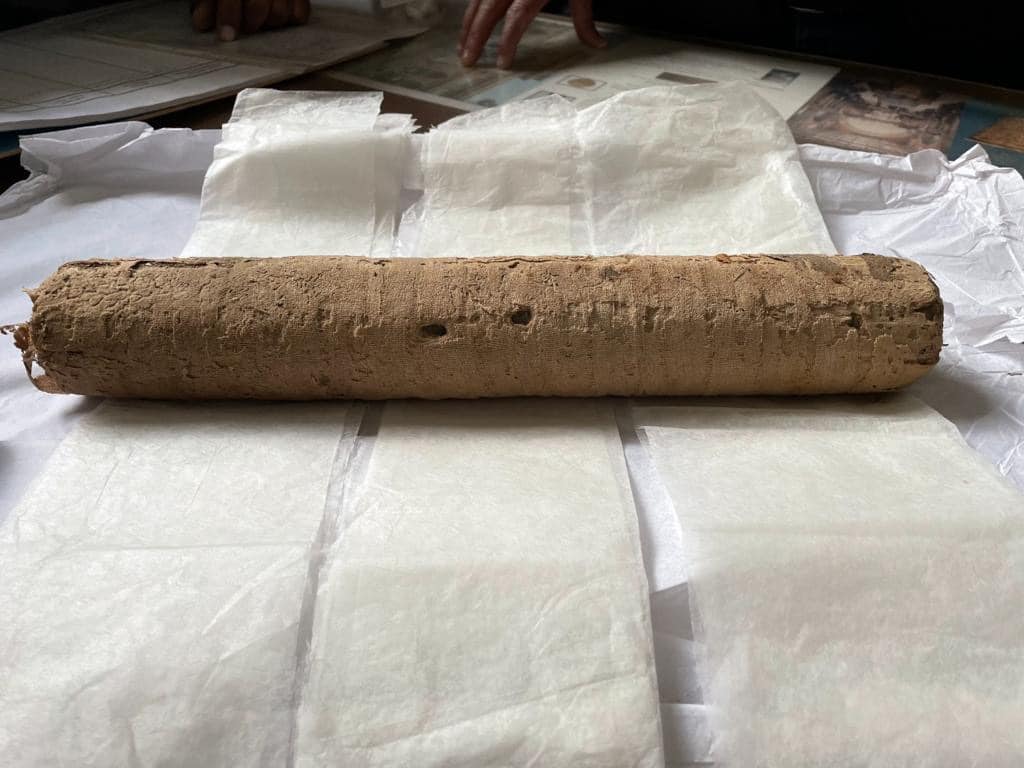
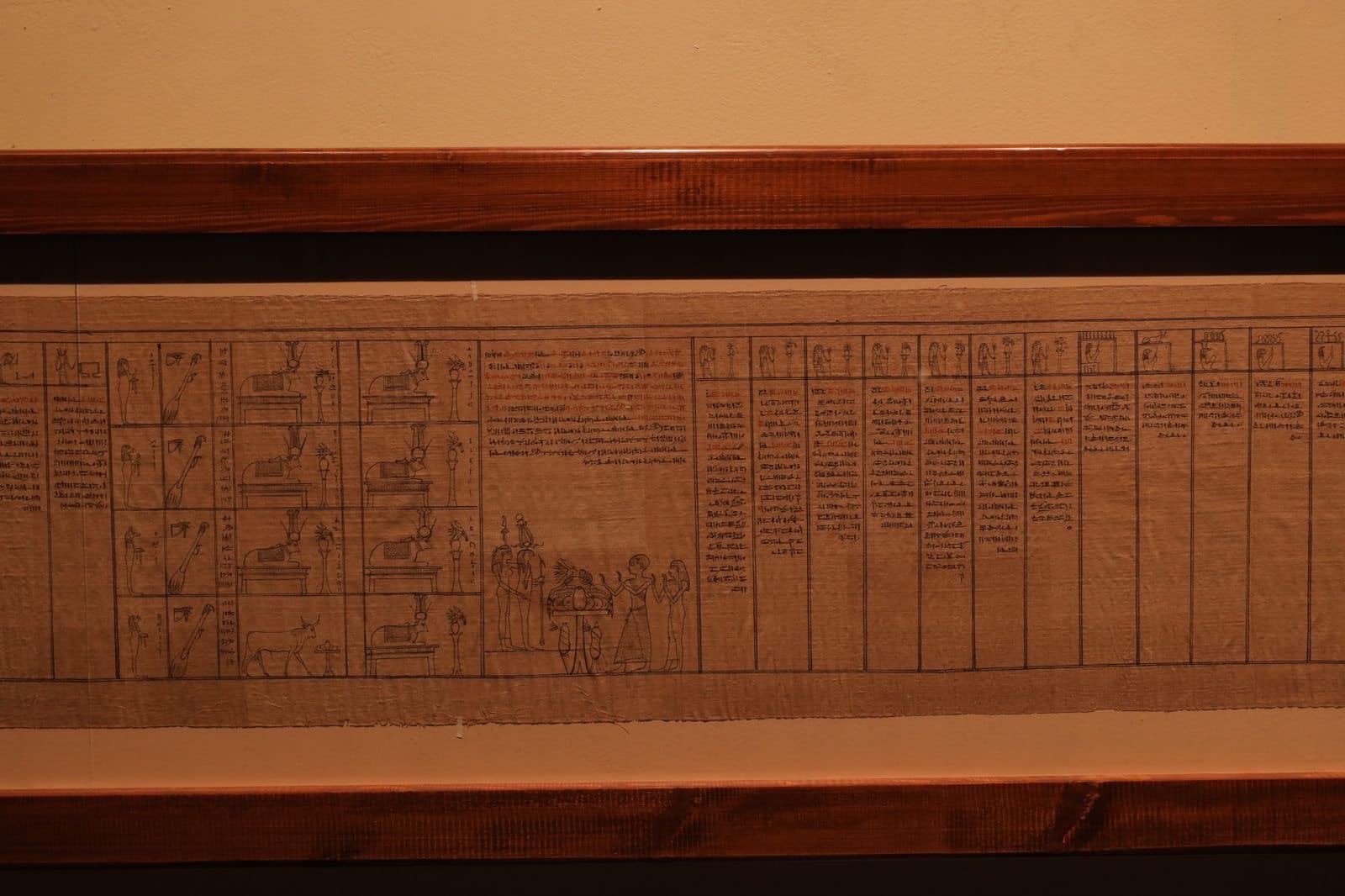
Earlier this year, the Egyptian Ministry of Tourism and Antiquities announced the discovery of a 52-foot-long papyrus scroll of the Book of the Dead discovered in the necropolis of Saqqara. This is the first complete ancient papyrus found in Egypt in 100 years. It was discovered in 2022 inside the coffin of man named Ahmose who died around 300 B.C.E.. His tomb was found just south of the Step Pyramid of Djoser (ca. 2611 B.C.E.), a landmark which remained a popular site for burials of the Egyptian elite for millennia.

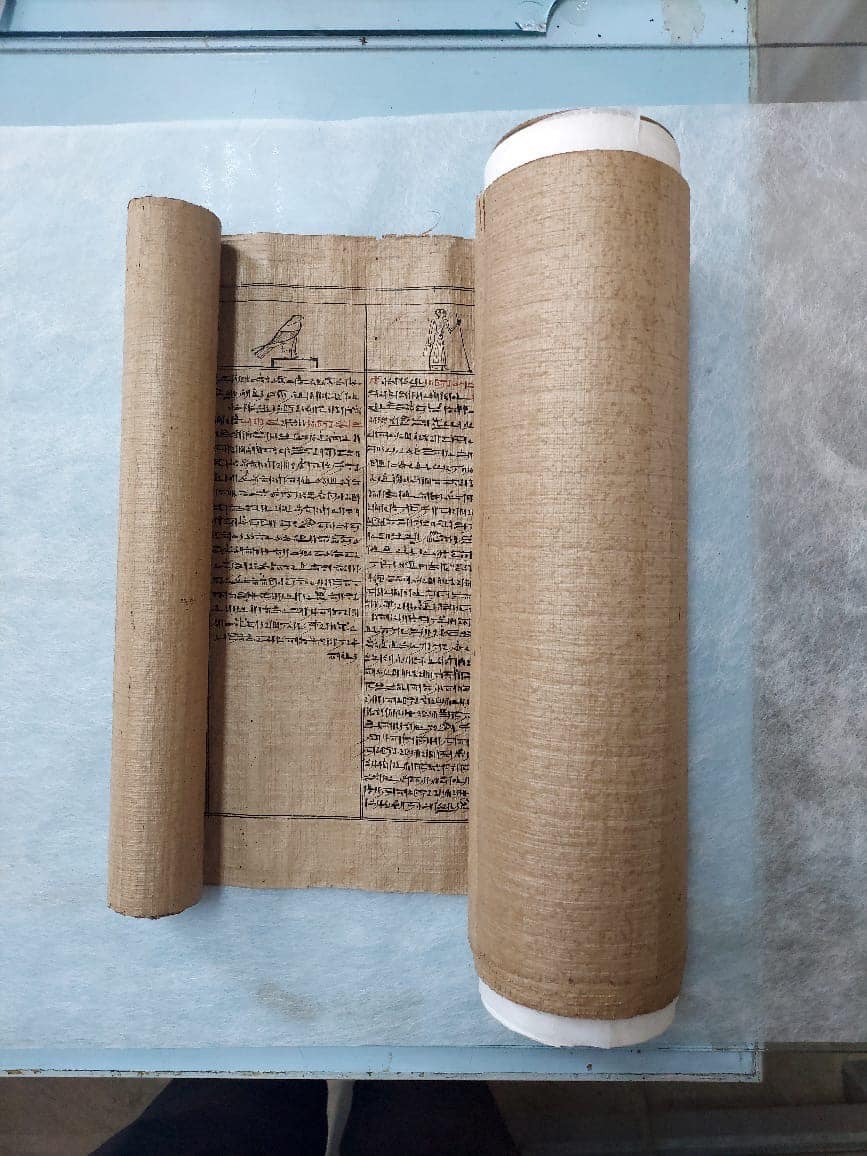
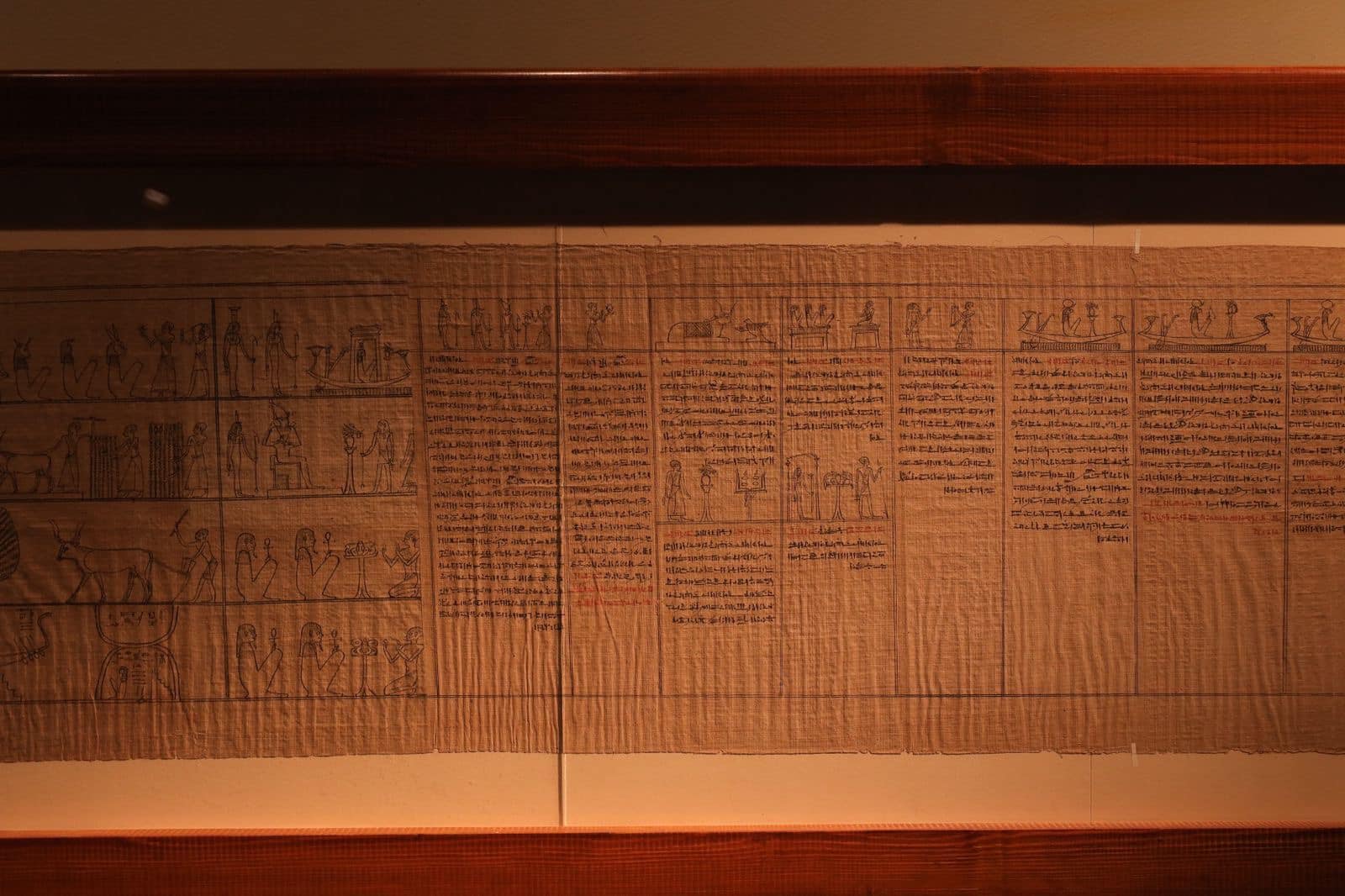
After the scroll was stabilized by technicians in the laboratory of the Egyptian Museum, it was carefully unrolled. The condition of the scroll is exceptional. Details of text and illustration are surprisingly clear and undamaged. The unrolled scroll is now on display in the Egyptian Museum in Cairo.

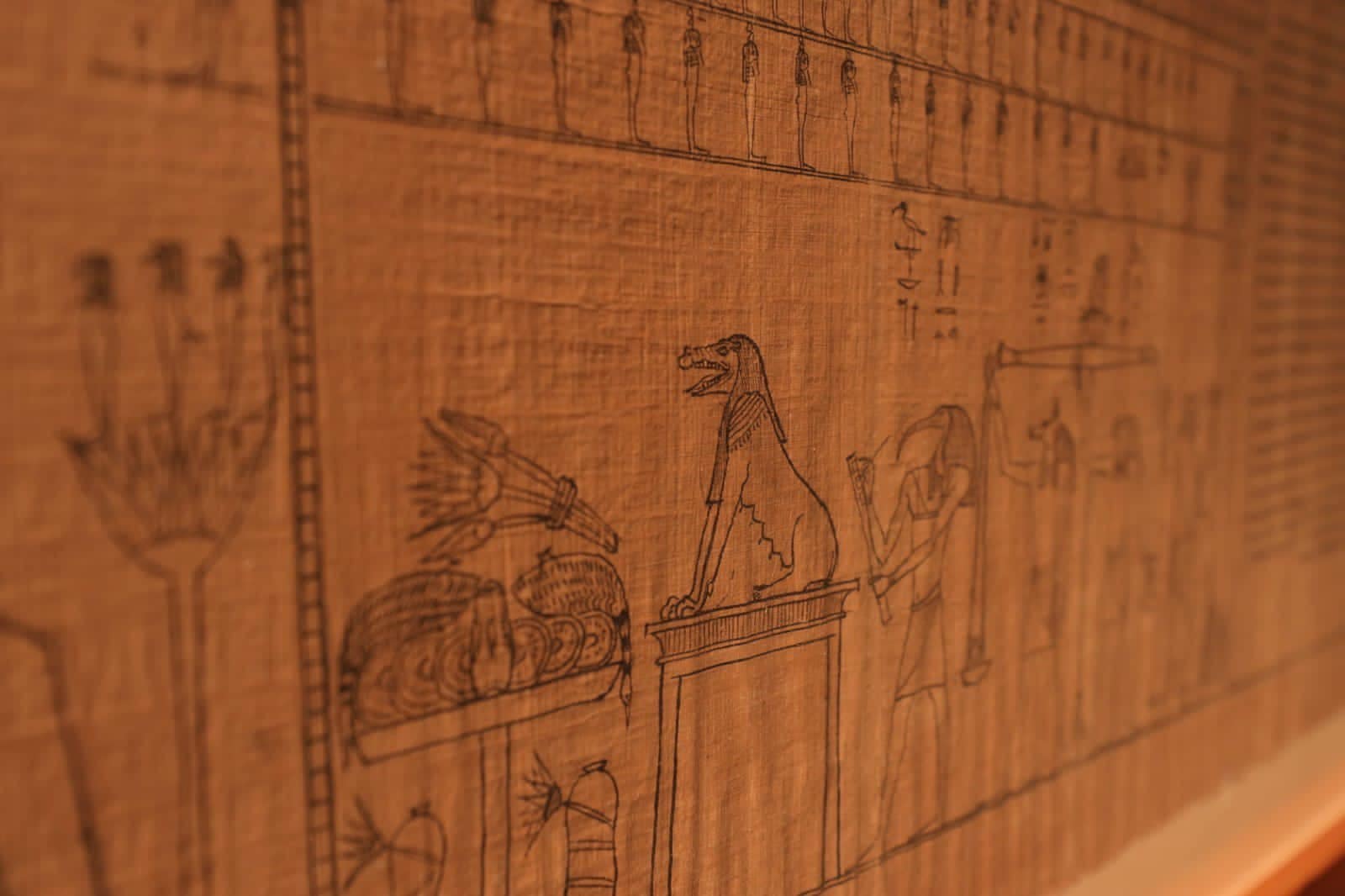
The Book of the Dead is a set of religious funerary texts that were created to guide the deceased into the underworld. It includes incantations of the gods, songs, prayers and a roadmap of what the souls of the dead will encounter during their journey — the judgment of the gods, punishments, rewards, etc.

The text is written in hieratic, a cursive form of hieroglyphics that was the predominant writing system in daily life. The text is primarily written in black ink with a few highlights in red. It consists of 113 chapters from the Book of the Dead written in 150 columns of various lengths and widths. The first 15 inches of the scroll are blank space; the book then opens with a large scene depicting Ahmose worshipping Osiris.

Posted in Africa, Art, Books, History, Middle East, Museums | Tagged , , , , | 1 Comment

Printed books prevail

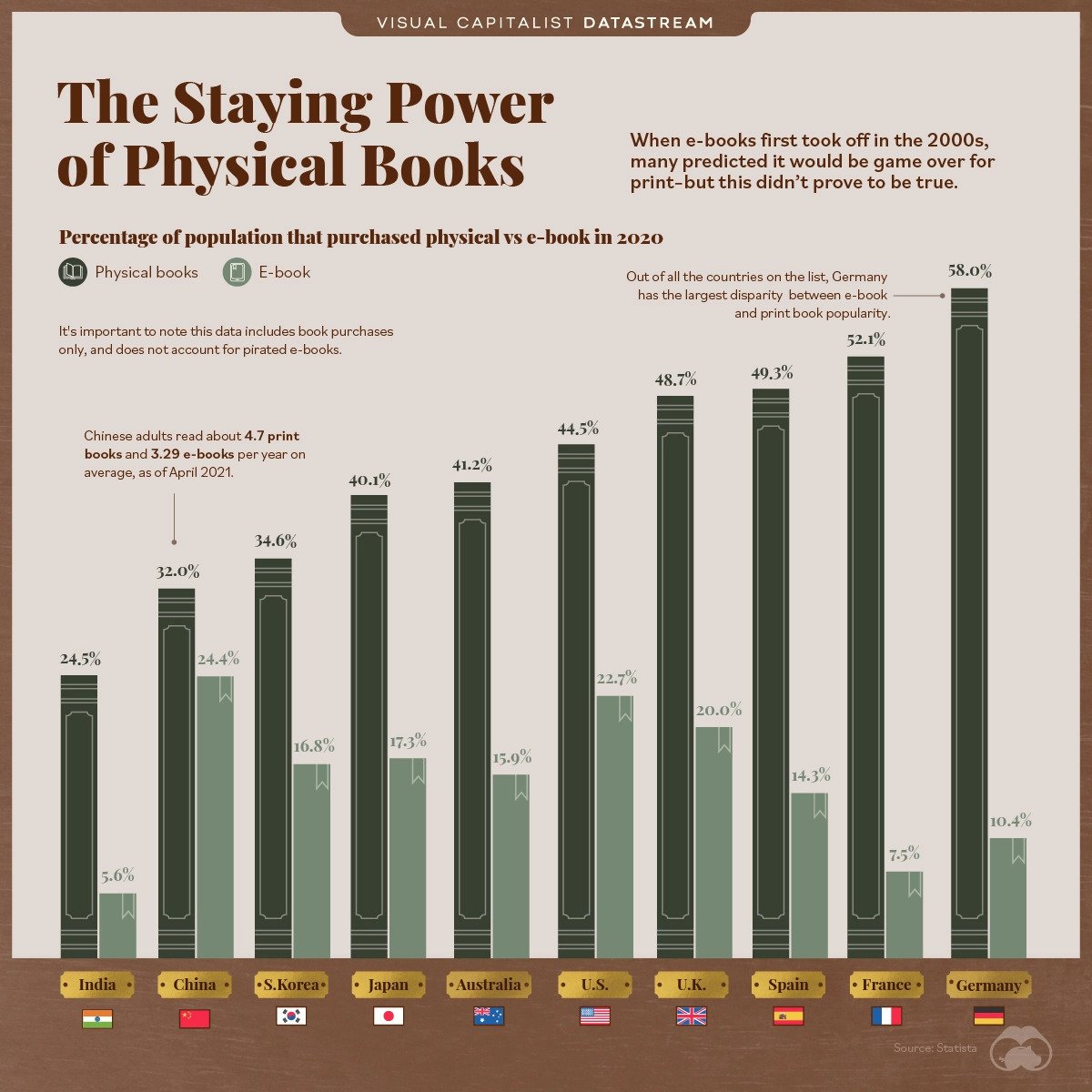
A tip of the hat to TBTP’s most loyal reader for the link to this infographic and article on the abiding appeal of the printed book. There is some comfort for an old bibliophile in learning that readers everywhere still prefer the physical book over the digital version. As I have mentioned before, I am no Luddite regarding e-books. I was an early adopter of E-readers and I have multiple reading apps on my iPad. Digital books and periodicals are handy away from home and for travel, but nothing compares to a tangible book.

The infographic above shows that:

  • Survey data from 10 different countries shows that a majority of people still prefer print books over e-books.
  • 42.5% of respondents purchased at least one print book in 2020—that’s significantly more than the 15.5% who’d bought at least one e-book.
  • Out of the 10 countries surveyed, Germany has the most print book lovers. 58% of German respondents bought a print book in 2020.


Posted in apps, Books, ebooks, Tech | Tagged , , , , | 2 Comments

Slightly bigger than my home library

I have been waiting for my personal invitation to visit the extraordinary Walker Library of the Human Imagination in Ridgefield, Connecticut, but alas it does not seem to be forthcoming. However, I have discovered that it’s possible to take a virtual tour of billionaire entrepreneur Jay Walker’s home library (see video below).


According to the library’s website:

The Walker Library of the History of Human Imagination celebrates humanity’s intellectual and emotional adventure of discovery, learning, and creativity by showcasing thousands of rare books, artworks, maps and manuscripts as well as museum-quality artifacts both modern and ancient.

Constructed in 2002, the 3,600 sq. ft. facility features multilevel tiers, “floating” platforms, connecting stairways, glass-paneled bridges, dynamic lighting and music, and specially commissioned artworks that celebrate major achievements in the history of human invention.

Invited guests to the Walker Library range from schoolchildren to business leaders, government officials and scholars, as well as librarians from around the world.

Along with the expected rare books, manuscripts, and incunabula, the fabulous library also contains rarities such as:

  • An original 1957 Russian Sputnik, the world’s first space satellite (one of several backups built by the USSR) and the U.S. response, a Vanguard satellite made from surviving parts of the actual American satellite that blew up on the launch pad.
  • A complete skeleton of a juvenile raptor dinosaur, about the size of a large housecat.
  • One of two known Anastatic Facsimiles of the original 1776 Declaration of Independence (made directly from the original using a wet-copy process).
  • An 1890 Edison sound recording and playback device that plays wax cylinder recordings.
  • A wooden sarcophagus from ancient Egypt, dating to approximately 1,800 BC.
  • A working Nazi Enigma device for encrypted communication.
  • A copy of Robert Hooke’s 1666 book Micrographia, containing some of the earliest published depictions of insects, leaves and other objects as seen under a microscope.
  • An instruction manual for NASA’s Saturn V rocket.
  • A chandelier from the James Bond film Die Another Day, rewired with 6,000 LEDs.
  • The very first book designed as a work of art in and of itself, Goethe’s 1828 Faust included illustrations by Delacroix. The Library’s copy features a carved leather binding.
  • Various medical artifacts including glass eyes and field surgical instruments from the U.S. Civil War.
  • A first edition Encyclopædia Britannica, published in 1768.
  • A U.S. flag flown to the Moon and back on Apollo 11, the first human lunar landing.
  • A 1667 publication called Bills of Mortality that tracked numbers and causes of death in London during the time of the Great Plague.
  • A 1699 atlas containing the first maps to show the sun, not the earth, as the center of the known universe. (“This map, by far the most important map in history, divides the Age of Faith from the Age of Reason,” says Jay.)
  • Anatomical illustrations produced from 1805-1813 by Italian artist and physician Paolo Mascagni, who used a scalpel and iodine to document human systems in hand-painted, life-sized illustrations.
  • The first published illustration of amputation, from a 1532 German book of military field surgery. This hand-painted copy is stained with human blood on the cover.
  • A military field surgical kit, circa 1900, including saws, clamps, and tools in a portable wooden box.

NB: if the video does not launch, please visit our home page here


Posted in Architecture, Art, Books, History, Libraries, Maps, USA | Tagged , , , | 5 Comments

Piracy Rules

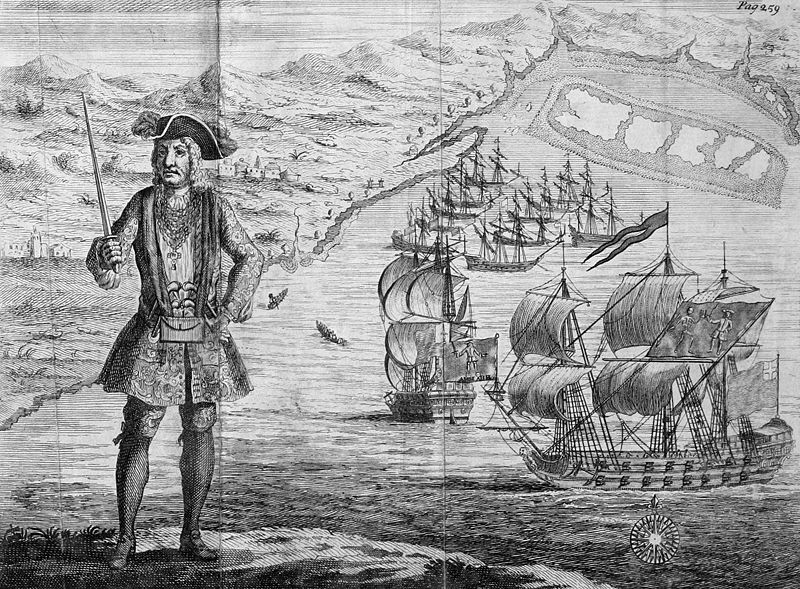
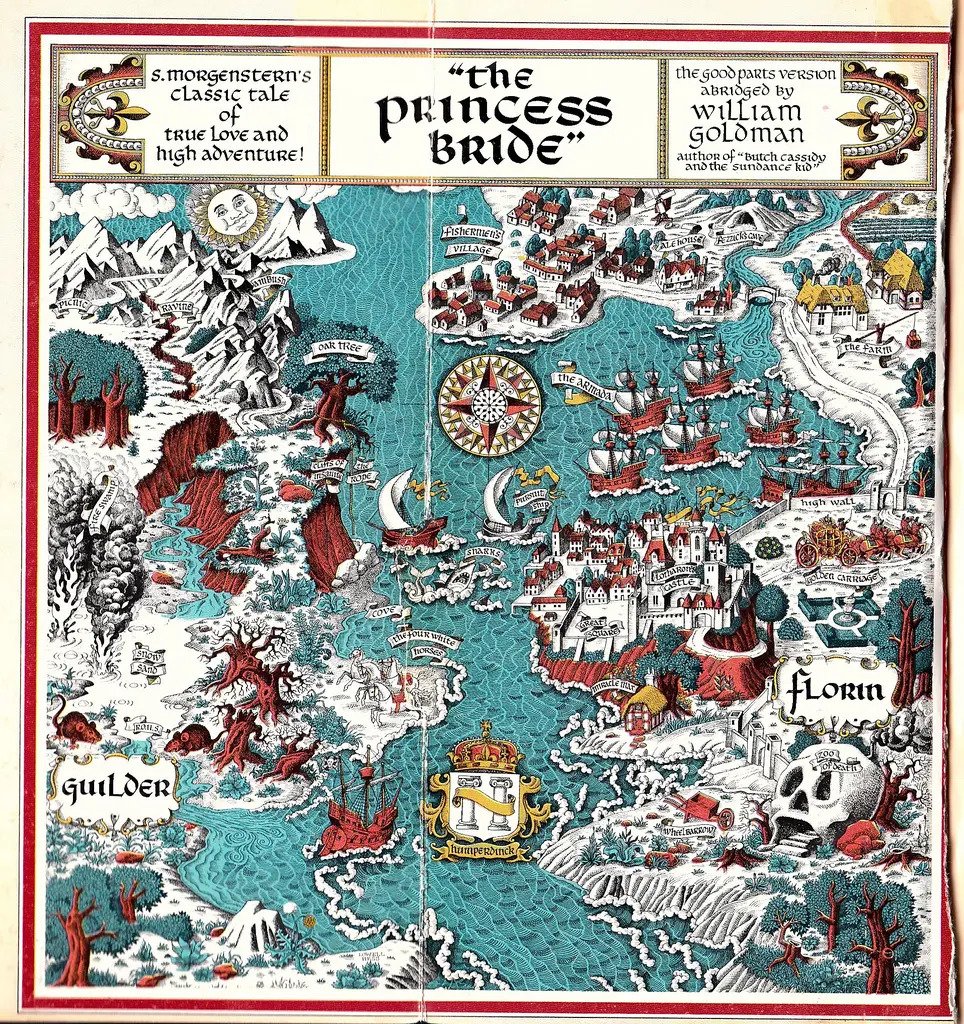
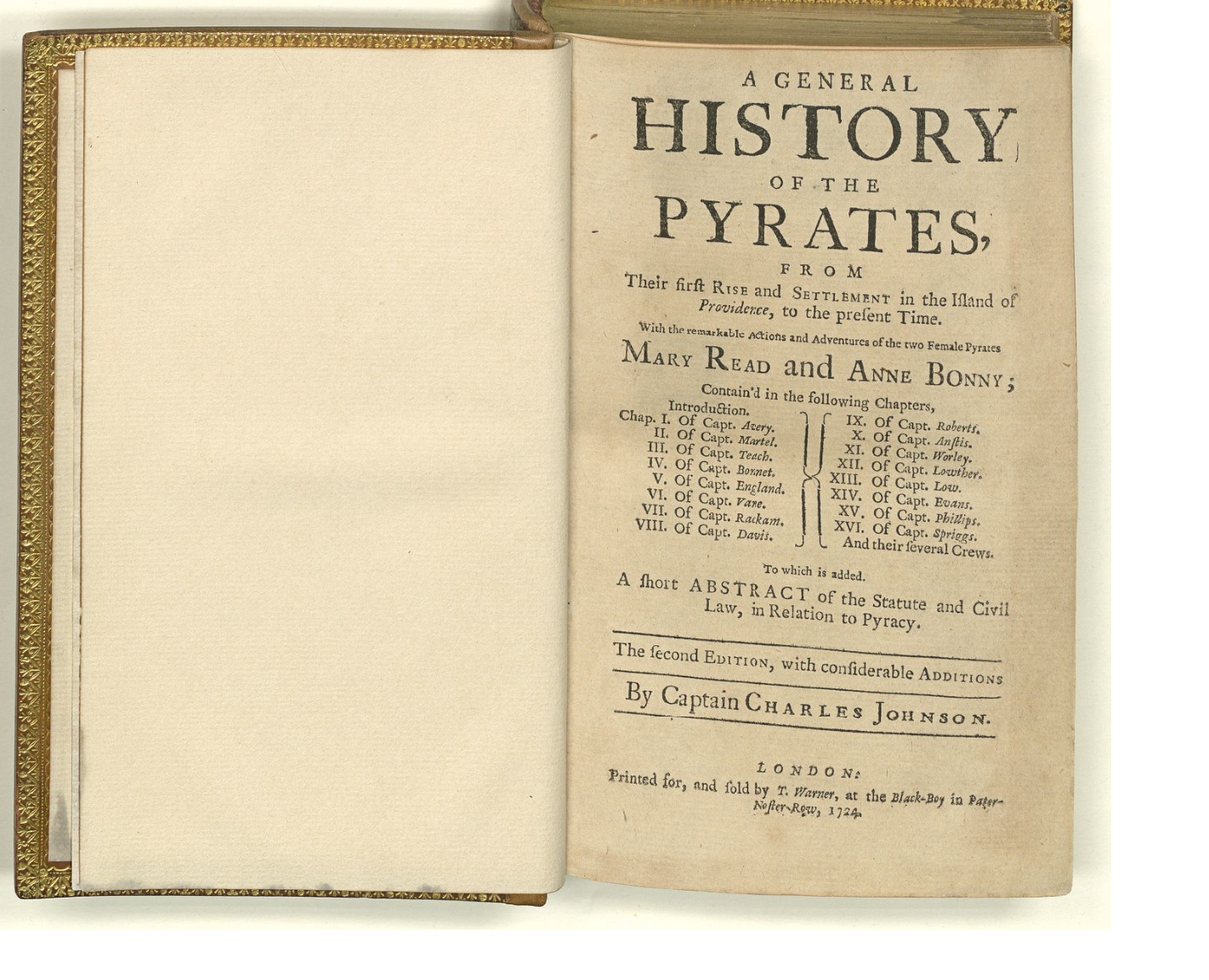
I was today years old when I discovered that the Dread Pirate Roberts of Princess Bride book and movie fame was an actual person. Not only was Welsh pirate Bartholomew Roberts (1682-1722) a famous swashbuckler, he was the most successful European pirate of the 18th century with more tha 400 captured vessels attributed to his crew.

According to Charles Johnson’s A General History of the Pyrates (1724), Captain Roberts had very strict rules for his crew:

  1. Every man has a vote in affairs of moment; has equal title to the fresh provisions, or strong liquors, at any time seized, and may use them at pleasure, unless a scarcity makes it necessary, for the good of all, to vote a retrenchment.
  2. Every man to be called fairly in turn, by list, on board of prizes because, (over and above their proper share) they were on these occasions allowed a shift of clothes: but if they defrauded the company to the value of a dollar in plate, jewels, or money, marooning was their punishment.
  3. No person to game at cards or dice for money.
  4. The lights and candles to be put out at eight o’clock at night: if any of the crew, after that hour still remained inclined for drinking, they were to do it on the open deck.
  5. To keep their piece, pistols, and cutlass clean and fit for service.
  6. No boy or woman to be allowed amongst them. If any man were to be found seducing any of the latter sex, and carried her to sea, disguised, he was to suffer death.
  7. To desert the ship or their quarters in battle, was punished with death or marooning.
  8. No striking one another on board, but every man’s quarrels to be ended on shore, at sword and pistol.
  9. No man to talk of breaking up their way of living, till each had shared £1,000. If in order to do this, any man should lose a limb, or become a cripple in their service, he was to have 800 dollars, out of the public stock, and for lesser hurts, proportionately.
  10. The captain and quartermaster to receive two shares of a prize: the master, boatswain, and gunner, one share and a half, and other officers one and a quarter.
  11. The musicians to have rest on the Sabbath Day, but the other six days and nights, none without special favour.


Posted in Books, Europe, Film, History, movies | Tagged , , | Leave a comment

Ukraine and Banksy share a message

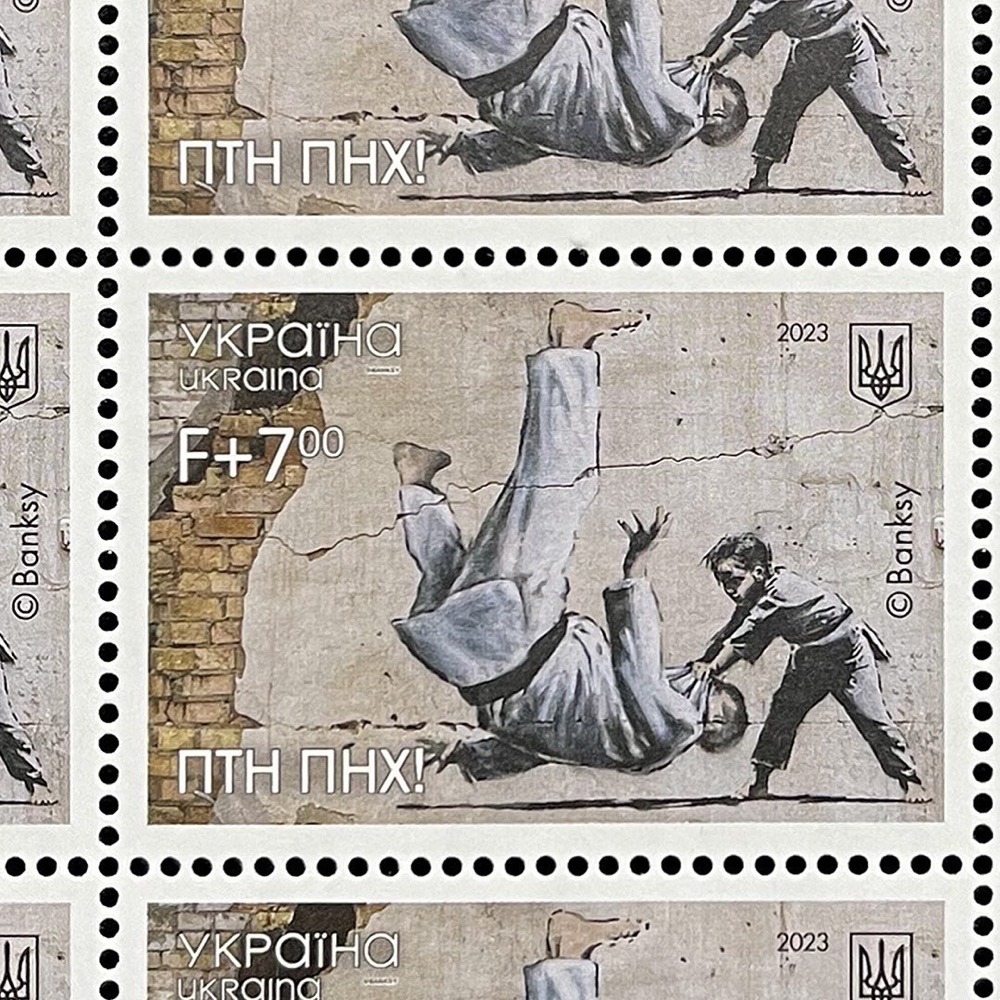
I’m a big fan of the elusive British street artist known as Banksy. His ability to provide artistic social commentary with humor and incisiveness is unrivaled. Now the Ukrainian postal service has released a stamp featuring artwork by Banksy to mark the first anniversary of the Russian invasion. The Banksy painted the image on a wall in the town of Borodianka in November 2022 and has given his permission for use on the stamp. From The Guardian:

The image draws inspiration from the Russian president, Vladimir Putin, known to be a black belt in judo, and depicts a young judoka representing Ukraine knocking down a grown man.

The phrase “FCK PTN” in Cyrillic has been added to the lower left part of the new stamp.

You can buy your own sheet of these stamps directly from the Ukraine postal service — they ship worldwide.


Posted in Art, Europe | Tagged , , | Leave a comment

A screaming comes across the sky

A screaming comes across the sky. It has happened before, but there is nothing to compare it to now.
It is too late. The Evacuation still proceeds, but it’s all theatre. There are no lights inside the cars. No light anywhere. Above him lift girders old as an iron queen, and glass somewhere far above that would let the light of day through. But it’s night. He’s afraid of the way the glass will fall soon it will be a spectacle: the fall of a crystal palace. But coming down in total blackout, without one glint of light, only great invisible crashing.

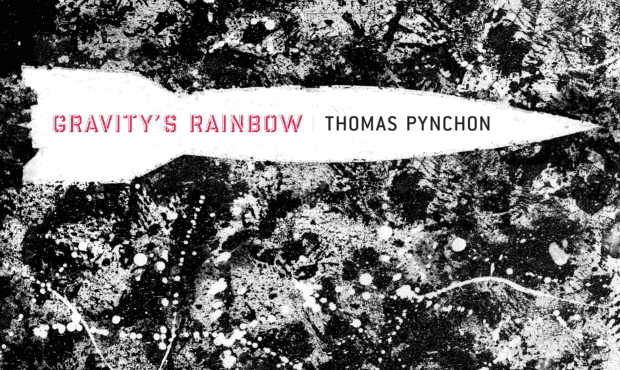
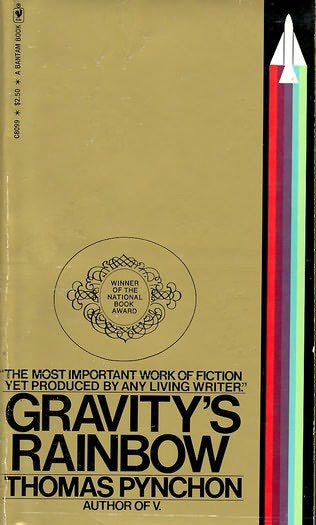
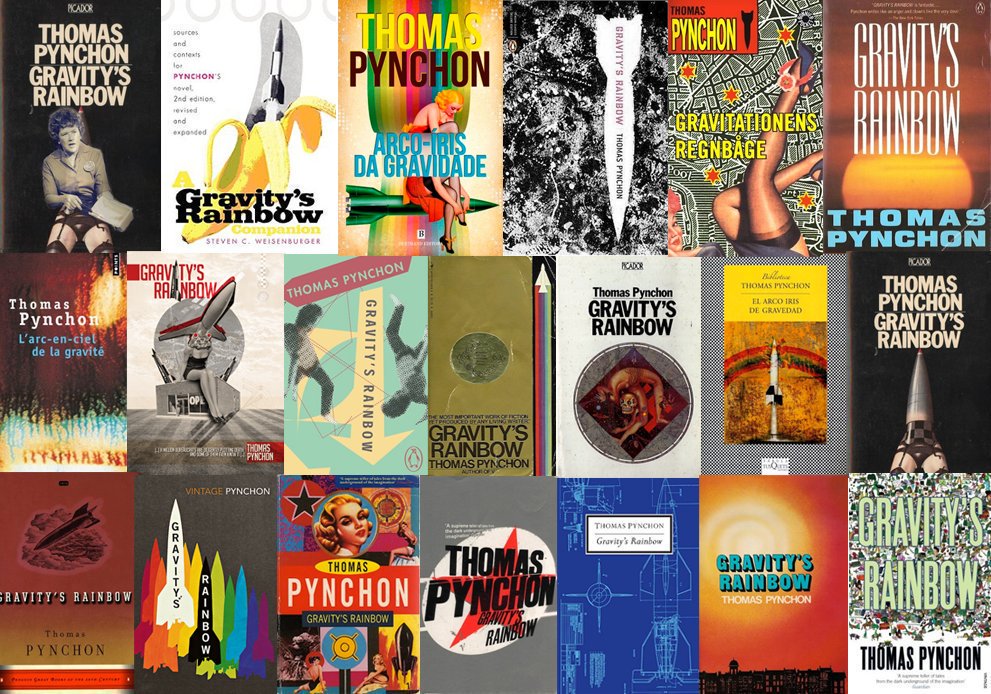
So begins Thomas Pynchon’s massive, brilliant, hilarious, insufferable, great, postmodern American novel Gravity’s Rainbow. This week marks the 50th anniversary of the book’s publication. Pynchon’s huge (760 pages) novel was issued in both hardcover and paperback versions simultaneously because the publisher feared that the target audience of readers under 30 would hesitate to pay the $15 cover price for the hardbound edition.

There is rarely a middle ground when it comes to this Pulitzer Prize winning novel; it’s a book that you either love or hate. I suspect that next to Moby Dick it’s the most begun and abandoned American novel of all time. Even the Pulitzer Prize Board, which awarded Pynchon the 1973 fiction prize, called the book “unreadable”, “turgid”, “overwritten” and “obscene.”

As an enormous fan of Pynchon’s earlier book The Crying of Lot 49, I eagerly snatched-up my local library’s copy of Gravity’s Rainbow as soon as it became available. And although I’m usually a fast reader, I remember incurring so significant library fines when I finally finished and returned the book. Comprised of four main parts and seventy-three episode, with over four hundred named characters, over 760 pages, the novel requires concentration and commitment.

If you are an adventurous and broad-minded reader, and you are up for the challenge, the 50th anniversary is a good time to dive into Pynchon’s masterpiece. Before accepting the challenge it is worth reading this excellent appreciation of the novel by Professor Julian Murphet on the Conversation website.


Posted in Books, USA, Writing | Tagged , , , | 2 Comments

Almost as good as being there

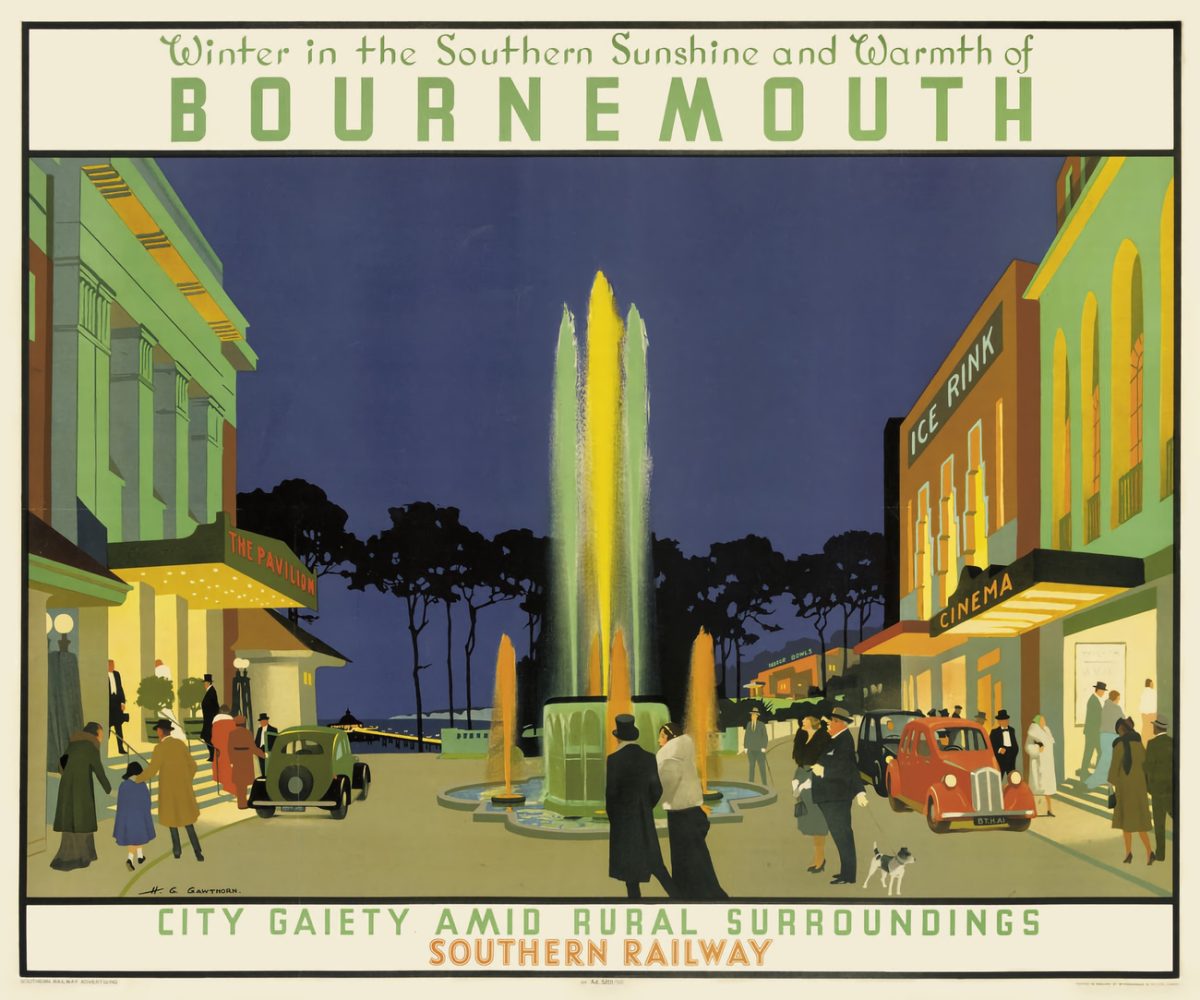
The modern poster dates back to the late 19th century when the printing industry perfected color lithography. This advance in printing allowed the whole new art form of color posters to flourish. Advertising agencies were quick to exploit the new poster art style. The travel tourism industry has used color poster art to communicate the advantages of a particular destination or mode of travel. Railways, cruise lines, ferries and airlines created many visually attractive and compelling travel posters.

I recently ran across a series of early 20th century British travel posters created by Henry George Gawthorn. Although he originally trained to be an achitect, early on Gawthorn focused on painting and drawing. Like many artists he found a consistent income from advertising artwork, especially travel posters. He often used flat colors in a distinctive art deco style that portrayed cosmopolitan and glamorous people at the beach, boating, or visiting a theatre.


Posted in Art, Europe, Public Transport, Tourism, Travel Writing | Tagged , , , | 5 Comments

Miscellany Monday

I usually lament the loss of dozens of New York City bookstores of my youth, but there some great shops still standing and, in recent years, a renaissance in bookselling has resulted in an optomistic turn for bibliophiles. Check out this excellent sample of NYC bookshops.
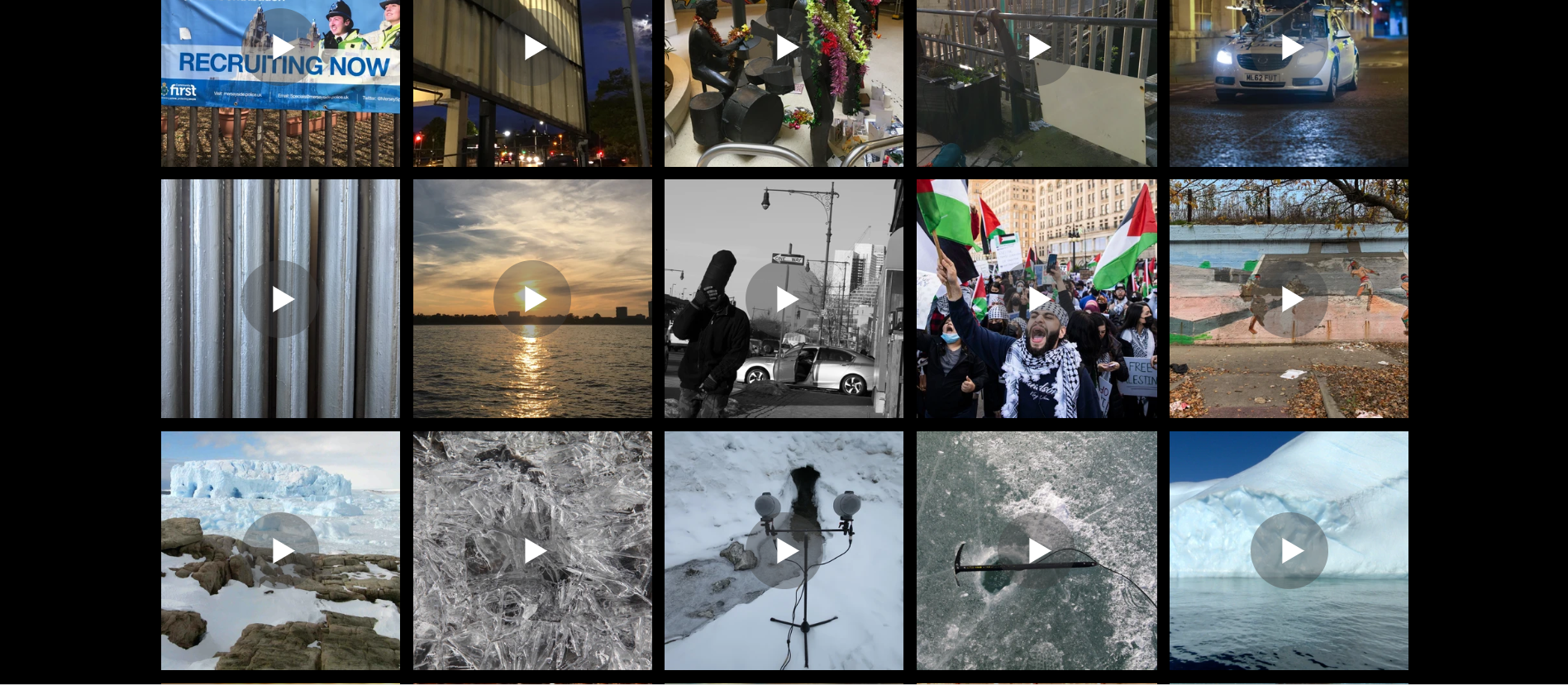
In my neverending campaign to share websites and projects that will capture imagination and occupy your valuable time, I present the fascinating and enigmatic Museum of SoundsThe website is maintained by the BBC Radiophonic Workshop and features clips diverse sounds arranged in groups of five and ranging from the sounds of icebergs breathing to the sounds of train stations, to the sounds of  forests. My only quibble with the project is the limited information about the aural clips.
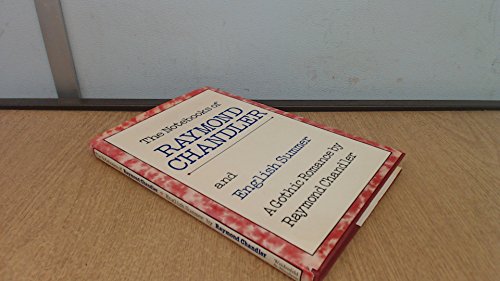
There are two kinds of truth: the truth that lights the way and the truth that warms the heart. The first of these is science, and the second is art. Neither is independent of the other or more important than the other. Without art science would be as useless as a pair of high forceps in the hands of a plumber. Without science art would become a crude mess of folklore and emotional quackery. The truth of art keeps science from becoming inhuman, and the truth of science keeps art from becoming ridiculous.

Throughout his career, author Raymond Chandler filled a series of small, leather-bound journals with thoughts and random musings. When he wrote this one in February of 1938, Chandler was forty-nine, and it would be another year before his debut novel, The Big Sleep, was released.

On February 24, 2022, Russia lauched a full-scale invasion of Ukraine. As a result of Putin’s illegal war at least 200,000 people have been killed or wounded. In Ukraine over 13 million people have been forced to abandon their homes, and many buildings, cultural artifacts and important infrastructure have been destroyed by the invading Russian army. The grapic above is from the Grid’s Ukraine, One Year at War: An Interactive Timeline of the Conflict.
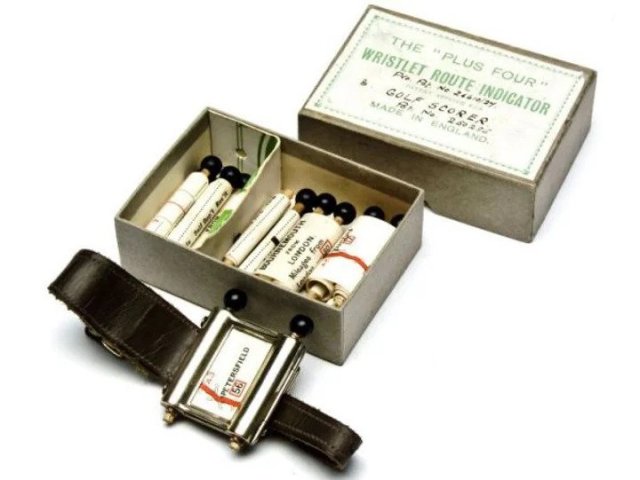
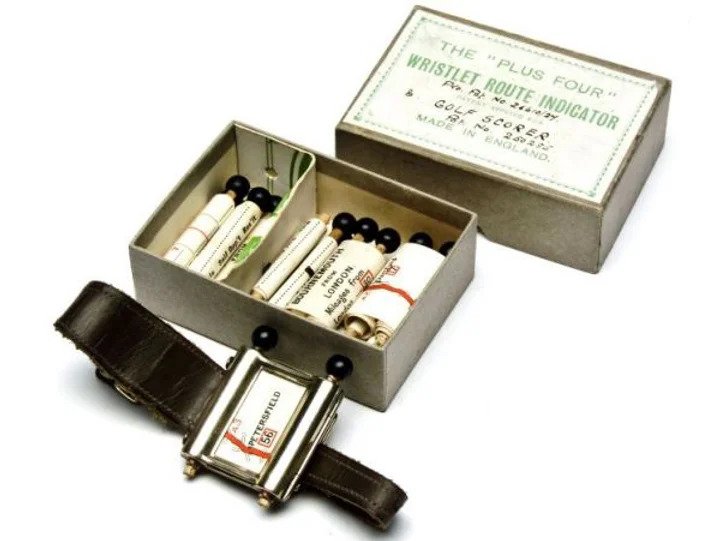
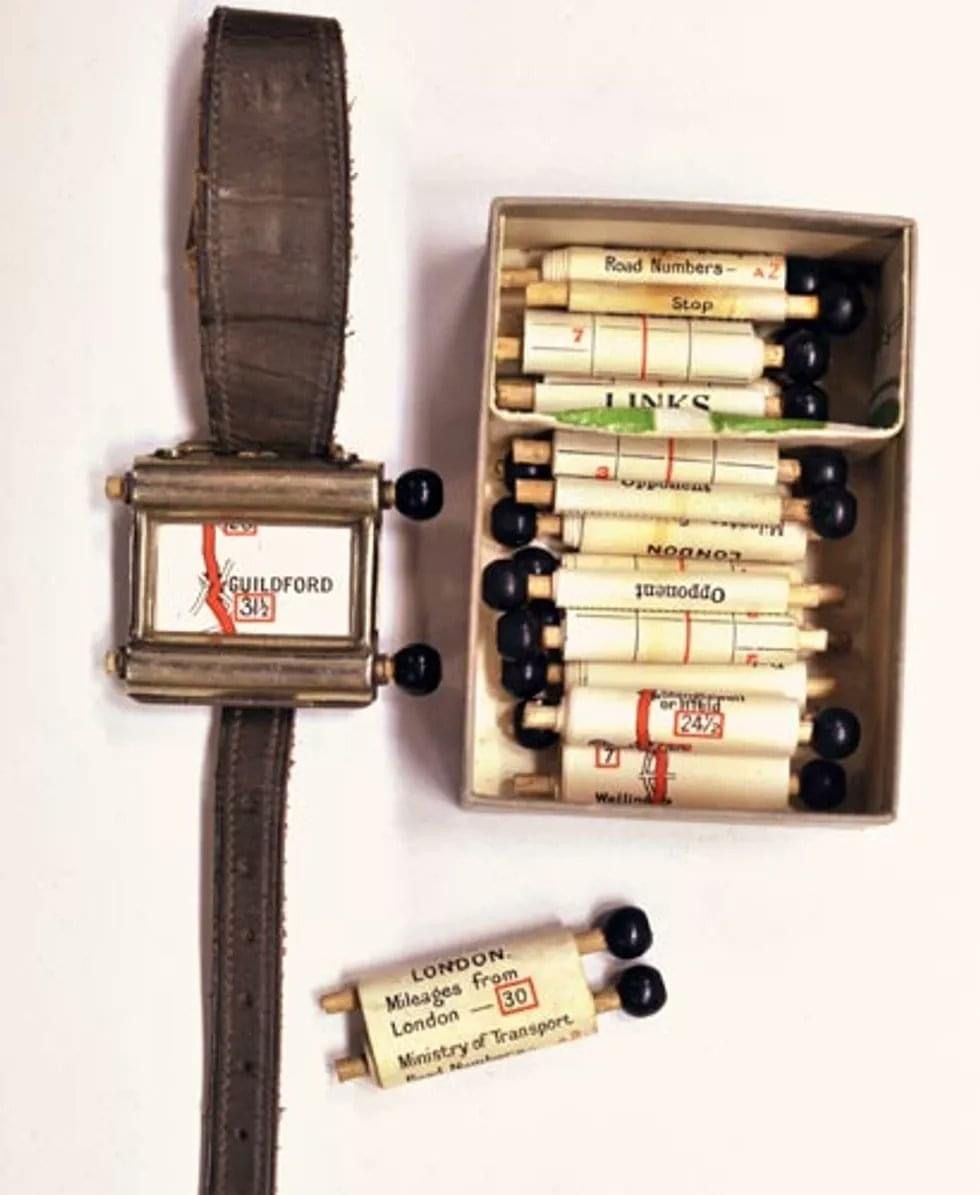
Long before Waze, Google Maps, GPS, and Sat-Nav there was the Plus Four Wristlet Route Indicator . Released in 1927, it came with single-journey scrolls plugged into a wrist-wearable device. The watch-like gadget needed no batteries, and worked quite like traditional scrolls, with paper rolling out from one side then back into the other. 
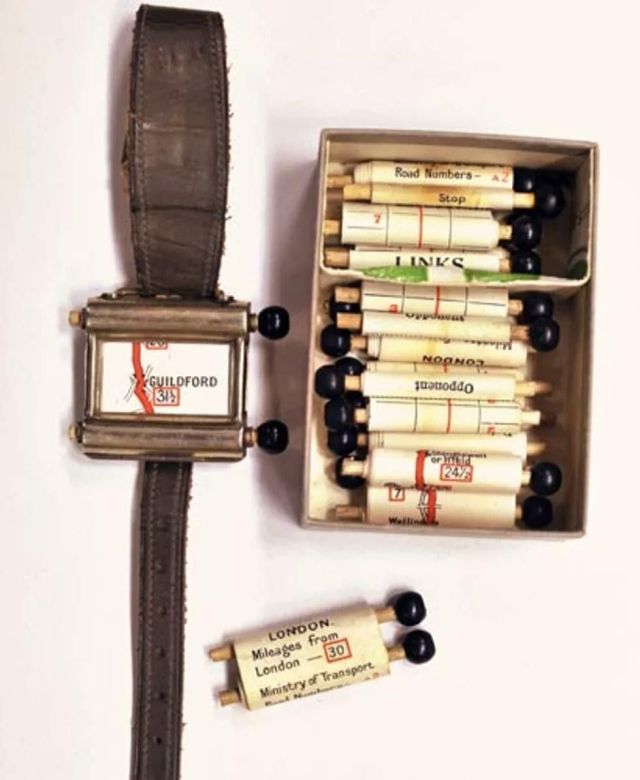


The Wristlet wearable was sold with a core set of 20 scrolls spanning various routes, most of them revolving around London, with more available for order from the manufacturer. Switching from one of the preset destinations necessitated stopping and swapping out scrolls along the way. Drivers or passengers would manually wind a dial on the side to keep the map moving along with the progress of their journey.

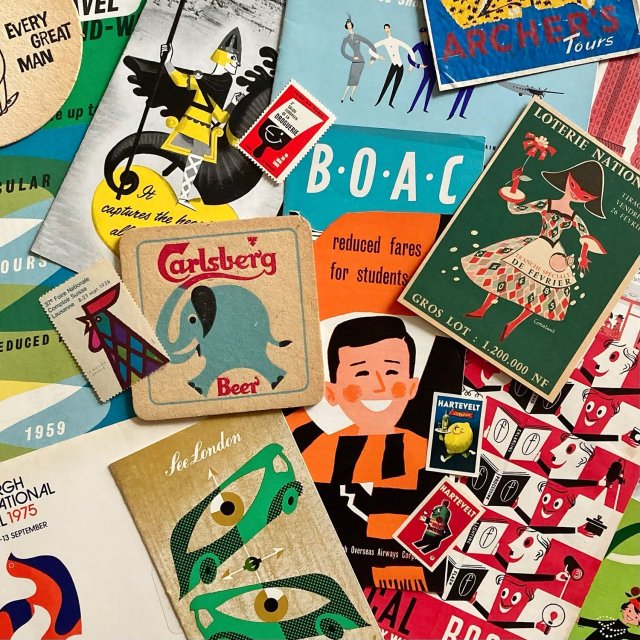
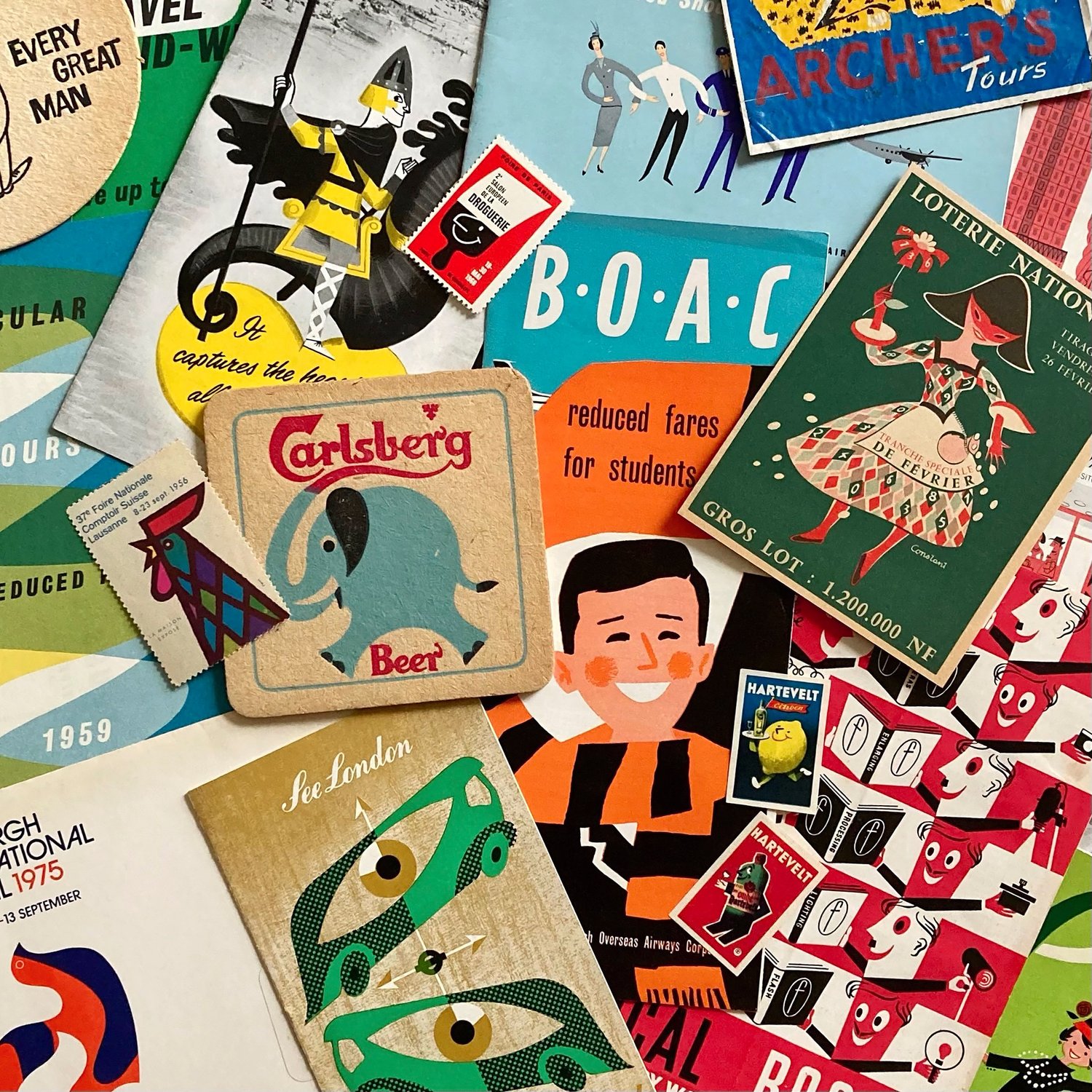
Modern Illustration is an archive of printed matter from circa 1950-1975, collected by illustrator Zara Picken. From book covers to flyers and from playing cards to stamps.

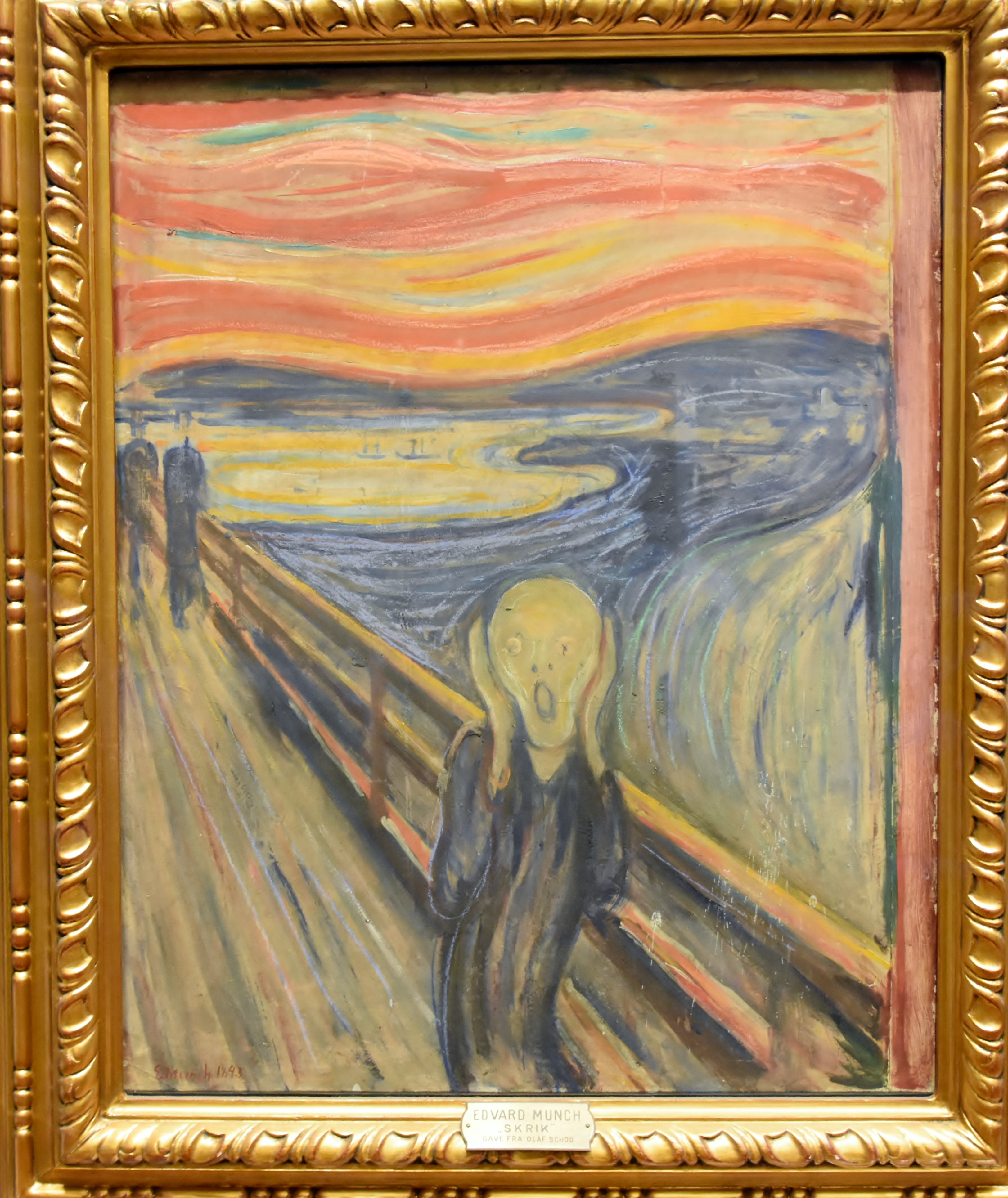
In 1893, Norwegian artist Edvard Munch unveiled The Scream: a dramatic oil painting in which a panic-stricken figure stands beneath a fiery sky, hands clasped to face, a couple standing further along the bridge they share. In January of 1892, a year before the he painted the scene, Munch wrote this entry in his journal.

Nice  22/1/92

I was walking along the road with two friends – the sun was setting – I felt a wave of sadness – The sky suddenly turned blood-red

I stopped, leaned against the fence tired to death – gazed out over the flaming clouds like blood and swords – the blue-black fjord and city – My friends walked on – I stood there quaking with angst – and I felt as though a vast, endless scream passed through nature


Posted in Art, Books, Bookstore Tourism, Maps, Museums, Tech, USA | Tagged , , , , | Leave a comment
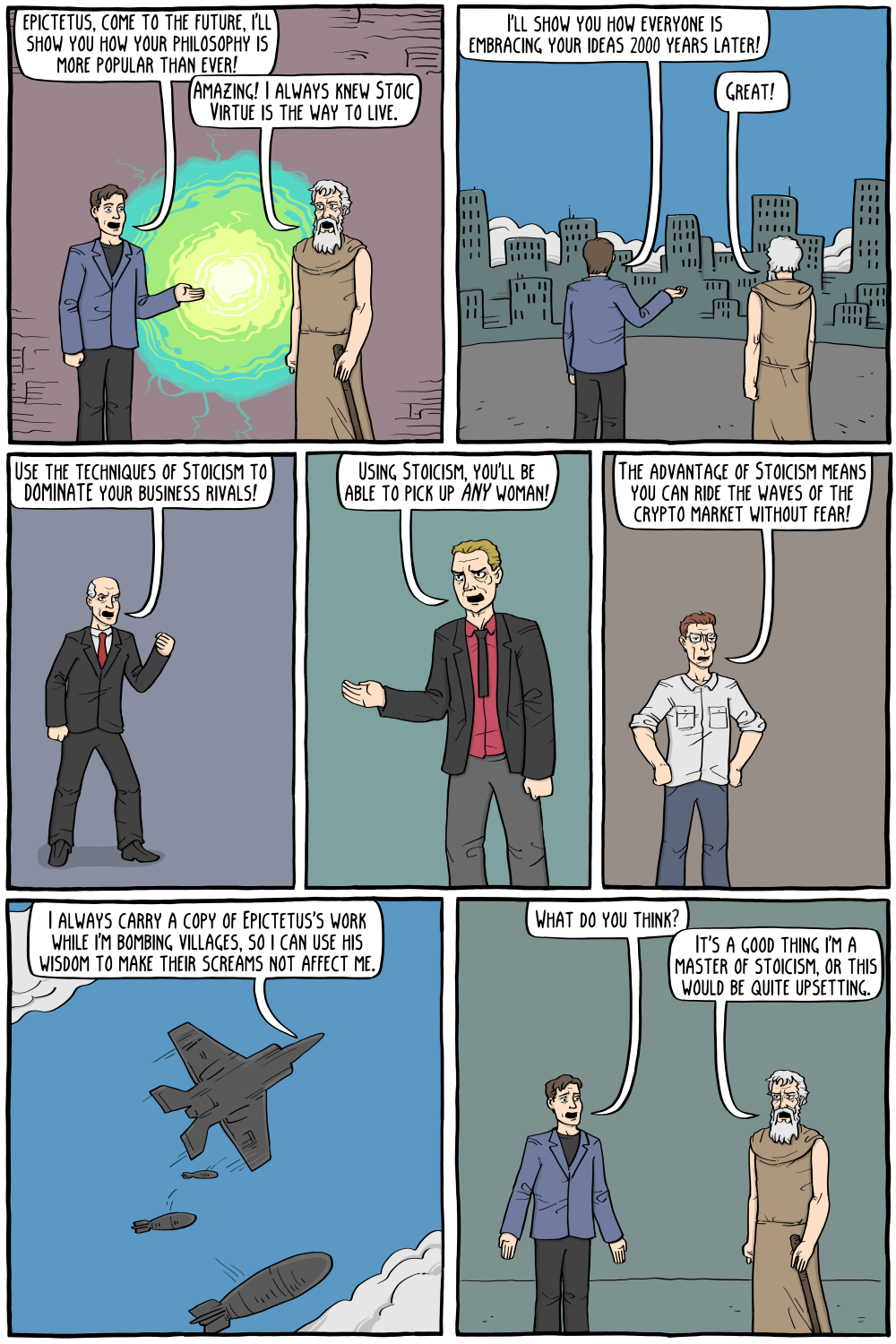
Stoicism is all the rage

Support the comic on Patreon!


Posted in Art, Uncategorized, Writing | Tagged , , , | Leave a comment

everything at heaven’s gate is broken up into its component parts

“A Society of Scoundrels”

by

Franz Kafka

Translated by Michael Hofmann


There was once a society of scoundrels, or rather not scoundrels per se, just ordinary, average people. They always stuck together. When one of them had perpetrated some rascally act, or rather, nothing really rascally, just averagely bad, he would confess it to the others, and they investigated it, condemned it, imposed penalties, forgave him, etc. This wasn’t corrupt — the interests of the individual and the society were kept in balance and the confessor received the punishment he asked for. So they always stuck together, and even after their death they didn’t abandon their society, but ascended to heaven in a troop. It was a sight of childlike innocence to see them flying. But since everything at heaven’s gate is broken up into its component parts, they plunged down like so many rocks.


Posted in Books, Europe, Writing | Tagged , , | Leave a comment