Neil Gaiman Never Went to College

Neil Gaiman never attended university, but this past weekend he received an honorary degree from the nearby University of the Arts in Philadelphia and spoke at the commencement. The bestselling author of American Gods, Coraline, Stardust, Neverwhere and many more great books encouraged the graduates to make their own art, stay focused, make mistakes and enjoy the ride. Here’s a look at the highlights of Gaiman’s address:

Posted in Art, Books, ebooks, USA, Writing | Tagged , , , , , | Leave a comment

It’s Towel Day

Don’t panic ! Towel Day is actually tomorrow May 25th. Fans of the late, great Douglas Adams, author ofThe Hitchhiker’s Guide to the Galaxy,have already chosen that special towel to carry on Towel Day.

When Adams died of a heart attack 11 years ago, fans launched the annual Towel Day celebration to celebrate his memory. This year booklovers in more than a dozen countries will be observing the day with read-ins, TV show and film showings, radio plays and many other HGG related events. Visit the official Towel Day website to find events in your region.

“A towel, it says, is about the most massively useful thing an interstellar hitchhiker can have. Partly it has great practical value. You can wrap it around you for warmth as you bound across the cold moons of Jaglan Beta; you can lie on it on the brilliant marble-sanded beaches of Santraginus V, inhaling the heady sea vapours; you can sleep under it beneath the stars which shine so redly on the desert world of Kakrafoon; use it to sail a miniraft down the slow heavy River Moth; wet it for use in hand-to-hand-combat; wrap it round your head to ward off noxious fumes or avoid the gaze of the Ravenous Bugblatter Beast of Traal (such a mind-bogglingly stupid animal, it assumes that if you can’t see it, it can’t see you); you can wave your towel in emergencies as a distress signal, and of course dry yourself off with it if it still seems to be clean enough.

More importantly, a towel has immense psychological value. For some reason, if a strag (strag: non-hitch hiker) discovers that a hitch hiker has his towel with him, he will automatically assume that he is also in possession of a toothbrush, face flannel, soap, tin of biscuits, flask, compass, map, ball of string, gnat spray, wet weather gear, space suit etc., etc. Furthermore, the strag will then happily lend the hitch hiker any of these or a dozen other items that the hitch hiker might accidentally have “lost”. What the strag will think is that any man who can hitch the length and breadth of the galaxy, rough it, slum it, struggle against terrible odds, win through, and still knows where his towel is, is clearly a man to be reckoned with.

Hence a phrase that has passed into hitchhiking slang, as in “Hey, you sass that hoopy Ford Prefect? There’s a frood who really knows where his towel is.” (Sass: know, be aware of, meet, have sex with; hoopy: really together guy; frood: really amazingly together guy.”

Posted in Books, Film, Writing | Tagged , , | 5 Comments

Stonehenge Moves to London

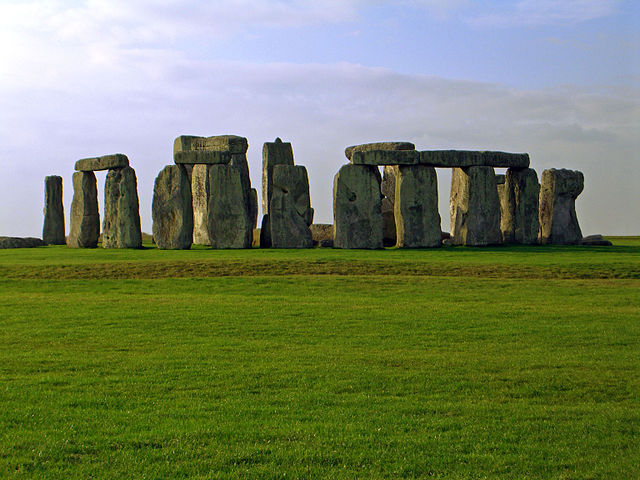
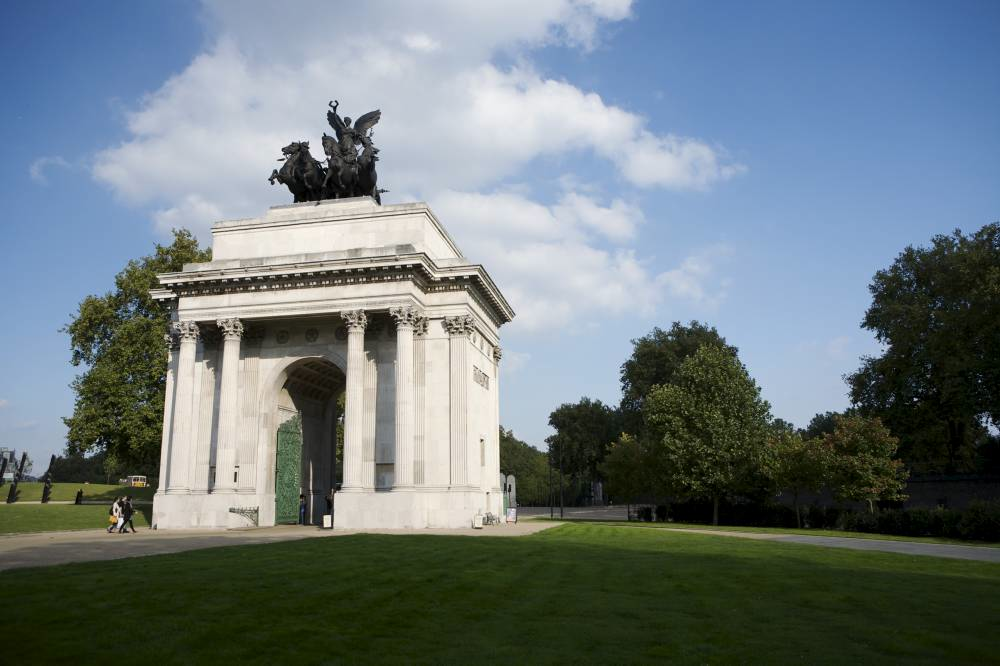
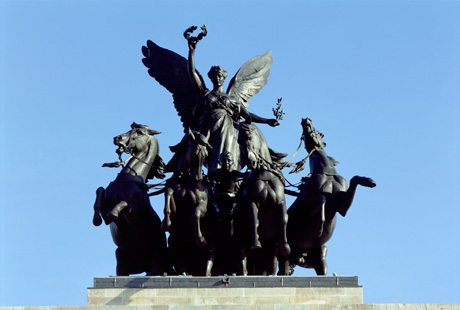
Built in 1828 to commemorate the Duke of Wellington’s defeat of Napoleon Bonaparte, the Wellington Arch at Hyde Park, London is set to become a public gallery. Launching the new exhibition site, called the Quadriga Gallery (referencing the sculptural group decorating the exterior),is the Stonehenge: Monumental Journey show just in time for the Olympic’s crowd.

The elaborate victory arch has previously served as a traffic island and was at one time home to London’s most diminutive police station. Originally facing the entrance to Hyde Park, the Wellington Arch was moved to its current location in 1883.

Hat-tip to Evan Smythe for this post

Posted in Art, Europe, History, Tourism | Tagged , , , , , | Leave a comment

Rome Reborn

I was recently searching for some information on the astonishing Roman aqueduct in Segovia, Spain when I stumbled on this stunning digital animation exploring Rome in 320 A.D.. If you’ve every visited The Eternal City, or dreamed of going there, this fabulous video fly-through will give you chills. You can discover more about the Rome Reborn project on their website .

Here’s some info on the project:

“Rome Reborn is an international initiative whose goal is the creation of 3D digital models illustrating the urban development of ancient Rome from the first settlement in the late Bronze Age (ca. 1000 B.C.) to the depopulation of the city in the early Middle Ages (ca. A.D. 550). With the advice of an international Scientific Advisory Committee, the leaders of the project decided that A.D. 320 was the best moment in time to begin the work of modeling. At that time, Rome had reached the peak of its population, and major Christian churches were just beginning to be built. After this date, few new civic buildings were built. Much of what survives of the ancient city dates to this period, making reconstruction less speculative than it must, perforce, be for earlier phases. But having started with A.D. 320, the Rome Reborn team intends to move both backwards and forwards in time until the entire span of time foreseen by our mission has been covered.

History

Since 1997, the Virtual World Heritage Laboratory of the University of Virginia (VWHL), the UCLA Experiential Technology Center (ETC), the Reverse Engineering (INDACO) Lab at the Politecnico di Milano, the Ausonius Institute of the CNRS and the University of Bordeaux-3, and the University of Caen have collaborated on a project to create a digital model of ancient Rome as it appeared in late antiquity. The notional date of the model is June 21, 320 A.D.

Purpose of the 3D model

The primary purpose of this phase of the project was to spatialize and present information and theories about how the city looked at this moment in time, which was more or less the height of its development as the capital of the Roman Empire. A secondary, but important, goal was to create the cyberinfrastructure whereby the model could be updated, corrected, and augmented. Spatialization and presentation involve two related forms of communication: (1) the knowledge we have about the city has been used to reconstruct digitally how its topography, urban infrastructure (streets, bridges, aqueducts, walls, etc.), and individual buildings and monuments might have looked; and (2) whenever possible, the sources of archaeological information or speculative reasoning behind the digital reconstructions, as well as valuable online resources for understanding the sites of ancient Rome, have been made available to users. The model is thus a representation of the state of our knowledge (and, implicitly, of our ignorance) about the urban topography of ancient Rome at various periods of time. Beyond this primary use, the model can function in other ways. It can be used to teach students or the general public about how the city looked; it can be used to gather data not otherwise available, such as the alignment of built features in the city with respect to each other or to natural features and phenomena; and, it can be used to run urban or architectural experiments not otherwise possible, such as how well the city or the buildings within it functioned in terms of heating and ventilation, illumination, circulation of people, etc. Finally, a digital model can be easily updated to reflect corrections to the model or new archaeological discoveries.”

 

Posted in Animation, Architecture, Art, Europe, Film, History, Tourism | Tagged , , , , | 1 Comment

Tokyo Aglow

Last week we posted an amusing little story about a scheme to make Amsterdam’s historic canals glow via bioluminescent bacteria. Well, Tokyo already set its Sumida River aglow during the first weekend in May.

The inaugural Tokyo Hotaru Festival was launched on May 5th and featured a moving display of more than 100,000 LED lights designed by Panasonic to resemble fireflies (hotaru) when afloat. The solar powered lights only illuminate upon contact with water and were all collected in large nets at the end of the night.

If your Japanese language skills are up to the task, the Hotaru Festival website has more info.

Hat-tip to Johnny Strategy for the post.

Posted in Asia, Tourism | Tagged , , , | 6 Comments

How Venice Works

Venice is not only a great city; it’s a complex archipelago made up of 124 different islands, dissected by 183 canals and crossed by 483 bridges. This marvelous film produced by the city of Venice explains how this fabulous, confounding and complicated place manages to function for its 60,000 residents and 3 million annual visitors.

Posted in Europe, Film, Tourism | Tagged , , , , | 5 Comments

Visit England

VisitEngland, the official national tourist board of England has released a handy free app just in time for the big Olympic hoopla. The app, titled Enjoy England, offers easy acess to thousands of tourist attractions around the country. It is fairly simplistic, as apps go, but allows for searching thousands of places of interest to visitors, has helpful maps and directions, and tools for trip planning. TBTP reader and contributor Evan Smythe has alerted us to Enjoy England and offered the following app review:

“The app is very straightforward – you just enter a location you wish to search, or pick from the drop-down list under ‘Select Location’. If you pick London for example, it currently lists 492 locations that you can visit. You can then refine this list using the ‘Categories’ button, which allows you to pick places that offer free admission, are indoor, outdoor, or somewhere that Visit England believes is a ‘Must see’. Alternatively you can use the ‘Location’ button to identify places within a certain distance from your current location – 1 mile, 2 miles and so on. Once you click through to the attraction itself, there’s a shot description, an address and, at the bottom, a very useful function, “Get Directions”. This then takes you through to the native Google Maps application where you can display the route from your current location to the attraction, either by car, public transport or on foot.

There’s also an option to ‘Upload a Suggestion’ if there’s a particular attraction that you think should be listed. The ‘Enjoy England’ app is quite basic, but I can see it being useful if you’re at a loose end and want to explore the local area – there may be places nearby that you’ve not discovered yet. You can find ‘Enjoy England’ in both the Apple iTunes and Google stores on your phone, and they’re both free.”

Posted in apps, Europe, Museums, Tourism, Travel Writing | Tagged , , , , | Leave a comment

Travel For Enlightenment

Lavinia Spalding, editor of The Best Women’s Travel Writing 2011 (Travelers’ Tales) and the author of Writing Away: A Creative Guide to Awakening the Journal-Writing Traveler, recently spoke at a TEDx conference in Park City, Utah on the existential power of travel stories to help us discover our shared humanity. Take a look:

Posted in Books, Film, Tourism, Travel Writing, Writing | Tagged , , , , | Leave a comment

Land of Dreams

In a public-private partnership between the U.S. government and the travel industry, this new $12.3 million ad campaign, called Land of Dreams, is about to be launched with distribution in Europe, Asia, South America and Canada over the coming months. The marketing entity, called Brand USA, hopes to inspire international travelers to visit the USA and spend, spend, spend. The swarmy little video features Roseanne Cash sing the title song. Take a peek. Would this inspire you to visit the U.S. ?

Posted in Canada, Europe, History, South America, Tourism, Travel Writing, USA | Tagged , , , , , | Leave a comment

Free Travel Apps

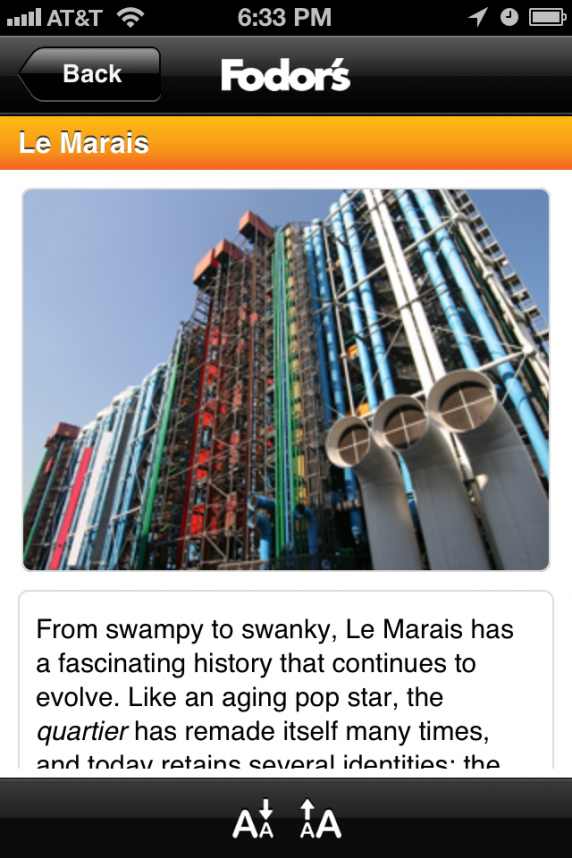
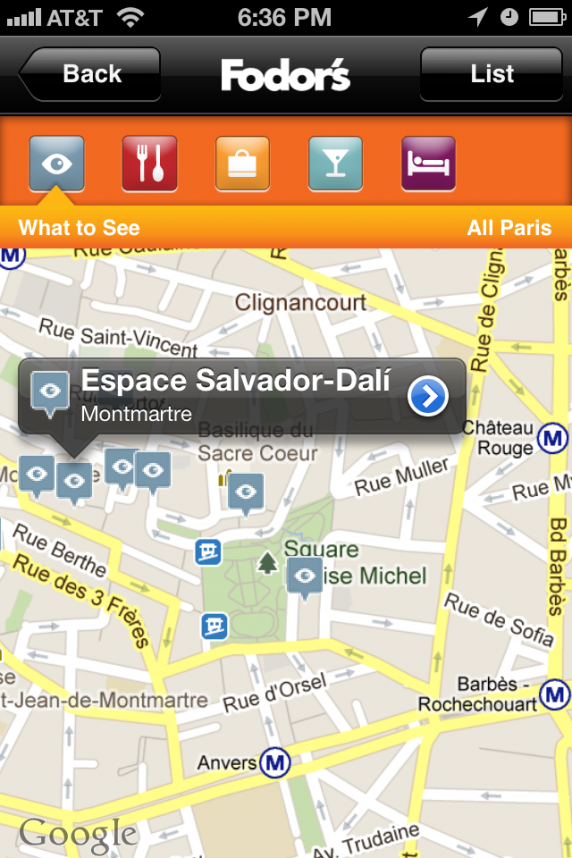
The popular travel guide publisher Fodor’s announced recently that they will be providing a series of city guides as mobile apps for iOS. These new apps are free for the first time. Apps from the Fodor’s Travel imprint offer solid information and recommendations for tourist attractions, eating entertainment, and other travel information. Now you can get around foreign cities without carrying a physical travel book.

The new versions of Fodor’s apps are available for New York, San Francisco, London, Paris, Rome, and Barcelona. In addition to the information you’d usually expect to find in a travel book, the apps allow you to search venues by price, see what’s nearby, bookmark your favorite spots, add field notes, and download maps before you travel so that you can access them online without paying for data roaming.

Posted in apps, Europe, Tourism, Travel Writing | Tagged , , , , , , | Leave a comment