
 We were recently fortunate to spend some time with the exceptional American artist & sculptor Jonathan Hertzel. Take a look at his website and his brand new blog to see his exciting work in progress.
Almost immediately after Stieg Larsson’s first novel, The Girl with the Dragon Tatt00, was posthumously published to international acclaim Millennium Mania spread like a literary virus around the world. This was primarily based on the quality of the work, but was also influenced in no small way by the amazing backstory. Now, six years later, the insatiable interest in Larsson’s personal story, as well as the Millennium Trilogy, has sparked numerous biographical projects.
The first English language bio to hit the bookstores is Barry Forshaw’s The Man Who Left To Soon ( John Blake Publishing,UK ). Forshaw is a highly respected journalist and author with an extensive knowledge of crime fiction, having penned The Rough Guide to Crime Fiction and edited British Crime Writing: An Encyclopedia.

Divided into three sections, Forshaw’s work of hagiography spends an inordinate amount of ink in the exhaustive retelling of the plots of the three novels. It is redeemed, however, by the thorough, and fascinating, background interviews with colleagues, family and friends. And, possibly the most interesting feature of the biography is the use of interviews with contemporary Scandinavian and British novelists, who share their positive and negative views on the trilogy.
With several more Stieg Larsson biographies and critical examinations of the Millennium Trilogy in the works,and a global legion of dedicated fans with a voracious appetite for anything to do with Larsson and the trilogy, we can expect to be inundated with books touting conspiracy theories about the author’s death and a rash of analyses of Lisbeth Salander. But for me the key to the trilogy’s brilliance will always be in its mix of writerly virtues—they’re well plotted, original, well written, entertaining, have engaging characters and offer real social and political commentary—and they’re exciting, old-fashioned page turners.
Today is the 50th anniversary of the publication of Harper Lee’s beloved classic novel To Kill a Mockingbird and numerous events—Read-A-Thons, film screenings, courtroom scene reenactments, etc.—are being held around the country.
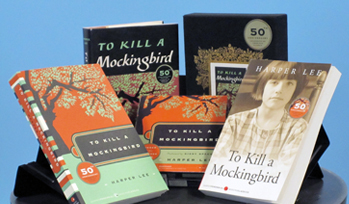
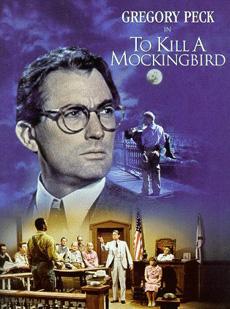
The heart-breaking coming of age tale set in the segregated South of the 1930s is one of the most taught books in American secondary schools, has been named one of the best novels of the 20th century, served as the inspiration for an Academy Award-winning film and has sold more than 30 million copies worldwide.
You can find an extensive schedule of commemorative events at the publisher’s website
.
Many thanks to the County Theater in Doylestown, PA for the invitation to a screening of Laurence Lowenthal’s documentary Millennium, The Story.

Stieg Larsson
Laurence Lowenthal created a documentary about Stieg Larsson and the Millennium Trilogy that covers everything you’ve ever wanted to know about the author, Stieg Larsson, and his family, childhood and professional life. As well as his tragic death at 50 in November 2004 before The Girl With the Dragon Tattoo was published.

Millennium, The Story
The film explores the real stories behind Larsson’s political magazine, Expo, and his anti-neo-nazi campaigns along with the role of Stockholm and the landscape of Sweden in Larsson’s life and writing. The battle over his inheritance. Eva Gabrielsson, Larsson’s girlfriend, and the manuscript for the fourth book she ‘might’ have, of course, figure prominently in the documentary.
The literary triumph and the Millennium phenomenom are analyzed by Larsson’s close friends, his father and brother, his publisher, journalist colleagues, the producer of the film adaptations and actors Noomi Rapace and Michael Nyqvist, who play Lisbeth Salander and Mikael Blomkvist.

Noomi Rapace
To his friends and the Swedish public, Stieg Larsson is still the rumpled, chain-smoking investigative journalist who fought Fascists, neo-Nazis and bigots, but six years after his death, he has become an International brand. Lowenthal’s documentary bares the mysteries of Larsson’s life, and exposes the banality of marketing a literary legacy.

Natural Bridge Bryce Canyon
“Should you shield the canyons from the windstorms, you would never see the beauty of their carvings.”
Elisabeth Kubler-Ross
Bryce Canyon (Luca Galuzzi-www.galuzzi.it)
The following post is courtesy of Miriam Parker:
Little, Brown and Company announces new suspense imprint’s name and launch list
On June 15, 2010, Little, Brown and Company announced the name of its new imprint devoted to publishing suspense fiction:
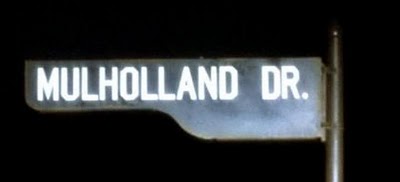
Mulholland Books
The name is taken from Mulholland Drive, a winding stretch of road in the Hollywood Hills. Its hairpin turns, sharp cliff faces, and breathtaking views of Los Angeles have long made it synonymous with drama and suspense. The mysteries of Mulholland have inspired countless novels and films, from the classic mysteries of Raymond Chandler and James M. Cainto the voices of James Ellroy, Michael Connelly, Michael Mann, and David Lynch.
Little, Brown Publisher Michael Pietsch said, “There is an extraordinary body of suspense fiction being written today—novels and stories whose goal is to entertain and surprise at all costs, from the first sentence. Everyone at Little, Brown is excited to be taking part in the launch of Mulholland Books, an imprint whose goal is to single out these writers and publish them with an eye to community building and fresh marketing that has only become possible today.”

Duane Swierczynski
Mulholland Books launches in Spring 2011 with novels by the famed L.A. prosecutor Marcia Clark and mystery grandmaster Lawrence Block, new novels by UK prizewinners Mark Billingham and Michael Robotham, a trilogy of novels by Marvel Comics writer Duane Swierczynski to be published over five months, a border thriller by L.A. Times veteran Sebastian Rotella, and a trade paperback gathering of Daniel Woodrell’s legendary Bayou Trilogy of novels set in St.Bruno Parish, Louisiana. Future lists will include novels by rising stars Charlie Huston and others. The plan is for Mulholland to grow to 24 books a year, one hardcover and one paperback a month, by 2012.
Mulholland Books is helmed by Editor John Schoenfelder, who joined Little, Brown in January, and Marketing Director Miriam Parker. Other Little, Brown editors also acquire for the imprint. Learn more at Mulholland Books.
The goal of Mulholland Books is simple: to publish books you can’t stop reading. The promise of a Mulholland Book—whether a crime novel, thriller, police procedural, spy story, or even supernatural suspense—is that you’ll read it leaningforward, hungry for the next word. With a focus on online community building, internet marketing, and authentic connections among authors, readers, and publisher, Mulholland Books will be at the center of a web of suspense—unexpected, fresh, and with a 21st-century approach to publishing. Meet Mulholland: You never know what’s coming around the curve.
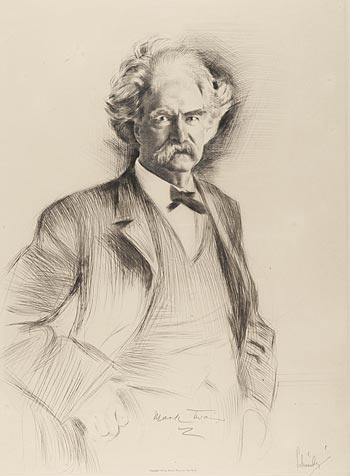
Mark Twain
If you are going to be in the NYC area this Fall be sure to plan on visting the Morgan Library for Mark Twain: A Skeptic’s Progress which runs from September 9, 2010 until January 3, 2011.
The Morgan Library & Museum and The New York Public Library—which hold two of the world’s great collections of manuscripts, rare books, letters, and other items related to the life of Mark Twain (1835-1910)—present a major exhibition at the Morgan exploring a central, recurring theme throughout the iconic author’s body of work: his uneasy, often critical, attitude towards a rapidly modernizing America. The exhibition coincides with the 175th anniversary of Twain’s birth in 1835 and includes more than 120 rare books, letters, notebooks, diaries, photographs, and drawings associated with the author’s life and work.
Mark Twain’s life spanned an era that saw much of the world—America in particular— embrace the Industrial Revolution. With the expansion of transportation and communications technology, there was a cultural shift from small-town rural concerns to a large-scale national agenda centered around great cities. As a young man, Twain had traveled by foot, horse, and riverboat. As a mature man, and one of the most widely traveled Americans, he journeyed by international steamship and railroad, and even saw the advent of the automobile.
For Twain, such technological, industrial, and urban developments were the means by which America might become a more prosperous and just society and also realize the nineteenth-century dream of universal progress. While he saw this achievement embodied by the concentration of educational and cultural institutions in Northern cities and towns, his conflicted love affair with his native South and its traditions, his close observation of the natural world, and his skepticism about the possibility of changing human nature, made him doubtful about the effectiveness of these means or even the possibility of human progress. In his final two decades, the skeptic saw his worst fears justified by the advance of European imperialism and its attendant atrocities in Africa and Asia, as well as by America’s own expansionist ambitions. Throughout his life’s journey, only his faith in the clarity and cleansing possibilities of the written word remained constant. Mark Twain: A Skeptic’s Progress captures the essence of the author’s wit, humor, and philosophy towards his era’s great changes in all their guises with examples of his work as a novelist, short story writer, fabulist, critic, lecturer, and travel writer.
THE EXHIBITION
Samuel Langhorne Clemens—better known by his pen name, Mark Twain—was the quintessential American author, humorist, lecturer, essayist, and master of satire. Twain enjoyed immense public popularity during his lifetime and became a friend to presidents, artists, industrialists, and royalty.
The exhibition features extensive portions of autograph manuscripts of two key non-fiction works. In Life on the Mississippi (1883), Twain’s examines the history of the river and the impact of technological progress and urban development on river life and paints sharply contrasting portraits of urban life in the North and South. Twain casts his critical attention more widely in the extensive account of his world travels published in Following the Equator (1897), employing savage sarcasm to express his outrage at the crimes that the Western colonial powers perpetrated on the native populations of Africa, Asia, and Australasia.
Life on the Mississippi is Twain’s memoir of his youthful years as a cub pilot on a steamboat paddling up and down the Mississippi River. The author used his childhood experiences growing up along the Mississippi in a number of works, but nowhere is the great river and the pilot’s life more thoroughly described than in this account. Told with insight, humor, and candor, Life on the Mississippi is an American classic. Twain’s deep nostalgia for the world of his youth gives special acuity to his observations on advances in technology, urban development, agriculture, manufacturing, transportation, and social justice, which changed the traditional culture of the South while bringing benefits to many.
An inveterate traveler, Twain crisscrossed the Atlantic more than a dozen times and also visited Turkey, Palestine, Hawaii, Australia, India, and South Africa. Wherever he went, he always absorbed the scenery and in his mind played the part of the American Vandal, the rube traveler who pretends to understand things he doesn’t. The exhibition includes autograph manuscripts and an extensive display of illustration mock-ups, comprising numerous photographs and drawings for Following the Equator (1897), Twain’s final work of travel literature, which began with the wildly successful The Innocents Abroad (1869).
Also on view are numerous leaves of the autograph manuscript of A Connecticut Yankee in King Arthur’s Court (1889), a fable that grows increasingly grim as Twain shows how the well-intentioned use of technology leads to self-destruction because of humanity’s incorrigible selfishness and need to worship authority.
Twain’s numerous attempts to participate in and capitalize on the entrepreneurial spirit of the times were predominantly failures. The exhibition introduces his experiments and includes an example of a memory game for acquiring and retaining all sorts of facts and dates. The original three-piece game was conceived and designed by Twain and produced by Charles L. Webster & Co. in 1891. The game includes a boxlike board with the game printed on one side and rules on the other as well as a small pamphlet of facts, along with a box containing the playing pins.
The exhibition is supplemented with handwritten manuscripts and typescripts of other works by Twain, his letters and correspondence, drawings and illustration mock-ups for printed editions, photographs, and several three-dimensional artifacts.
Mark Twain: A Skeptic’s Progress is co-curated by Isaac Gewirtz, Curator of the Henry W. and Albert A. Berg Collection of English and American Literature at The New York Public Library and Declan Kiely, Robert H. Taylor Curator of Literary and Historical Manuscripts at the Morgan.

Devil's Postpile National Monument
Welcome to the Atlas Obscura, a compendium of this age’s wonders, curiosities, and esoterica. The Atlas
Obscura is a collaborative project with the goal of cataloging all of the singular, eccentric, bizarre, fantastical, and strange out-of-the-way places that get left out of traditional travel guidebooks and are ignored by the average tourist. If you’re looking for miniature cities, glass flowers, books bound in human skin, gigantic flaming holes in the ground, phallological museums, bone churches, balancing pagodas, or homes built entirely out of paper, the Atlas Obscura is where you’ll find them.

Auroville, India
The Atlas Obscura is not just about collecting oddities. In an age where everything seems to have been explored and there is nothing new to be found, the Atlas Obscura celebrates a different way of traveling, and a different lens through which to view the world.
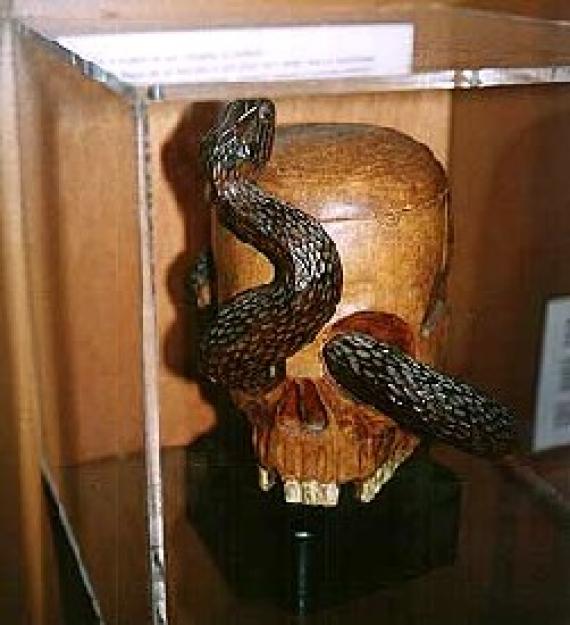
Rattlesnake Museum
The Atlas Obscura depends on a community of far-flung explorers to find and report back about the world’s wonders and curiosities. If you have been to, know of, or have heard about a place that belongs in the Atlas Obscura, they want you to tell them about it. Anyone and everyone is welcome and encouraged to nominate places for inclusion, and to edit content already in the Atlas. It works as a modified wiki; all submissions go through an editorial review process before posting.
This community-generated clearinghouse of the bizarre, fascinating and little-known is composed of categories both geographic and descriptive. The wonderful and whimsical categories include: Geological Oddities, Ghost Towns, Outsider Art, Weird Weather Phenomena, Watery Wonders, Architectural Oddities, Anomalous Islands, Wonder Cabinets, Unusual Monuments, Memento Mori, Fascinating Fauna and much, much more.
Don’t even think about visiting The Atlas Obscura if you want to get any work done.

1 For All
1 for All: Standing up for the First Amendment
By Ken Paulson
Every July 4th, we celebrate the Founding Fathers who gave America the gift of liberty.Except that they didn’t. Actually, the operative word is “fathers.” These gentlemen did a fine job of building a nation founded on freedom — unless you happened to be a woman, a slave or poor.For all the poetic flourish of the Declaration of Independence, the most powerful passage in America’s history can be found in the First Amendment to the Constitution. The five freedoms guaranteed there gave Americans the right to speak out against injustice, to report about inequality, to protest and petition, and to draw strength from freedom of faith. In the centuries that followed this nation’s founding, the First Amendment was used to free the slaves, extend the vote to women and ensure equal protection under the laws.Yet despite its pivotal role in making America what it is today, there are no fireworks celebrating the First Amendment. The anniversary of its ratification on Dec. 15 goes largely unnoticed. More tellingly, most Americans have no idea what the First Amendment says. Surveys indicate that only one American in 25 can name the freedoms of the First Amendment and that a majority — when pressed — can come up with only one, typically freedom of speech. It’s constitutional illiteracy of the highest order.The truth is that we don’t do a very good job of standing up for the First Amendment. Its freedoms are truly the cornerstone of democracy and make America the special nation it is. It’s time we said that. Publicly. Passionately. Over and over again. That’s the core concept behind 1 for All, a nationwide campaign to remind the public that there’s one amendment that we all use daily. And it’s the one that truly guarantees freedom for all.1 for All is the collaborative effort of educators, artists, journalists, lawyers, librarians and many more who believe that the American public would benefit from a greater understanding of the First Amendment and the need to protect all voices, views and faiths. Thousands of news media, arts and religious organizations from all 50 states have offered their help in support of these core freedoms. The campaign features ads that celebrate freedom in America and the ways we exercise those freedoms in our daily lives. The First Amendment gives us freedom of speech, but it also provides freedom to tweet. It protects political speeches, but it also guarantees our right to sing, dance and perform.In fact, the First Amendment enriches our lives on a daily basis. That’s the essence of 1 for All. The campaign — which will launch on July 1 — is defined by these guiding principles:
1 for All is a celebration of the freedoms that truly make America special. It’s not a coincidence that the strongest, most dynamic, most creative and most ambitious nation in the history of the planet is also the most free. Ken Paulson is a founder of 1 for All, the president of the Newseum and First Amendment Center 
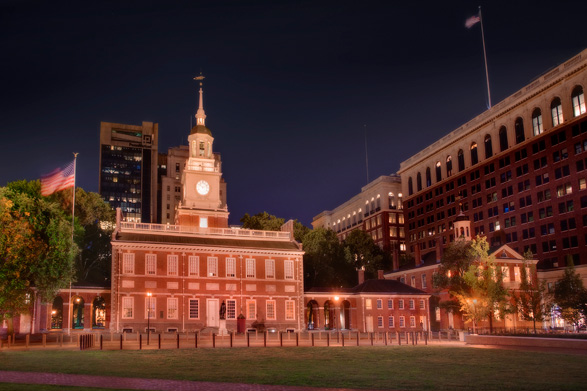
Independence Hall (photo:GPTMC)
During the sweltering summer of 1776, fifty-six unlikely revolutionaries defied the King of England and gathered at the Pennsylvania State House in Philadelphia to declare independence for the fledgling United States of America.
“We hold these truths to be self-evident, that all men are created equal, that they are endowed by their Creator with certain unalienable Rights, that among these are Life, Liberty and the pursuit of Happiness.”

Liberty Bell (photo: GPTMC)
The Liberty Bell has a new home on Independence Mall, but the symbol of American freedom was originally installed in the Pennsylvania State House in 1753. According to tradition, the 2,080 pound bell was rung on July 8, 1776 to summon Philadelphia citizens for a public reading of the Declaration of Independence.
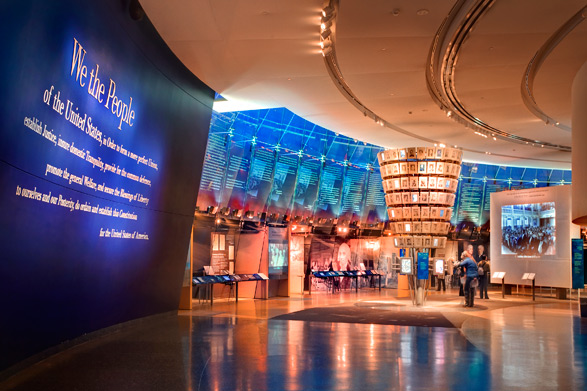
National Constitution Center (photo: GPTMC)
The U.S. Constitution is only four pages long, but it’s one of the most influential documents ever produced. Philadelphia’s new National Constitution Center explores and explains this amazing document through exciting interactive exhibits, high-tech displays, films and original artifacts. Rare copies of the Constitution are also on display.


 Travel Between The Pages