Denial is a Cliff We Are Driven Over
|
|
Denial is a Cliff We Are Driven Over
|
|

The engaging short film below offers a quick tour of the Smith –Settle printing and bookbinding company in Leeds, England, where books are still made the old-fashioned way. The film’s director Glen Milner covers each step in the process as bookbinders piece together a new hardbound edition of the memoir Mango and Mimosa (1974) by the British writer and painter Suzanne St Albans. From folding pages to sewing and gluing paper to the leather spine, skilled human are front and center throughout. Milner documents this melding of mechanics and craft with an almost musical rhythm, conveying skills and methods born of centuries of refinements.

Just in case you needed another reason to wash your hands these days…
The bright emerald green cloth on the books (above & below) gets its intense color from copper acetoarsenite, more commonly known as arsenic. The inorganic pigment was used extensively during the 19th century before the full extent of poisoning risks were known. Over the years, as both a book collector and bookseller, I have been handling books in this colorful bindings like any other. But apparently I have been exposing myself to an unsafe level of arsenic. One of the possible major offenders was the very popular Black’s travel guide series.
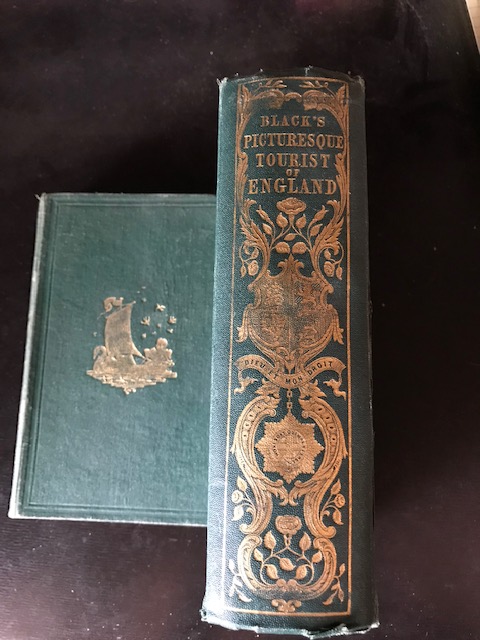
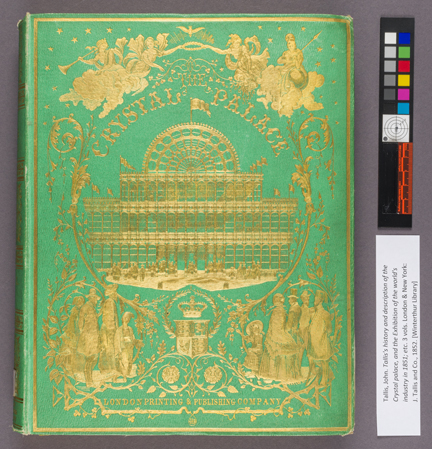
The bindings seen in the image at the top of the post were tested by Melissa Tedone, Conservator at Winterthur Museum, Garden & Library, in December 2019 as part of the Poison Book Project. The sample is comprised largely of green cloth case bindings, but some green paper (upper left) also tested positive. You can read more about the Poison Book Project here.
“What differentiates this research project from others centered around arsenic-based pigments in library collections is threefold: first, the toxic pigment permeates the outer covering of Victorian-era, cloth-case publisher’s bindings; second, the large quantity of arsenic-based pigment present in bookcloth; and third, such mass-produced bindings may be commonly found in both special and circulating library collections across the United States and the United Kingdom.”
If you are a collector of 19th century books, a librarian,or a seller of antiquarian titles, I highly recommend reading the referenced article on the Poison Book project, paying close attention to the suggestions on handling and storage.

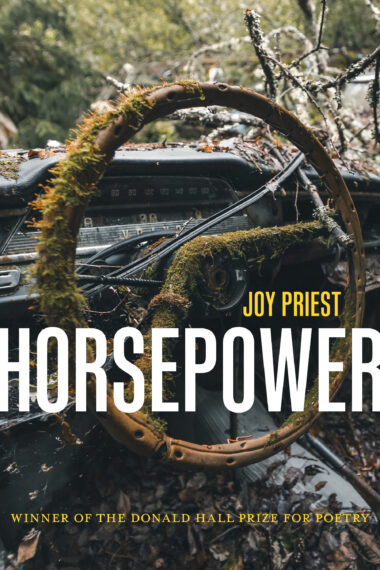
I don’t think that I’ve ever actually read O, the Oprah Magazine, but I recently heard about an issue that featured “17 Black-owned bookstores in America that amplify the best in literature.” It also recommended the favorite bookshops of renowned authors like Tayari Jones, Deshawn Winslow, Jacqueline Woodson, Nicole Dennis-Benn and Kiley Reid.
“While institutionalized racism and police brutality have long been a part of America’s history, millions across the country are now reconciling with and addressing generations of racial inequality,” The article’s author McKenzie Jean-Philippe wrote. “For some, that means taking to the streets in protest. For others, it’s uplifting the cause by supporting Black owned businesses, or seeking education through anti-racist literature. Because of the latter, one industry that’s seen an influx in support and attention are Black-owned bookstores. Many shops across the country are overwhelmed with customers due to the collective push to both ‘buy Black’ and read books written by Black authors.”
I was happy to find that the article featured some of my favorite local Philadelphia bookshops too:


Tomorrow more than 630 bookstores across North America are planning to celebrate Independent Bookstore Day . Booksellers are promoting a variety of virtual and in person events this year.
Kids’ and YA events:
Adult events:
In celebration of IBD, between August 28 and August 31, Europa Editions is offering indie bookstore customers a free ebook of Elena Ferrante’s Frantumaglia when they pre-order The Lying Life of Adults. Europa will provide the ebook directly to customers who fill out an online form.

Visit the Independent Bookstore Day website to learn more about the annual event.


The iconic artist Ed Ruscha has long been inspired by urban America – its cars, billboards, gas stations and low-slung houses all strung out in a seemingly endless sprawl. The short film below combines images from the Getty Research Institutes’s Ed Ruscha’s Streets of Los Angeles Archive with audio of Ruscha reading LA-inspired passages from another major influence on his art, Jack Kerouac’s 1957 beat classic On The Road. Commissioned by the Getty Museum to mark Ruscha receiving the 2019 Getty Medal for contributions to the arts, the film by the US director Matthew Miller is a melancholic take on contemporary America.

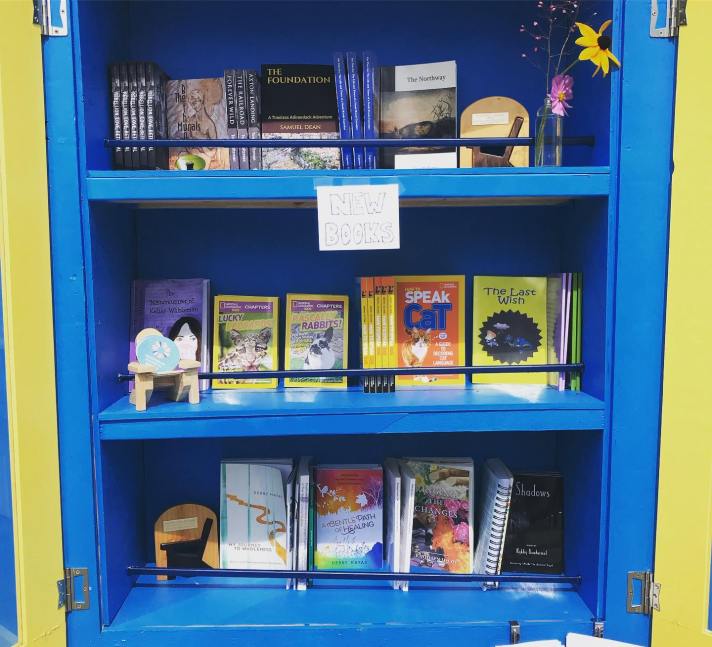
The staff of the Adirondack Center for Writing (ACW) in upstate New York partnered with the Book Nook in Saranac Lake, The Bookstore Plus in Lake Placid, TREES Adirondack Gifts & Books in Bolton Landing to visit small communities throughout the region that don’t have easy access to new books or don’t have their own bookstores. Throughout the summer, the rolling bookshop will be setting up at ice cream shops in the region.

ACW worked with a group of students at Paul Smiths College to create a small mobile bookstore they could easily hitch to the back of a vehicle. All the books they’re selling will be based on a suggested donation so that people of all income levels can buy what they’d like.
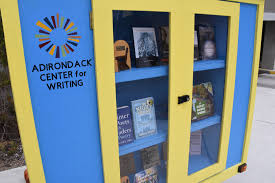
I’ve had a soft spot for any kind of bookmobile since I was a child and the local library bookmobile would visit my school. This has to be one of the cutest that I’ve ever seen.
For more info, go to https://adirondackcenterforwriting.org/
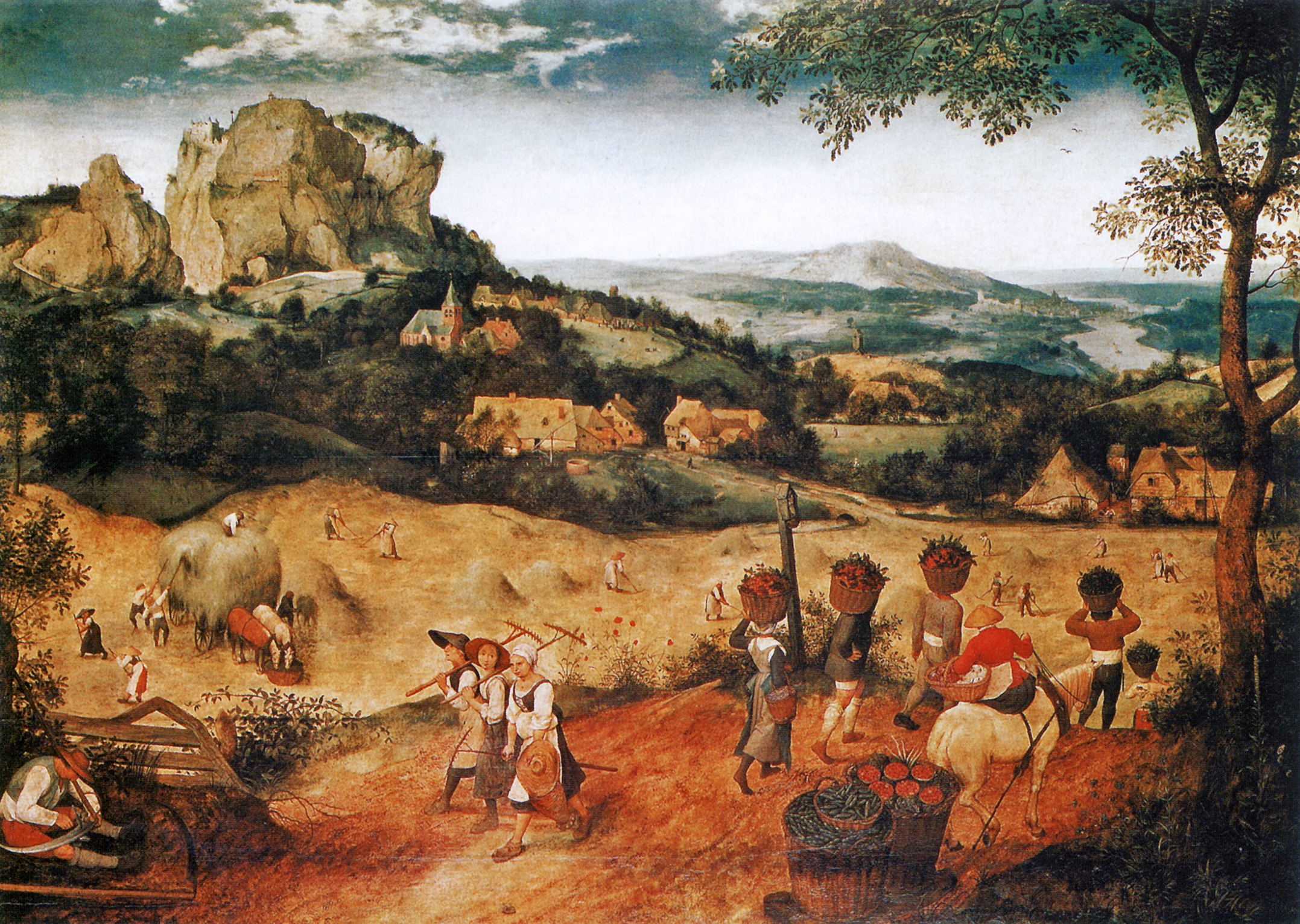
“Haymaking”
by
William Carlos Williams
The living quality of
the man’s mind
stands out
and its covert assertions
for art, art, art!
painting
that the Renaissance
tried to absorb
but
it remained a wheat field
over which the
wind played
men with scythes tumbling
the wheat in
rows
the gleaners already busy
it was his own—
magpies
the patient horses no one
could take that
from him
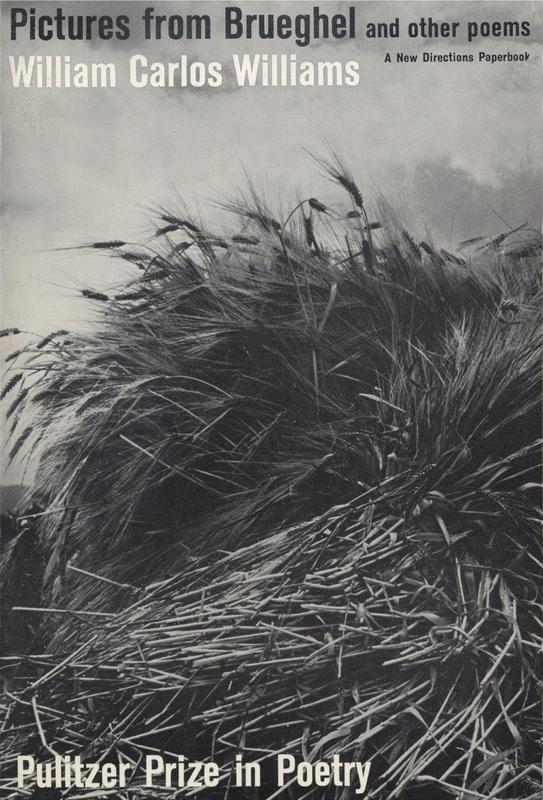
Pictures from Brueghel and Other Poems by William Carlos Williams was first published by New Directions in 1962. The book consists of a collection of 105 poems written from 1949-1962. The beginning of the book consists of a collection of 10 poems based on paintings by the Flemish painter, Pieter Brueghel the Elder. The collection of poetry reflects William Carlos Williams’s own late-life poetry as it was the final poetry collection published during his lifetime. In 1963, Pictures from Brueghel and Other Poems won the Pulitzer Prize in Poetry although William Carlos Williams received the award posthumously for he had died two months prior to winning .



 Travel Between The Pages